Talk to anyone who has dealt with a parking dispute in an Indian city, and the story follows a familiar pattern. Two vehicles. Conflicting accounts. No witnesses. An insurance process that drags on for weeks and ends with both parties quietly absorbing costs they should not have had to pay.
It happens constantly. And almost every time, a single piece of equipment would have resolved the entire situation in under a minute.
The car camera market in India has grown sharply over the past three years — not because drivers suddenly became more tech-savvy, but because enough people have been on the wrong end of exactly that situation to start taking it seriously.
The Question Most Buyers Ask — And the Better One They Should
The typical first-time buyer searches for a car reverse camera, finds somewhere between thirty and fifty options at wildly different price points, picks something in the middle, and considers the decision made.
That approach works fine — until the first night-time parking attempt in a dimly lit basement. Or the first monsoon evening reversing out of a tight spot with a fogged rear windshield. Or the first time someone clips the car in a parking lot and drives away before anything can be noted down.
The smarter question is not which camera fits the budget. It is — what conditions will this camera actually face?
In Indian driving environments, the answer is usually: bad light, dust, humidity, chaotic urban parking, and occasional situations where having footage is the difference between a resolved dispute and an expensive one. A camera chosen without accounting for those conditions will underperform precisely when it matters most.
Night Vision Is Not a Bonus Feature
This point gets undersold consistently in product listings and buying guides.
A car reverse camera with night vision uses infrared LEDs to produce a usable image even when ambient light is minimal. In practical terms — an apartment basement at 10 PM, a narrow lane behind a restaurant, a residential street with broken streetlights — the difference between a night-vision camera and a standard one is not marginal. It is the difference between seeing clearly and seeing almost nothing.
Most parking incidents in Indian cities happen in exactly these conditions. Daytime visibility is rarely the problem. The problem is the poorly lit stretch where a child’s cycle is parked just outside the camera’s useful range, or the low concrete wheel-stopper that disappears entirely in a dark feed.
Any car reverse camera shortlist that does not filter for genuine night vision performance is starting from the wrong place.
Why Recording Changes, the Entire Equation
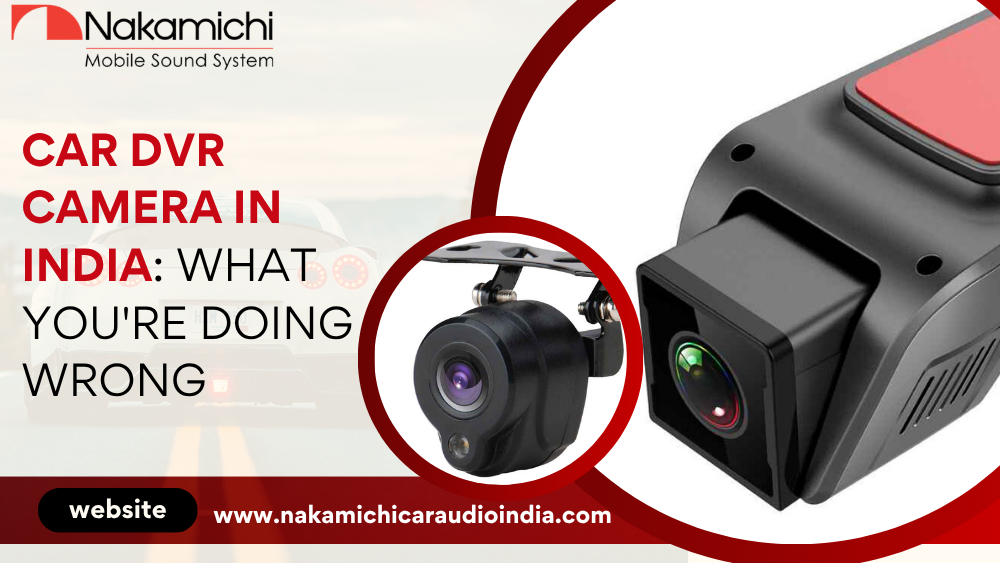
A display-only reverse camera solves one problem. A car DVR camera front and rear setup solves several simultaneously.
Continuous recording from both directions means that whatever happens on the road — a minor collision at a junction, a hit-and-run in a parking lot, a dispute about who changed lanes first — there is actual footage rather than competing versions of events. Loop recording handles storage automatically. Parking mode on better systems triggers recording based on motion or impact, even when the engine is off.
The Indian context makes this particularly relevant. Insurance claims, traffic disputes and parking lot arguments are common enough that documented footage is not an edge case — it is a regular practical advantage. Car DVR camera India options have improved considerably, with GPS tagging, wide-angle dual lenses and reliable night recording now available outside the premium price bracket.
Where Nakamichi Fits into This
Nakamichi occupies a specific position in the Indian car accessories market — not the cheapest option and not aggressively marketed, but consistently regarded for low-light performance and build quality that holds up over time.
Their dual-channel systems handle front and rear recording simultaneously, with automatic switching to the rear feed when reverse gear is engaged — no manual toggling, no lag. The night vision output on their reverse cameras produces genuinely usable footage in the kind of ambient lighting that exposes cheaper alternatives as nearly useless.
For Indian road conditions specifically — dust, heat, humidity, the general unpredictability of urban traffic — the build durability matters across a two or three-year ownership period in ways that only become apparent once cheaper options start failing.
For anyone building a serious shortlist for a car DVR camera setup, Nakamichi’s range deserves a proper look before the decision is made.
The verdict
Indian roads do not forgive poor visibility. The combination of dense urban traffic, inconsistent road lighting, and the sheer unpredictability of what appears in a blind spot makes camera quality a genuinely practical concern — not a feature to optimize last after choosing a colour and a price point.
A car reverse camera with night vision handles the visibility problem. A front and rear DVR setup handles the documentation problem. Together, they cover the two situations where Indian drivers most commonly find themselves wishing they had better equipment.
Nakamichi builds for both. Worth examining before the next close call makes the decision unavoidable.
FAQs
1. Is night vision actually necessary in a car reverse camera for Indian conditions?
For most urban Indian environments — yes. Basement parking, unlit lanes, market areas after dark — a camera without night vision delivers a feed too dark to be useful. It is a basic functional requirement, not an upgrade.
2. What separates a car DVR camera front and rear system from a basic reverse camera?
A reverse camera only shows what is behind you while reversing. A DVR system records continuously from both directions — giving you actual footage for insurance claims, accidents or parking disputes. In India, that documentation function is often more valuable than the display alone.
3. Are dashcams legally usable in India?
Yes. Dashcams are legal in private vehicles and footage has been accepted in insurance claims and legal proceedings. No restrictions exist on front or rear recording in personal cars.
4. How should someone evaluate car DVR camera options given the wide price range?
Focus on night vision quality, lens angle and build durability for Indian heat and humidity. Cheap units degrade faster than their specs suggest. Real-world Indian user reviews tell you more than any comparison chart.
5. What makes Nakamichi worth considering over other brands?
Low-light performance and long-term build durability — the two areas budget alternatives fail most predictably. Their systems integrate cleanly, switching is seamless, and night vision holds up in exactly the conditions Indian drivers face daily.