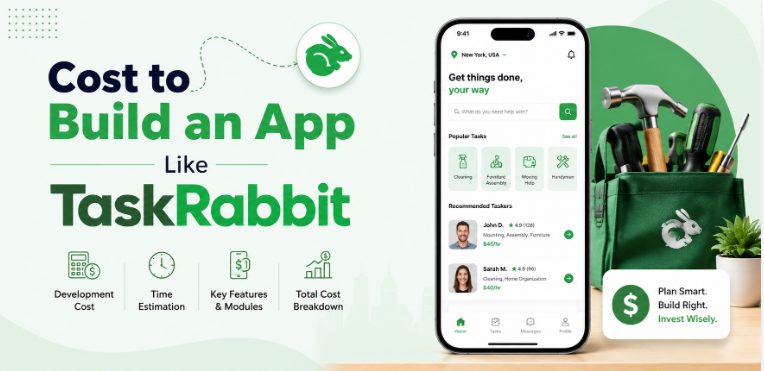
The on-demand economy has fundamentally changed how people access everyday services. Instead of searching for local professionals through directories or relying on word-of-mouth recommendations, users can now book cleaners, movers, electricians, plumbers, and handymen with just a few taps on their smartphones.
This shift has created significant opportunities for entrepreneurs and investors looking to launch digital marketplaces that connect customers with skilled service providers. Among the companies that helped shape this industry, TaskRabbit stands out as one of the most recognized examples of a successful service marketplace.
If you’re planning to build an app like TaskRabbit-like app, one of the first questions you’ll face is:
How much will it cost?
There isn’t a single answer. Development costs vary depending on your product vision, feature set, technology choices, and long-term business goals. A simple MVP can be launched on a relatively modest budget, while an enterprise-grade marketplace requires considerably more investment.
This guide explains the key factors that influence development costs, the features you’ll need, realistic budget estimates, and practical ways to optimize your investment.
Understanding the Marketplace Model
Before discussing the cost to develop an app like TaskRabbit, it’s worth understanding why platforms like TaskRabbit have become so popular.
Unlike traditional service businesses, marketplace apps don’t employ workers directly. Instead, they create a digital platform where customers can find local professionals, compare providers, schedule services, make payments, and leave reviews.
The platform generates revenue by facilitating these transactions, usually through commissions, booking fees, subscriptions, or premium listings.
This asset-light business model makes marketplace apps highly scalable once they’ve established a healthy balance between customer demand and service provider supply.
Why the Market Continues to Grow
Consumer expectations have changed dramatically over the last decade.
People increasingly expect services to be:
- Available instantly
- Easy to book online
- Transparent in pricing
- Secure to pay for
- Backed by customer reviews
At the same time, more professionals are choosing flexible work arrangements over traditional employment. These two trends continue to fuel the growth of on-demand marketplaces across industries.
Although handyman services remain a popular category, the same business model can also support:
- Home cleaning
- Appliance repair
- Electrical work
- Plumbing
- Gardening
- Painting
- Furniture assembly
- Moving assistance
- Pet care
- Personal services
This flexibility makes the marketplace model attractive for startups exploring different service verticals.
What Determines Development Costs?
No two marketplace apps are identical.
Several variables affect the overall investment required.
1. Product Scope
The biggest cost driver is the number of features you plan to launch with.
A basic marketplace that allows customers to register, book services, and complete payments requires significantly less work than a platform that includes AI recommendations, subscriptions, multilingual support, or advanced analytics.
Many startups begin with a focused product that solves one problem well before expanding into additional features.
2. Platform Choice
You’ll also need to decide where your application will be available.
Common options include:
- Android
- iOS
- Web
- Cross-platform mobile development
Cross-platform frameworks have become increasingly popular because they reduce development time while maintaining a consistent experience across devices.
3. User Experience
Marketplace applications depend heavily on trust.
Customers should be able to book services quickly without confusion, while professionals need tools that simplify job management.
A well-designed interface requires investment in research, wireframes, prototyping, usability testing, and visual design. Although this adds to the initial budget, it often improves user retention and reduces customer support issues after launch.
4. Backend Infrastructure
Every booking, payment, notification, and profile update relies on a robust backend system.
The backend is responsible for:
- User authentication
- Booking management
- Payment processing
- Notifications
- Database management
- API integrations
- Admin controls
As your user base grows, the backend must scale without compromising speed or security.
5. Third-Party Services
Most marketplace apps integrate external services instead of building every feature from scratch.
Common integrations include:
- Online payments
- Maps and navigation
- Push notifications
- SMS verification
- Email services
- Cloud storage
These integrations save development time but also introduce ongoing operational costs.
Core Features Every Marketplace Needs
The exact functionality depends on your business model, but most service marketplaces include three primary interfaces.
Customer App
The customer experience usually includes:
- Account registration
- Profile management
- Service browsing
- Search and filters
- Booking scheduler
- Secure payments
- Booking history
- Ratings and reviews
- Notifications
- In-app messaging
The goal is to make booking a service as simple as ordering food or booking a ride.
Service Provider App
Professionals need tools that help them manage their work efficiently.
Typical features include:
- Profile creation
- Identity verification
- Availability management
- Job requests
- Earnings dashboard
- Route navigation
- Customer communication
- Service history
Giving providers a seamless experience is just as important as serving customers, since marketplace success depends on retaining both sides.
Admin Dashboard
Behind every successful marketplace is an administrative system that keeps operations running smoothly.
Administrators typically manage:
- Customer accounts
- Service providers
- Categories
- Bookings
- Payments
- Commission settings
- Reports
- Customer support
The dashboard also provides valuable business insights that guide future decisions.
Features That Increase Development Costs
Once a marketplace gains traction, businesses often introduce more sophisticated functionality.
Examples include:
- AI-powered recommendations
- Dynamic pricing
- Loyalty programs
- Subscription memberships
- Business accounts
- Video consultations
- Multi-language support
- Advanced reporting
- Fraud detection
- Smart search
These additions improve user experience but require additional planning, development, and testing.
How Much Does It Cost?
The final budget depends on the complexity of your product.
For planning purposes, businesses often divide projects into three categories.
| Project Type | Estimated Cost | Suitable For |
| MVP | $10,000–$20,000 | Testing a new idea with essential marketplace functionality. |
| Mid-Level Marketplace | $20,000–$40,000 | Businesses ready to launch a more polished product with advanced features and improved scalability. |
| Enterprise Platform | $40,000+ | Large-scale platforms serving multiple markets with sophisticated functionality and enterprise integrations. |
These estimates cover development only. Marketing, maintenance, cloud hosting, and operational expenses should also be included in your overall business plan.
Should You Start With an MVP?
For most startups, the answer is yes.
Launching with a Minimum Viable Product allows you to validate demand before committing a larger budget.
Instead of building every possible feature, focus on solving one clear problem exceptionally well.
An MVP typically includes:
- User registration
- Service listings
- Booking system
- Online payments
- Ratings and reviews
- Basic admin panel
Once real users begin interacting with the platform, you’ll gain valuable insights into which features deserve future investment.
Hidden Costs Many Founders Overlook
Development is only one part of the overall investment.
Running a marketplace also involves recurring expenses that are easy to underestimate.
These include:
Cloud Hosting
As your user base grows, server capacity and storage requirements increase.
Payment Processing Fees
Every online transaction typically incurs a processing charge.
App Store Fees
Publishing mobile applications involves developer account subscriptions and platform-specific fees.
Customer Support
Marketplace businesses require ongoing support for customers and service providers.
Security
Regular security updates, monitoring, and backups are essential for protecting user data.
Maintenance
Bug fixes, operating system updates, and performance improvements continue long after launch.
A good rule of thumb is to allocate around 15–20% of your initial development budget annually for maintenance and enhancements.
Development Timeline
The timeline largely depends on project scope.
| Project | Estimated Timeline |
| MVP | 2–4 months |
| Growth-stage platform | 4–6 months |
| Enterprise marketplace | 6–10 months |
Trying to launch every feature at once often delays market entry. Many successful startups release smaller iterations and improve the product based on customer feedback.
Ways to Optimize Your Budget
Building a marketplace doesn’t necessarily require an unlimited budget.
Several strategies can help control costs while maintaining quality.
Focus on Essentials
Launch with the features users truly need instead of trying to compete with mature platforms immediately.
Build Iteratively
Release updates in phases rather than investing heavily upfront.
Reuse Proven Solutions
Integrating established payment, authentication, and notification services is often more efficient than developing proprietary alternatives.
Prioritize Scalability
Designing a flexible architecture early can reduce expensive redevelopment later.
Validate Before Expanding
Use customer feedback to guide future investments instead of relying solely on assumptions.
Revenue Opportunities
A marketplace should be designed with monetization in mind from the beginning.
Common revenue models include:
Commission on Bookings
The platform receives a percentage of each completed transaction.
Service Fees
Customers pay a small convenience fee when placing bookings.
Featured Listings
Professionals pay for increased visibility in search results.
Subscriptions
Premium plans can provide additional benefits for frequent users or service providers.
Advertising
Relevant businesses may promote products or services within the app.
Diversifying revenue streams can create a more resilient business model over time.
Choosing the Right Development Partner
Selecting an on-demand app development company is about more than comparing prices.
A strong development partner should understand marketplace dynamics, scalable architecture, user experience, and post-launch maintenance. Reviewing previous marketplace projects, asking about their development process, and discussing long-term support can help you make a more informed decision.
Remember that the cheapest proposal isn’t always the most cost-effective if it leads to delays, technical debt, or expensive rework later.
Is Building a Marketplace Worth the Investment?
Whether you’re investing in the TaskRabbit clone app model or exploring a niche service marketplace, businesses can accelerate their launch with a Gojek Clone App, a ready-made multi-service platform designed for rapid deployment.
The strongest platforms focus on creating value for both customers and service providers while building trust through reliable payments, transparent pricing, and high-quality user experiences.
Launching with a focused niche—such as home maintenance, moving services, or appliance repair—can also make it easier to establish traction before expanding into additional categories.
Rather than trying to replicate every feature from day one, many successful marketplaces grow gradually, adding functionality as user demand increases.
Final Thoughts
Building an app like TaskRabbit is both a technical and business challenge. While development costs can range from $10,000 for a basic MVP to $40,000 or more for an enterprise solution, the overall investment extends beyond coding. Product strategy, user experience, infrastructure, marketing, and ongoing maintenance all play an important role in long-term success.
For most startups, beginning with a focused MVP offers the best balance between cost and risk. It allows you to validate your idea, collect user feedback, and refine the platform before making larger investments.
Ultimately, the goal isn’t simply to recreate an existing marketplace; it’s to build a service platform that solves real customer problems, supports service providers effectively, and has a sustainable path to growth.