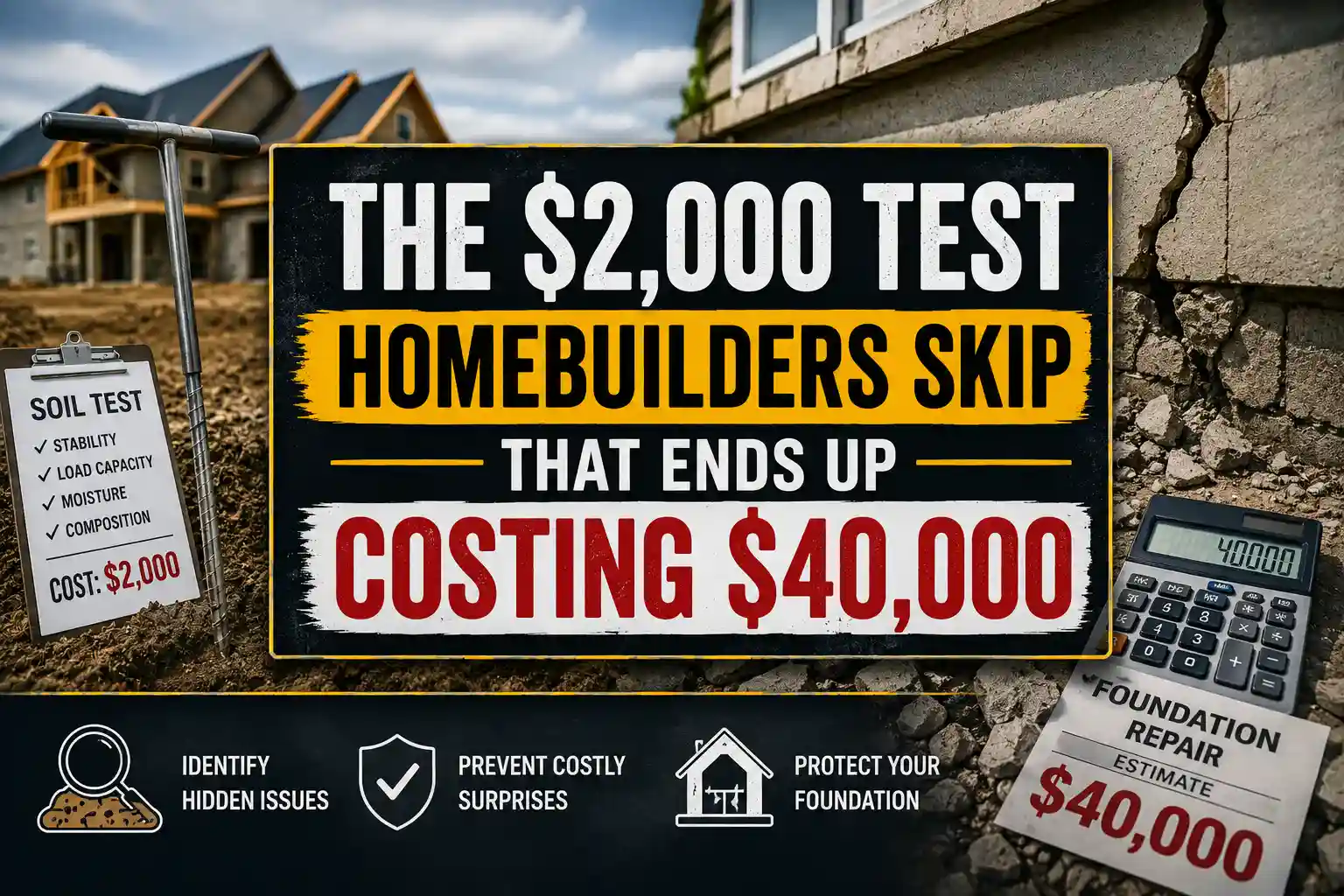
Ask any structural engineer or foundation contractor which corner gets cut most often on tight residential budgets, and a lot of them will name the same thing without hesitation: geotechnical soil testing. It’s one of the first line items to get crossed off when a build is trying to trim upfront costs, and it’s also one of the most consistently expensive mistakes to make, because the soil under a house doesn’t announce its problems until the foundation is already built on top of it.
Why soil testing feels skippable
On paper, soil testing looks like exactly the kind of thing a budget-conscious build can live without. It typically runs somewhere in the low thousands of dollars, it doesn’t produce anything visible, and unlike a countertop or a roofline, nobody’s going to notice whether it happened once the house is finished. For a builder or homeowner trying to keep a project moving and under budget, it’s an easy target: a cost with no visible payoff, sitting right next to a long list of costs that clearly do have one.
The problem is that soil testing isn’t really about the soil in the abstract. It’s about whether the specific foundation type planned for a specific site is actually appropriate for what’s underneath it, and getting that wrong doesn’t show up as a line-item overage. It shows up months or years later as cracked slabs, doors that stop closing properly, uneven settling, or in worse cases, structural movement serious enough to require underpinning or partial foundation reconstruction.
What a soil test actually catches
A geotechnical soil investigation isn’t a single generic check, it’s a set of specific measurements that directly determine what kind of foundation a site can safely support:
- Bearing capacity, how much weight the soil can hold before it compresses or shifts under a structure’s load. Undersized foundations built on soil with lower bearing capacity than assumed are a common source of long-term settling problems.
- Clay expansion potential. Expansive clay soils swell significantly when wet and shrink when dry, a cycle that puts constant, uneven pressure on a foundation over time. Building on expansive clay without accounting for it is one of the most common causes of long-term foundation cracking in certain regions.
- Moisture content and drainage characteristics. Poor natural drainage around a foundation site compounds almost every other soil-related problem, since water intrusion is what activates most of the failure modes tied to soil composition.
- Rock, boulder, or contamination issues. Unexpected subsurface obstructions or contamination can dramatically increase excavation costs if discovered mid-construction rather than during pre-build testing, on top of any remediation required.
Each of these findings directly changes what foundation type and depth is actually appropriate for a given lot. Skip the test, and a builder is essentially guessing at those answers based on general assumptions about the area rather than what’s actually under that specific parcel.
Why the cost asymmetry is so stark
This is the part that makes skipping soil testing such a poor trade in hindsight. The test itself typically costs a small fraction of overall foundation spend, while the cost of a foundation failure traced back to unaddressed soil conditions can run into tens of thousands of dollars in remediation, well beyond what a properly specified foundation would have cost in the first place. Underpinning an existing foundation, correcting drainage after the fact, or repairing structural cracking are all significantly more disruptive and expensive than getting the foundation type and depth right before construction starts, since all of that work has to happen around, or underneath, a house that’s already standing.
This is exactly the kind of cost factor worth understanding fully before finalizing a foundation budget, since it changes not just the testing line item but potentially the entire foundation type selected for the project. There’s a thorough breakdown of foundation cost estimation for homes and buildings that walks through how soil testing fits into the bigger picture alongside foundation type selection, excavation costs, and drainage planning, which is genuinely useful context for understanding why this particular line item punches so far above its cost when it comes to preventing much larger problems down the line.
A short list of questions worth asking before foundation work begins
- Has a geotechnical soil test actually been performed on this specific lot, not just assumed based on general knowledge of the area?
- Does the proposed foundation type match what the soil report actually recommends, rather than being chosen purely on cost or regional convention?
- Has drainage been planned around the site’s actual moisture characteristics, particularly for sites with any indication of clay content or poor natural drainage?
- If skipping the test to save money, is that decision being made with full awareness of what it’s trading away?
Soil testing is one of the rare cases in construction budgeting where spending a small amount upfront directly and predictably reduces the odds of a dramatically larger cost later. It’s easy to treat as optional because its value is invisible until the moment it isn’t, at which point it’s usually a very expensive lesson to learn.