Everyone has an opinion about AI these days. Ask one person, and they’ll call it the biggest leap forward since the internet. Ask another, and they’ll call it overhyped, or even dangerous. The truth sits somewhere in between.
This article breaks down the real advantages and disadvantages of artificial intelligence, using plain language instead of hype or fear. AI already shapes daily life in ways most people barely notice. It powers the recommendations on your streaming app and flags fraud on your bank card. Your support ticket might get answered by it at 2 a.m. It even drafted the first version of this sentence.
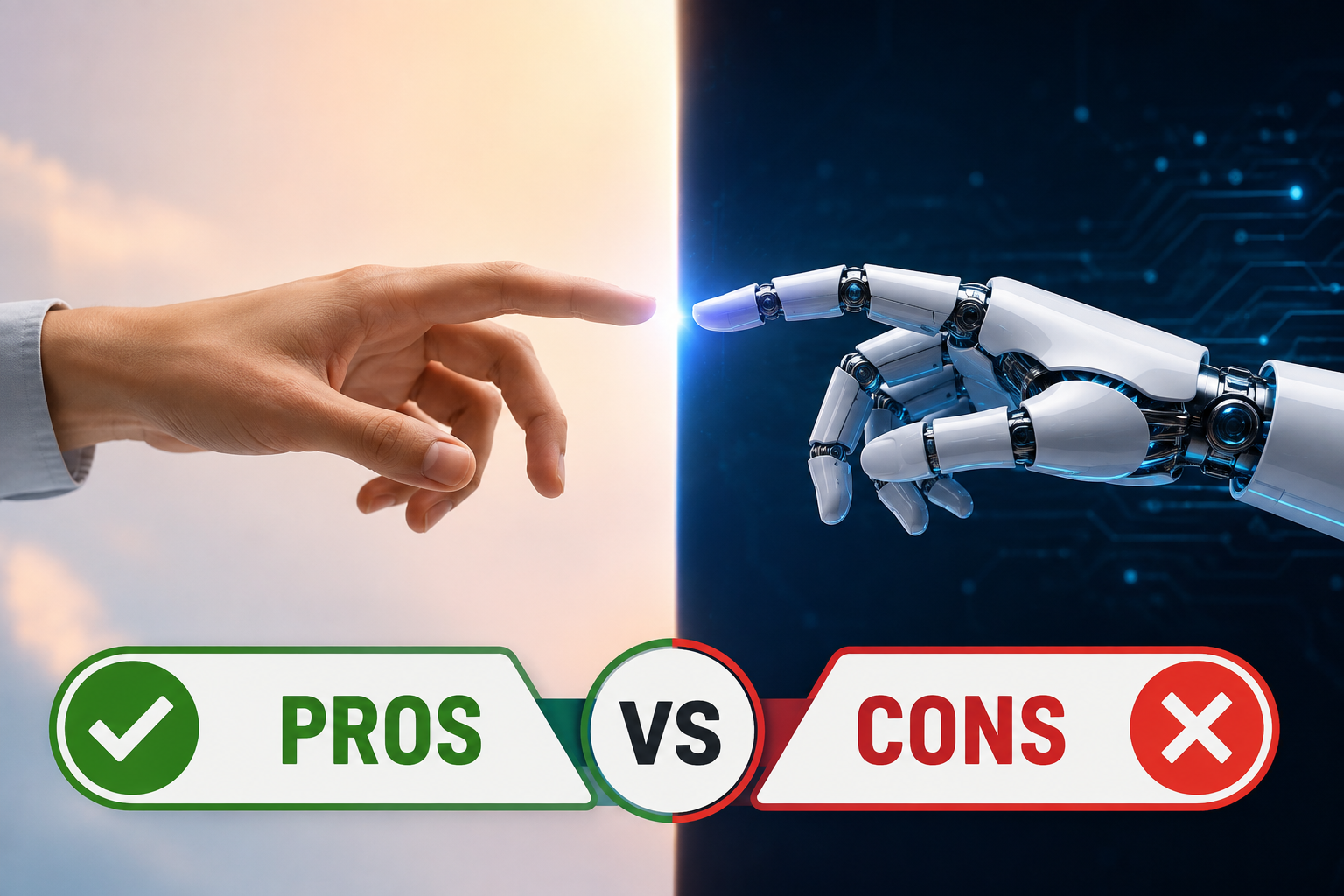
AI brings real value in many situations. It also carries real risks. This guide covers five clear advantages and five clear disadvantages of artificial intelligence, without marketing gloss on one side or doom-and-gloom on the other.

What Do We Mean by Artificial Intelligence?
Artificial intelligence means software that performs tasks which normally require human thinking, spotting patterns, understanding language, and making predictions. Some AI tools stay simple, like a spam filter. Others reach impressive levels of sophistication, like systems that can write, code, or hold a conversation.
Businesses trying to figure out where AI actually helps should talk to people who work with it daily. Teams like ATeam Tech Solutions’ AI and automation group help companies identify which processes are worth automating and which ones only sound good on paper. That distinction often matters more than the technology itself.
With the basics covered, let’s look at the advantages and disadvantages of artificial intelligence in detail.
5 Advantages of Artificial Intelligence
1. It Gets Repetitive Work Done Fast
This advantage stands out first for most businesses. AI can sort invoices, tag customer emails, and clean spreadsheets in seconds. Employees spend less time on grunt work. They spend more time on tasks that need real judgment, like relationship-building and creative problem-solving.
McKinsey’s State of AI in 2025 report found that generative AI adoption among businesses more than doubled in a single year. That pace shows companies moving fast to free up capacity by automating routine tasks.
2. Decisions Happen Faster, Backed by More Data
Gut instinct works fine at a small scale. It struggles when a business needs to process millions of data points at once. AI can scan that volume in seconds and return a clear recommendation. Banks use it to catch fraud in real time. Retailers use it to adjust prices before competitors react. Airlines use it to reroute flights around bad weather.
AI doesn’t replace human judgment. It gives decision-makers more solid ground to stand on.
3. Healthcare Keeps Improving Because of It
This advantage draws the least controversy. AI-assisted imaging tools catch early signs of cancer that a tired radiologist might miss. Hospitals use predictive models to flag patient deterioration before it turns into an emergency. AI has also sped up drug discovery, a process that once took years.
AI doesn’t replace doctors here either. It gives them a second set of eyes that never gets tired.
4. It Doesn’t Need Sleep
A system that performs the same way at 3 a.m. and 3 p.m. offers real value. Customer support chatbots, fraud monitoring, and network security all run around the clock, and AI handles that schedule without complaint. It also skips the off days that affect human performance, which matters in fields like manufacturing quality control and financial auditing.
5. It Tackles Problems Too Big for Manual Work
Some problems involve too many moving parts for a human team to model by hand. Climate patterns, genome sequencing, and citywide traffic flow all fall into this category. AI already helps design efficient solar panel layouts, predict natural disasters earlier, and model disease spread across populations. This work rarely makes headlines, but it may be the most valuable use of the technology.
5 Disadvantages of Artificial Intelligence
1. Jobs Face Real Risk
This disadvantage deserves a direct answer. As AI improves, certain jobs shrink or disappear, especially in data entry, basic customer service, and administrative work. The World Economic Forum’s Future of Jobs Report 2025 projects that new roles will emerge by 2030, but it also expects a large number of existing jobs to disappear over the same period.
New jobs don’t automatically help the people who lost old ones. Retraining takes time, money, and support that not every worker or employer can provide right away.
2. It Can Reproduce Bias
AI systems learn from data, and data reflects the world it came from, including its biases. Documented cases already exist: hiring tools that quietly favored certain demographics, facial recognition systems that misidentified people of color at higher rates, and loan-approval systems that disadvantaged certain applicants without anyone intending it.
This risk exists now, not in some future scenario. Fixing it takes active effort, not just hope that the next model performs better.
3. Your Data Becomes the Fuel
Most AI systems need large amounts of personal data to work well: search history, health records, voice recordings, daily habits. This raises real questions that nobody has fully answered. Who owns that data? How long does a company keep it? What happens if a breach exposes it? A breach involving an AI platform can expose more sensitive information than a typical breach, simply because these systems ingest so much data by design.
4. It Costs Real Money and Real Resources
Training a serious AI model costs a lot. It requires specialized hardware, heavy computing power, and significant electricity. Someone pays that cost eventually, whether it’s the company building the model or the smaller business that can’t afford a custom solution and ends up dependent on a large provider instead.
An environmental cost also applies here. Training and running large models uses meaningful electricity and water for cooling data centers. That footprint grows as AI use keeps expanding.
5. People Trust It More Than They Should
This disadvantage sneaks up on people. As AI gets things right more often, people stop double-checking its answers, even when they should keep checking. Researchers call this automation bias: trusting an answer simply because a machine produced it. AI models sometimes generate confident but wrong answers, a problem often called “hallucination.” Without close attention, those mistakes slip into places that matter, like medicine, law, and financial decisions.
A quieter cost exists too. People who lean on AI often for writing, math, or problem-solving may lose some of their own sharpness over time. Researchers haven’t measured the full size of that effect yet, but it deserves attention.
Where Does This Leave Us?
AI isn’t good or bad on its own. It works as a tool, and tools take on the character of how people use them. The advantages and disadvantages of artificial intelligence both carry real weight. The upside includes faster decisions, better healthcare, tireless consistency, and the ability to solve problems once considered out of reach. The downside includes job disruption, embedded bias, privacy risk, real financial and environmental cost, and the quiet danger of over-trusting a system.
People and businesses get the most from AI when they treat it as a starting point, not a final answer. They pair its speed with human judgment. That balance will matter more as the technology keeps advancing, whether you run a company, shape policy, or simply try to make sense of a changing world.
Also Visit: https://usamagazine.online/
Common Questions About the Advantages and Disadvantages of Artificial Intelligence
Is AI more helpful or more harmful overall? The answer depends on where AI gets applied. In healthcare and logistics, the benefits clearly lead. In employment and privacy, the risks demand real regulation and oversight, not just good intentions.
Will AI wipe out most jobs? Most research points to a shift, not a wipeout. New jobs emerge alongside jobs lost. That shift depends heavily on how much retraining and support actually gets funded.

Can people fix AI bias completely? Better training data, regular audits, and human review can reduce AI bias. Full elimination stays unlikely, since AI keeps learning from data generated by an imperfect world.