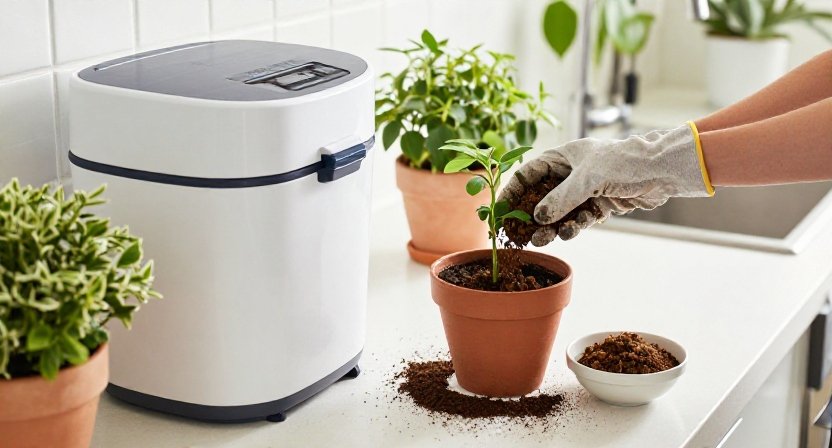
Houseplants benefit from food recycler output, but the material tends to work best when it’s been cured and mixed into soil at the right ratio. Applying it straight from the machine is one of the most common mistakes new composters make, and it’s an easy one to avoid once you understand why fresh output and potted plants don’t always mix well.
The good news: a little patience and a simple routine turn composter output into one of the best things you can feed your indoor plants.
Why Fresh Output Can Harm Potted Plants
A processing cycle reduces volume and removes moisture, but it doesn’t always complete the full biological breakdown. The material that comes out may still be active, with microbes continuing to work through the remaining organic matter.

In a garden bed, there’s enough soil volume to absorb that activity. In a small pot, the margin is much thinner. Active material can pull nitrogen from the surrounding soil to fuel decomposition, temporarily limiting what’s available for leaf growth. Concentrated mineral salts left behind after drying can also stress roots at close range.
The common sign is crisp, brown leaf edges that look like a watering problem but may actually be salt damage. Curing the material before use helps remove the risk.
How To Cure The Output
Curing finishes what the machine started, and it takes very little hands-on effort. Place the output in a breathable container like a cardboard box, a paper bag, or a bucket with holes in the lid. Keep the moisture level roughly as damp as a wrung-out sponge, and stir it every few days so air reaches the material evenly.
Two to four weeks is a typical curing window, though warmer rooms may speed the process up. The material is generally ready when it looks uniformly dark, holds together loosely when squeezed, and smells like clean earth. If you can still identify specific food fragments like a piece of eggshell or a strip of onion skin, give it another week. If it smells sour or sharp, it likely needs more airflow and may be holding too much moisture.
Once it’s cured, the material is stable and should be safe for most houseplant roots.
Mixing Ratios For Potted Plants
Ratios matter more indoors than outdoors because there’s less soil to buffer a mistake. Treat these numbers as starting points and lean lighter with any plant you’d rather not risk.
- Repotting mix: Blend roughly one part cured material with four parts potting soil before placing the plant in its new pot.
- Established plants: Work about one part into six parts of existing soil, staying in the top two inches to avoid disturbing roots.
- Seedlings and cuttings: Best to skip it entirely. Young roots tend to be too sensitive for concentrated amendments.
Food recycler output is dense, so measure by volume rather than eyeballing it. What looks like a small handful in a storage bag can take up more space than you’d expect once it’s in a pot.
Top Dressing Without Overdoing It
Top dressing means spreading a thin layer of cured material across the soil surface without mixing it in. It works well for plants you’d rather not repot or disturb, like a mature palm or a root-bound pothos.
Keep the layer under a quarter inch. Leave a clear gap around the stem so material doesn’t pack against it and trap moisture, which can encourage rot. Water lightly after applying so the nutrients begin moving downward into the soil. Refreshing every two to three months is usually enough.
One thing to watch for: a consistently damp surface layer can sometimes attract fungus gnats. Letting the top inch of soil dry out between waterings typically prevents this.
If You’ve Already Applied Too Much
Scrape off the surface material first. Flush the pot with room-temperature water, letting it run freely through the drainage holes for a minute or two, then repeat an hour later. Trim any badly damaged leaves since crisped tissue generally won’t recover on its own. Hold off on any feeding for at least a few weeks and let the plant reset.
Most houseplants tend to bounce back with time. New growth may just take a few weeks to appear.

The Simple Version
Cure it, measure it, and apply it thinly. That’s the whole method. An electric composter output is a soil amendment, something that improves your soil’s structure and feeds plants gradually over time. Treated with a little patience, it’s one of the most useful things your kitchen can produce.