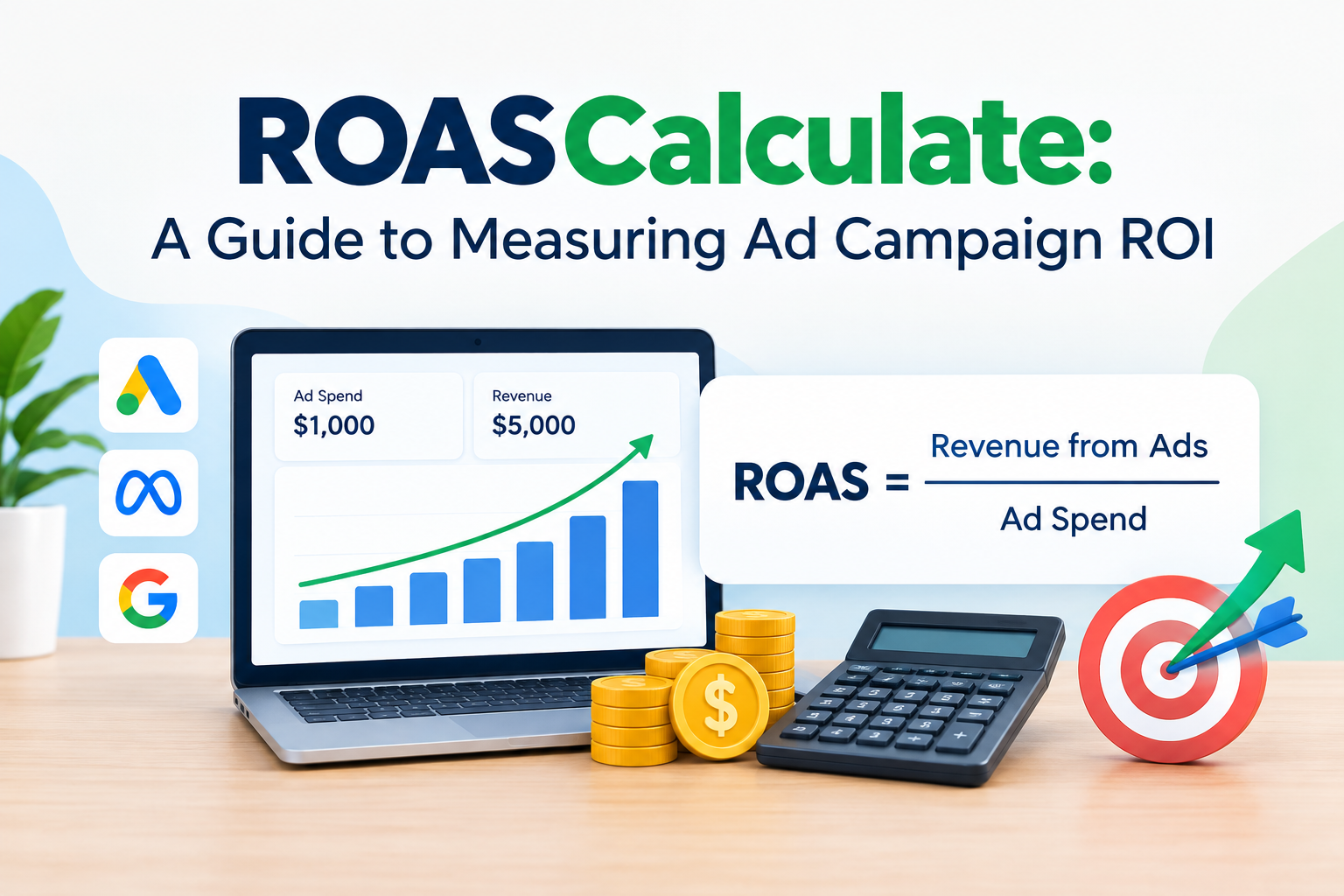
Introduction to Advertising ROI
Every business wants its advertising budget to generate sales, leads, and measurable results. However, spending money on Google Ads, Facebook Ads, or other marketing channels does not guarantee a profit. Businesses need to track their advertising performance and understand how much revenue their campaigns generate compared with their advertising costs. This is where Return on Ad Spend (ROAS) becomes useful.
ROAS helps marketers evaluate campaign results using a simple calculation. It can show whether an advertising campaign is generating enough revenue to support business goals. With RoasCalculate, marketers can better understand advertising performance and make informed decisions about their budgets.
What Is Return on Ad Spend (ROAS)?
Return on Ad Spend, commonly known as ROAS, measures the revenue generated for every unit of money spent on advertising. It is widely used in digital marketing because it connects advertising costs with the revenue attributed to campaigns.

For example, suppose an online store spends $500 on an advertising campaign and generates $2,000 in attributed revenue. The campaign produces $4 in revenue for every $1 spent on advertising, resulting in a ROAS of 4:1.
This information helps businesses compare campaigns, identify effective advertising channels, and decide where to allocate their budgets. However, ROAS measures revenue rather than profit. Product costs, shipping, salaries, and other operating expenses must also be considered when evaluating overall profitability.
Understanding the ROAS Formula
The ROAS formula is straightforward and can be applied to different digital advertising campaigns.
ROAS = Advertising Revenue ÷ Advertising Cost
For example, if a business generates $6,000 in revenue from a campaign that costs $1,500, the calculation is:
ROAS = $6,000 ÷ $1,500 = 4
The result is a 4:1 ROAS, meaning the business generates $4 in attributed revenue for every $1 spent on advertising.
Marketers can also express this result as 400% when presenting ROAS as a percentage. It is important to use the same attribution period and revenue definition when comparing campaigns. Otherwise, the results may not provide a fair comparison.
Why Measuring Ad Campaign ROI Matters
Measuring advertising performance gives businesses a clearer view of how their marketing budgets are being used. Without reliable data, marketers may continue spending on campaigns that generate clicks but produce few sales.
ROAS tracking can help businesses:
- Identify campaigns that generate more attributed revenue.
- Compare advertising platforms and audience segments.
- Monitor changes in campaign performance.
- Adjust budgets based on measurable results.
- Evaluate whether advertising targets are being met.
For example, a retailer running two campaigns may discover that one generates more revenue per advertising dollar than the other. This information provides a reason to investigate the difference and test budget adjustments. The decision should also account for profit margins, customer quality, and conversion rates.
How a ROAS Calculator Simplifies the Process
Calculating campaign performance manually is manageable for a few campaigns, but it becomes time-consuming when a business manages several advertising channels. A ROAS calculator simplifies the calculation by turning revenue and advertising cost figures into an easy-to-understand result.
Users typically enter the revenue attributed to a campaign and the amount spent on advertising. The calculator then divides the revenue by the advertising cost.
For example:
- Advertising revenue: $10,000
- Advertising cost: $2,000
- Calculated ROAS: 5:1
This means the campaign generated $5 in attributed revenue for every $1 spent on advertising.
A ROAS calculator can help marketers check results quickly, compare campaign performance, and reduce calculation errors. RoasCalculate can be used as a reference point for understanding these calculations and organizing advertising performance reviews.
The Role of an Ad Spend Calculator
An ad spend calculator helps marketers estimate and review their advertising budgets. While a ROAS calculator focuses on the relationship between revenue and advertising costs, an ad spend calculator can support budget planning.
Suppose a business wants to spend $3,000 on a campaign and aims to generate $12,000 in attributed revenue. The required ROAS would be:
$12,000 ÷ $3,000 = 4:1
This calculation gives the marketing team a measurable target. The team can then monitor campaign results and determine whether performance is moving toward that target.
Businesses should set advertising budgets according to their financial capacity, profit margins, customer acquisition goals, and historical performance. A higher budget does not automatically produce higher returns.
How to Improve Advertising Campaign Performance
Improving ROAS requires regular monitoring, testing, and analysis. A single calculation can show the current result, but it cannot explain every reason behind that result.
1. Review Audience Targeting
Check whether advertisements are reaching people who are likely to purchase the product or service. Reviewing audience segments can help identify differences in conversion rates and revenue.
2. Improve Landing Pages
A relevant landing page helps visitors understand the offer and take the next step. Clear product information, simple navigation, transparent pricing, and a straightforward checkout process can support conversions.
3. Test Advertising Creatives
Compare different headlines, images, videos, and calls to action. Run controlled tests where possible, and use conversion data rather than clicks alone to evaluate the results.
4. Monitor Campaign Costs
Review bids, daily budgets, and cost per conversion. Rising advertising costs can reduce ROAS when attributed revenue does not increase at a similar rate.
5. Evaluate Profit Margins
A campaign with a high ROAS may still be unprofitable if product and operating costs are high. Calculate the revenue required to cover these expenses before deciding what ROAS target makes sense for your business.
During campaign reviews, RoasCalculate can serve as a practical reference for checking calculations and keeping attention on measurable advertising results. Consistent tracking helps teams identify changes and decide which areas need further investigation.
Common Mistakes to Avoid When Measuring ROAS
One common mistake is treating ROAS as the same as profit. Revenue generated from advertising must still cover product costs and other expenses.
Another mistake is comparing campaigns that use different attribution windows or tracking methods. Differences in reporting can make one campaign appear more effective than another.
Marketers should also avoid making decisions based on a very short reporting period. Small data samples can produce misleading results, particularly when conversion volumes are low. Reviewing trends over an appropriate period provides more context.
Finally, ensure that advertising platforms track conversions correctly. Duplicate purchases, missing events, and inconsistent revenue values can affect the accuracy of reported results.
Conclusion
Measuring advertising performance is an important part of managing a digital marketing budget. TheROAS formulahelps businesses understand how much attributed revenue their advertising generates relative to campaign costs. A ROAS calculator makes this process faster, while an ad spend calculator supports budget planning.
By monitoring campaign data, testing improvements, and considering profit margins, businesses can make more informed advertising decisions. RoasCalculate provides a useful starting point for understanding ROAS and developing a consistent approach to campaign measurement.
Frequently Asked Questions
1. What does ROAS mean?
ROAS stands for Return on Ad Spend. It measures the revenue attributed to advertising compared with the amount spent on that advertising.
2. How do you calculate ROAS?
Divide the revenue attributed to an advertising campaign by its advertising cost. For example, $4,000 in revenue divided by $1,000 in ad spend equals a 4:1 ROAS.
3. What is a ROAS calculator?
A ROAS calculator is a tool that calculates advertising returns by using campaign revenue and advertising costs.
- Is a high ROAS always profitable?
No. ROAS measures revenue relative to advertising costs, not total profit. Product costs, shipping, salaries, and other expenses also affect profitability.

5. How often should I check my advertising ROAS?
Review ROAS regularly based on campaign volume and business goals. Daily monitoring can identify issues, while weekly or monthly reviews may provide better context for longer-term decisions.