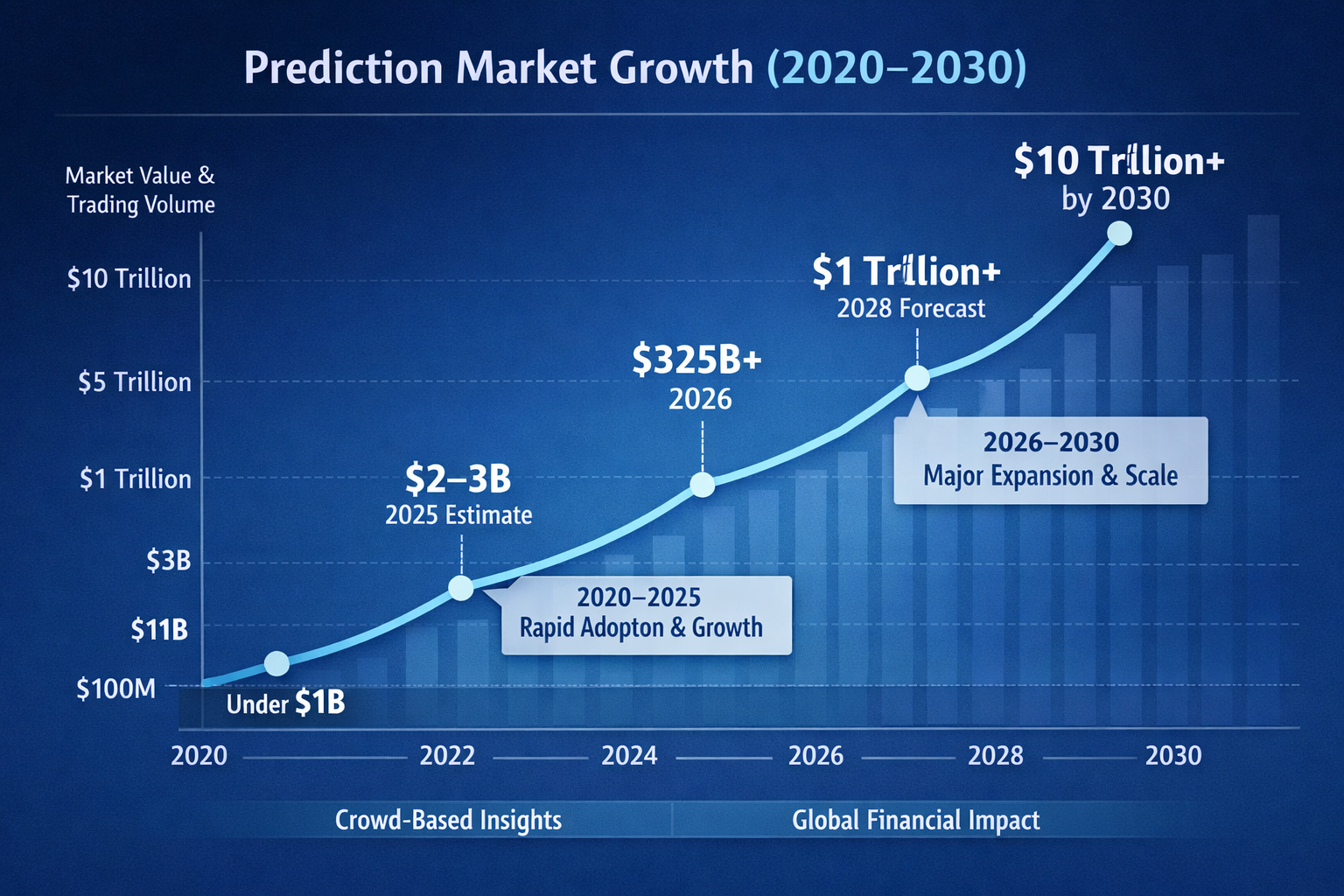
Prediction markets have become one of the most compelling stories in fintech. By letting people trade on the outcome of real-world events — elections, sports, crypto prices, economic data — these platforms turn collective opinion into a live, tradable signal. Combined monthly volume across the largest players has surged into the tens of billions of dollars, and analysts project the global market could grow from roughly $20 billion to nearly $95 billion within the decade.
That momentum has founders, fintech operators, and entrepreneurs asking the same question: how do you actually build one? This guide covers the three things that matter most — the essential features, the technology stack underneath, and the business models that turn trading activity into revenue.
What a Prediction Market Platform Does
At its core, a prediction market lets users buy and sell shares in the outcome of an event. A contract priced at $0.70 implies the market believes there’s a 70% chance the event happens. If the prediction is correct, each share settles at $1; if not, it’s worth nothing. Prices move continuously based on supply and demand, so the platform itself becomes a real-time probability engine.

Unlike traditional betting, users trade against each other rather than a house, which makes the model feel transparent and skill-based. Capturing that experience reliably is the real challenge — and the reason your choice of a prediction market platform development company shapes everything from launch speed to long-term scalability.
Essential Features
Core Trading Features
- Market creation and management. The engine that lets operators list “yes/no” or multi-outcome questions with live pricing and clear resolution rules.
- Real-time order matching. The system that pairs buyers and sellers instantly, whether through an order book or an automated market maker.
- Live pricing and analytics. Prices and probabilities that update the moment sentiment shifts, backed by real-time data and sentiment insights.
- Market resolution and settlement. Reliable, transparent logic to decide outcomes and pay out winning positions automatically.
User Experience Features
- Wallet and payments. Secure deposits, withdrawals, and balance management — fiat, crypto, or both.
- Profiles, rankings, and leaderboards. The status layer that drives competition and retention.
- Interactive feeds. Spaces where users post opinions, comment, and share insights, turning trading into a social experience.
- Customized notifications. Timely alerts on price moves, resolutions, and new markets that bring users back daily.
Operator and Trust Features
- KYC/AML and verification. Identity, age, and location checks to stay compliant.
- Admin dashboard. Full control over markets, users, fees, and reporting.
- Secured payment and wallet integration. Encrypted, reliable fund handling that users can trust.
The order-matching and settlement systems are where generic developers struggle most. These are financial-grade components, and getting them wrong means mispriced markets and failed payouts. This is exactly the kind of work a specialist opinion trading platform developer has already solved and can deliver far faster than an agency learning on your budget.
The Technology Behind a Prediction Market
A prediction platform looks simple on the surface but hides real complexity underneath. A robust build typically spans four layers.
1. Frontend Layer
The interface users interact with — built in React or Next.js for web and native frameworks (Swift for iOS, Kotlin for Android) for mobile. It must be fast, responsive, and capable of rendering live price updates without lag, since markets move in real time.
2. Backend and Application Layer
The server-side brain, usually built on Node.js, handling user management, market data, order routing, and settlement logic. It relies on MongoDB and MySQL for structured and unstructured data, Redis for low-latency caching during traffic spikes, and message queues (and protocols like gRPC) to coordinate high-concurrency events so nothing is dropped when thousands trade at once.
3. Blockchain Layer (Optional)
For decentralized platforms, smart contracts mint outcome shares, hold collateral in a stablecoin, and execute settlement automatically, while an oracle feeds verified real-world results on-chain. Low-cost chains keep transaction fees negligible. This model powers transparent, trustless markets — the approach behind Polymarket-style exchanges and Augur-style decentralized markets. Many operators instead run centralized or hybrid builds for speed, lower cost, and easier compliance, closer to a Kalshi-style regulated exchange.
4. Integration and Deployment Layer
The connective tissue: multiple payment gateways, wallet systems, KYC providers, and live sports and market-data feeds. Containerized deployment on AWS with Docker and Jenkins, plus security tooling like OWASP practices and SonarQube analysis, ties it all together and lets the platform scale horizontally as the user base grows.
Compliance: A Technical Requirement, Not an Afterthought
Prediction markets sit in a sensitive legal space that varies sharply by jurisdiction. In some regions they’re regulated as financial exchanges; in others, anything resembling real-money gaming is restricted or banned outright. India’s Online Gaming regulations, for instance, draw firm lines around real-money gaming features.
Your development partner doesn’t replace a lawyer, but a serious one architects the right controls from day one — identity and age verification, geo-fencing, responsible-use limits, and transparent market-resolution rules. Build these in early; retrofitting compliance after launch is painful and costly.
Business Models: How Prediction Markets Make Money
The revenue model is one of the most attractive parts of this category, because income scales directly with trading activity. The main streams are:
- Transaction fees. A small cut on each trade — usually the primary income source.
- Platform fees. A fixed charge for using the service.
- Data and insights. Aggregated, anonymized trend data has real commercial value to businesses and researchers.
- Advertising and sponsored markets. Ad placements and branded markets once you reach scale.
- Licensing. Charging other businesses to use your market data or technology.
Because every stream depends on volume, success comes back to liquidity and engagement. The more active and trusting your user base, the more each of these earns — which is why seeding popular markets and keeping pricing tight matters as much as the revenue model itself.
Cost and Timeline
Development typically ranges from around $10,000 for a straightforward build to $50,000 or well beyond for a feature-rich platform with blockchain integration, advanced analytics, and multi-language support. A clean MVP usually takes 4–8 weeks with an experienced team; heavier customization pushes that to 8–12 weeks.
Be wary of quotes far below market — they often hide missing scope, skipped security work, or inexperience that resurfaces later as delays and change-request fees. Transparency about cost, scope, and timeline is one of the clearest signs of a mature partner.
The Development Process at a Glance
A disciplined build moves through research and planning, UI/UX design, backend development, frontend development, testing and QA, launch and deployment, and ongoing post-launch support. That last stage matters more than founders expect — markets need creating and resolving, bugs need fixing, and features need adding to stay competitive. A partner offering true end-to-end delivery is worth far more than a cheaper shop that disappears after the invoice clears.
Why the Right Partner Decides Your Outcome
You can get the features, technology, and business model right on paper and still fail if the engine underneath is weak. The teams that succeed build prediction markets as a specialty — not as a side project.
OpiniosLabs is built precisely for this. It’s a dedicated prediction market platform developer whose portfolio spans the full landscape — from Polymarket and Kalshi to Probo, Manifold, PredictIt, and Metaculus-style builds. Backed by the engineering depth of parent company Yudiz Solutions, the team pairs genuine domain knowledge with a production-grade stack, security-first development, and fully customizable solutions — and can take a well-defined platform live in roughly 60 days. Their prediction-market development guides and resources are a strong place to start if you want to see how they approach platforms modeled on the biggest names in the space.

Final Thoughts
Prediction market platform development sits at a rare intersection of strong user demand, a proven revenue model, and mature technology. Your job as a founder is to nail the essential features, choose a scalable and compliant architecture, and pick a business model that fits your market — then partner with a team that has built these platforms before. Get those right, and you won’t just enter one of fintech’s fastest-growing categories; you’ll build a platform ready to compete, scale, and last.