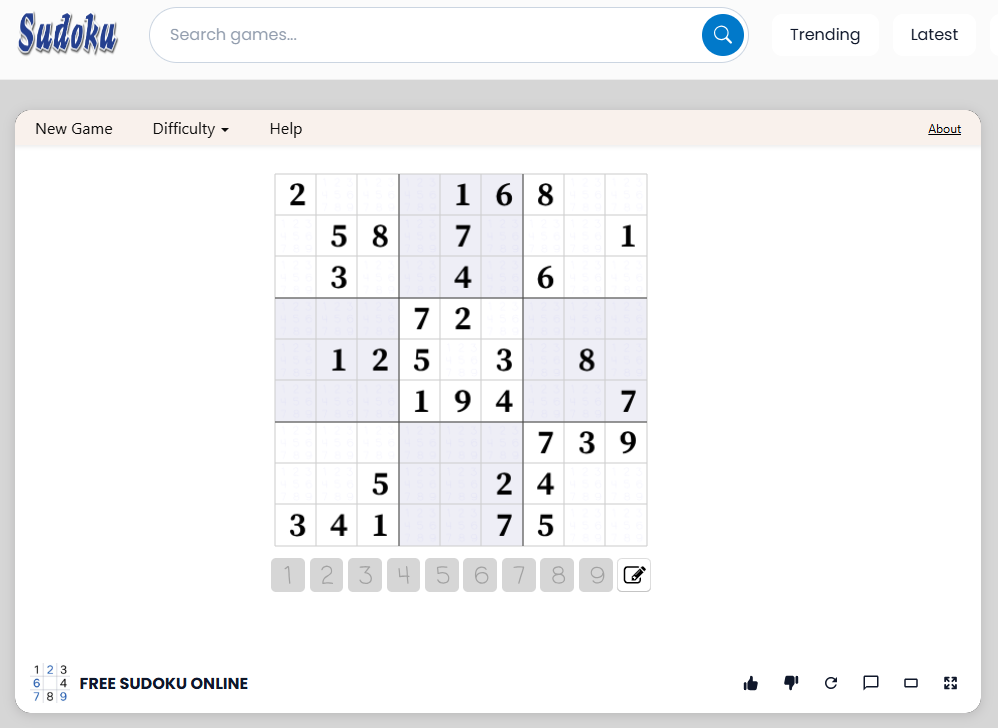
Sudoku is a popular number puzzle game that challenges logical thinking, concentration, and problem-solving skills. With simple rules and countless possible combinations, Sudoku offers an enjoyable experience for beginners and experienced players alike. Whether you want to relax during a short break or improve your mental skills through regular practice, this classic puzzle provides an engaging way to exercise your mind.
Today, Sudoku is available in newspapers, books, mobile applications, and online gaming platforms. Players can enjoy different difficulty levels, explore new strategies, and challenge themselves with increasingly complex puzzles. Understanding the basic rules and learning effective techniques can make every Sudoku session more rewarding.
What Is Sudoku?
Sudoku is a logic-based number puzzle played on a grid containing nine rows and nine columns. The main objective is to fill every empty cell with a number from 1 to 9 while following a set of simple rules.

Each complete grid must satisfy three conditions. Every row must contain the numbers from 1 to 9 without repetition. Every column must also contain all nine numbers exactly once. Finally, each 3×3 box must include every number from 1 to 9 without duplicates.
Unlike arithmetic games, Sudoku does not require advanced mathematical calculations. Success depends on observation, deduction, and careful reasoning. Players analyze the available numbers, identify possible choices, and gradually complete the grid through logical decisions.
The Basic Rules of Sudoku
The rules of Sudoku are easy to understand, making the game accessible to players of different ages. At the beginning, several cells already contain numbers that provide clues for solving the puzzle. These numbers cannot be changed during normal gameplay.
Players must examine the empty cells and determine which numbers can legally fit into each position. A number is valid only when it does not appear elsewhere in the same row, column, or 3×3 box.
Every correctly designed Sudoku puzzle has a logical solution. Guessing is usually unnecessary when players carefully evaluate the available information and apply suitable solving techniques.
Different Sudoku Difficulty Levels
Sudoku commonly offers easy, medium, hard, and expert puzzles. Easy levels provide more clues and require fewer advanced techniques, making them ideal for beginners.
Medium puzzles introduce more complicated situations that demand closer observation. Hard and expert challenges often require advanced strategies, including candidate elimination and detailed pattern recognition.
Choosing the right difficulty level helps players develop confidence without becoming overwhelmed. As their skills improve, they can gradually explore more demanding puzzles.
How to Play Sudoku Successfully
Learning how to play Sudoku involves understanding the grid and identifying the safest moves. Instead of filling random numbers into empty cells, players should examine existing clues and eliminate impossible options.
A systematic approach makes the puzzle easier to manage. Start with areas containing many numbers, then move toward sections with fewer clues. Each confirmed number provides additional information that can help solve nearby cells.
Start With Rows, Columns, and Boxes
The easiest way to begin is by looking for rows, columns, or 3×3 boxes that already contain several numbers. These areas usually have fewer empty cells and therefore offer more opportunities for immediate progress.
For example, if a row contains the numbers 1, 2, 3, 4, 6, 7, 8, and 9, the missing number must be 5. The answer becomes clear without complicated calculations.
After completing an obvious cell, review the surrounding rows, columns, and boxes. A single correct placement can reveal several additional opportunities.
Use Candidate Numbers
When a cell cannot be solved immediately, identify the numbers that could legally occupy that position. These possibilities are called candidates.
Suppose an empty cell cannot contain 2, 4, 6, 7, or 9 because those numbers already appear in its relevant row, column, or box. The remaining candidates are 1, 3, 5, and 8.
Writing down candidates can make complex puzzles easier to understand. If later discoveries eliminate three of those possibilities, the remaining number becomes the correct answer.
Online Sudoku games often include a notes feature that allows players to record candidates directly in the grid.
Effective Sudoku Strategies for Better Results
Improving at Sudoku requires more than knowing the basic rules. Experienced players rely on repeatable techniques that reduce uncertainty and prevent unnecessary mistakes.
Identify Naked Singles
A naked single occurs when an empty cell has only one possible candidate. Since every other number violates at least one Sudoku rule, the remaining candidate must be correct.
This technique is especially useful in easy and medium puzzles. Regularly checking candidate lists helps players discover these opportunities before moving to more complicated strategies.
Look for Hidden Singles
A hidden single appears when a number can fit in only one empty cell within a particular row, column, or 3×3 box. The cell may contain several candidates, but only one position in that region can accept the number being considered.
Recognizing hidden singles requires examining an entire region rather than focusing on individual cells. This approach often reveals solutions that are not immediately obvious.
Avoid Unnecessary Guessing
Guessing may appear to speed up progress, but an incorrect assumption can create multiple mistakes throughout the grid. These errors may remain unnoticed until much later.
Instead, eliminate impossible candidates and confirm each placement through logic. If no immediate solution appears, examine another region or reconsider the candidate possibilities.
Patience and accuracy are more valuable than filling the grid quickly.
Benefits of Playing Sudoku Regularly
Sudoku provides an enjoyable mental challenge that encourages players to think carefully and evaluate different possibilities. It can also become a relaxing activity during breaks, commutes, or quiet evenings.
Improve Logical Thinking
Every Sudoku puzzle requires players to connect clues and draw conclusions from available information. Repeated practice encourages a structured approach to problem-solving that can be useful in everyday activities.
Players learn to evaluate possibilities, recognize contradictions, and make decisions based on evidence rather than assumptions.
Develop Concentration and Patience
Completing a difficult puzzle requires sustained attention. Players must remember previous discoveries, examine small details, and avoid distractions while working through complicated sections.
Sudoku also teaches patience because some puzzles take time to solve. Finding the answer through careful reasoning can create a satisfying sense of accomplishment.
Enjoy a Relaxing Mental Activity
Many people enjoy Sudoku because it offers a focused activity without requiring constant movement or complicated equipment. A short session can provide a welcome break from routine tasks.
However, Sudoku should be viewed as an enjoyable mental exercise rather than a guaranteed way to prevent cognitive decline or improve every aspect of memory.
Play Sudoku Online for Convenient Entertainment
Online Sudoku makes the classic puzzle accessible from computers, tablets, and smartphones. Players can start a new challenge within seconds without needing printed puzzle books or physical materials.
Many platforms provide adjustable difficulty settings, helpful notes, error indicators, timers, and progress tracking. These features allow beginners to learn the rules while giving experienced players additional ways to test their abilities.
Online versions are particularly convenient because players can complete puzzles whenever they have spare time. Some prefer quick games during short breaks, while others enjoy working through challenging grids for longer periods.
When selecting an online Sudoku platform, look for a clear interface, responsive controls, and puzzles that match your current skill level. An option to disable automatic assistance can also help experienced players develop greater independence.
Conclusion
Sudoku remains a timeless puzzle game because it combines simple rules with endless opportunities for logical exploration. From understanding rows and columns to mastering candidate elimination, every puzzle provides a chance to practice careful reasoning and improve problem-solving habits.
Beginners can start with easy grids and gradually progress toward harder challenges. Experienced players can refine their techniques by recognizing singles, analyzing candidates, and avoiding unnecessary guesses.

Whether played online or on paper, Sudoku offers accessible entertainment for anyone who enjoys numbers, patterns, and thoughtful challenges. Start with a puzzle that matches your ability, apply each rule carefully, and enjoy the satisfaction of completing the grid one logical step at a time.