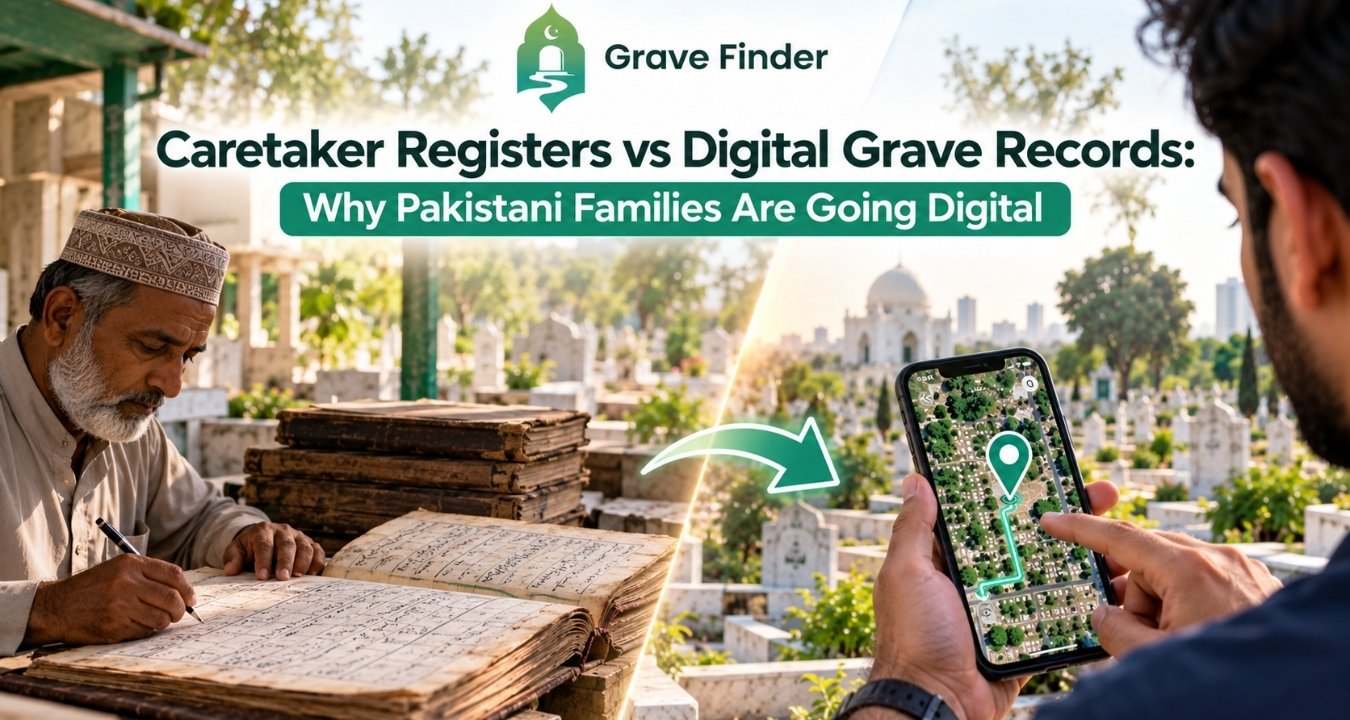
Any Pakistani family will have a story to tell you about an old grave. Someone strolled the rows an hour, and knew it was close to the tree. But the tree was missing, and the caretaker had already gone home. The small room had a dusty register, the only record of his life, decades long. That is gradually changing today and grave records in Pakistan are going digital. This article fairly compares the two systems thus you have the choice of which one fits you. You will see how families are finding the grave in a couple of minutes.
The Old Way: How Caretaker Registers Work
In Pakistan, there are caretakers in most graveyards, who are typically gorkan (grave-diggers). He records the information in a fat paper register when a burial occurs. The entry typically includes the name, the name of father, date, and a plot number. In larger cemeteries there is also a municipal office which maintains a separate register.
In 2021, the KMC of Karachi announced a one-window system of documenting burials and graveyards. Nevertheless, the memory of the gorkan himself is frequently more important than a written page. Talk of a grave and he will frequently take you to it. Protecting that personal knowledge is a treasure, and families have relied on it since time immemorial. But it is in the head of one man and in one small book of paper.

Where Paper Registers Fall Short
The old paper registers were appropriate in the previous days and such small graveyards and families resided nearby. The situation is quite different now in such cities as Karachi, Lahore and Rawalpindi. The Miani Sahib of Lahore, all by itself, contains over 300,000 graves, some of Mughal date. No paper register can contain that amount of entries safe and easy to consult. The following are the issues that families continue to experience in Pakistan.
- Ink bleaches, pages tear, monsoon leaks or termites may spoil entire years.
- Handwriting can be very difficult to read, particularly when the names are hastily written.
- There is typically only one copy and it can be destroyed by one fire.
- A caretaker who retires or dies, carries off his memory.
- Fridays, Eid holidays, or late evenings the office may be locked.
- Family members in another country cannot view a record in a small graveyard room.
Then there is an even tougher issue, which no one wants to discuss publicly. Karachi and Lahore news items recount how old and unvisited graves were being reused without commotion. When no one can tell the whereabouts of a grave, then it will be easy to lose track. That is why many families nowadays tend to maintain their own record.
What a Digital Grave Record Looks Like
The same details are stored in a digital record, but it resides on your phone. It also includes features that a paper register could never have (such as precise GPS latitude and longitude). A good record contains the complete name, name of father and date of death. Then it displays the name of the graveyard and block, row or serial number. Images of the headstone assist the family members to identify it even when they are a couple of steps away.
Then one map pin makes all these walking directions. The idea is already proven to work well by some graveyards that have numbered graves. The Wadi-e-Hussain in Karachi assigns each grave a number and allows the family to search online. Since 2017, Shehr-e-Khamoshan Authority has been constructing model graveyards in Punjab. Their graves and headstones are of the same size, and maintain rows in a strict order.
Why Pakistani Families Are Making the Switch
The largest driver is a mere coincidence: due to the worldwide dispersion of our families nowadays. There are millions of Pakistanis in the Gulf, in the UK, Europe and North America. When they have a short flight home, no one would want to spend an entire day searching. They can walk directly to the grave of their father or mother, a commonality that connects them. Younger individuals also demand their information on their mobile phones, not in a locked cupboard. They memorize the places of shops with ease and a grave of a grandparent does not feel any different.
Another reason is peace of mind, particularly following the stories of reused graves. Families have a dated photo and GPS pin that provides evidence that the grave is real. Lastly, online documentation makes sharing responsibilities within the entire family easy. The headstone is cleaned by one cousin and a second one visits each Ramadan. All are to work in the same book, and no one will receive the wrong grave. This is the way that serious records in Pakistan are transitioning to phones.
Do Digital Records Replace the Caretaker?
Many older burials can also be found on their registers and this is also a valuable local source. The most intelligent solution is merely to work with both systems simultaneously.
The first thing is to ask the caretaker to show you the grave with his register. Digitally verify that assured position and no amount of knowledge will be misplaced. Even a simple thank-you note to the caretaker in the end will go a long way. The collaboration between caretakers and apps can transform grave records in Pakistan into a more trustworthy source.
How to Create a Digital Record for Your Family’s Graves
All you require is no technical expertise and the entire exercise takes a few minutes. You can do it like this on your next visit to the graveyard with Grave Finder.
- Download Grave Finder in Google Play and create an account using your email.
- Choose the qabristan on the list, or approach the list to ask it to be added.
- Try to find it by name first, as somebody might have added the record already.
Otherwise, tap Add New Grave and enter the minimal information.
- Be next to the headstone and save your position as the pin.
- 3-2 concise photos, including one proximity and one landscape.
- Add grave to My List, and give the link to family.
The grave can now be located by any member of the family just by pressing a button.
Don’t Throw Away the Old Papers
Digitizing does not entail discarding the old family documents in your cupboard. A lot of houses have burial slips, death certificates and receipts of union councils. These papers usually have the number of the plot that no one in the family recalls. And, too, sit with your elders and enquire about all the graves that they know.
Their recollection of past landmarks can save you hours of search in future. Take the photos of each paper and provide the information to the digital record. In this manner, the new tools and the old knowledge finally come into play. Your grandchildren will be glad that you do it now, when there are older folks around.
A Few Honest Limits of Digital Records
Yet there is no system that is ideal and there are boundaries that digital records have. To search, add or share a grave, you require an internet connection. Nevertheless, GPS may wander a few metres in case of a weak signal. Allow your phone to take some time to connect to a better signal. There may be errors in the community records, as they are introduced by various families.
Grave Finder manages this by a Report button and review of reports by the administrator. Nevertheless, it is not a government-based register, thus always checking valuable information on site. Anyone may open shared links, and they ought to remain within the family. Despite these restrictions, digital grave records in Pakistan are taking over a wobbly register.
About Grave Finder
Grave Finder is a free Pakistani app that can save, locate and share graves. It also caters to families in Karachi, Lahore, Islamabad and other Pakistani cities. A name, name of the father, date of death, and photos can be stored in each record. No date of birth is required in the app, keeping it confidential.
Moreover, any user can complain about inaccurate information to the administration team to investigate. The team is available on support@gravefinder.pk and it typically responds quite fast. The motto of the app elucidates the application in three words, Find, Remember, Respect.
FAQs
Is there an official grave database in Pakistan?
There is no single national database for grave records in Pakistan yet. Nevertheless, there are graveyards that maintain registers and some even provide search online.
Will you please provide me with a copy of the caretaker’s register?
A great number of caretakers will allow you to look at the register should you visit in a polite fashion. Additionally, scan a picture of your family on the door and save it electronically.
Is Grave Finder an official record system?
No, Grave Finder is not a government grave registry, it is a community site. Reporting is done by reviewing records (user reports) and therefore verifying key details with the graveyard.
What is the way of relatives abroad finding the grave?
Send the grave link to them via WhatsApp or email and they can access it. Then, Google Maps not only shows them where to go on foot to the very grave.
Conclusion
Caretaker registers have been the service of Pakistani families since generations and they should be respected. But no paper can keep pace with congested cities and dispersed families. In Pakistan, the digital grave records fill that gap without having to displace caretakers. So save your loved ones’ graves once, and your family won’t lose them.

Get Grave Finder Now.
Install Grave Finder on your phone via Google Play and get a grave record of your family today. Then share it with everyone, so the way back is never lost again.