A sales leader glances at the dashboard. The numbers are present, and the data are present. But the insights are missing.
Somewhere in the midst of all this data is a pattern waiting to be uncovered, which could potentially improve forecasting, reduce churn, or identify the next big thing. In fact, the company has gone ahead and invested in AI tools to help achieve this.
But the truth is that nothing has really changed.

This is the reality in many boardrooms across the world today. Organizations are investing heavily in AI technology. Yet many are still trying to bridge the gap and leverage this technology to create business impact.
Although AI is a powerful technology, using AI tools is different from creating an AI business. This is precisely the reason why organizations are now increasingly using AI tech consulting services to help them in their journey. While technology is important, strategy is more important.
And the companies that figure this out early gain a serious competitive advantage.
AI Has Become a Competitive Necessity
AI used to be a futuristic concept discussed in innovation labs. Today, it is part of everyday business operations.
Businesses utilize AI for sales forecasting, workflow automation, customer personalization, and predicting risks in real-time business activities. All these aspects impact businesses in terms of revenue, efficiency, and customer satisfaction.
The numbers reflect this shift.
According to McKinsey’s State of AI research, around 88% of organizations now use AI in at least one business function.
Adoption is everywhere. Success is rare.
Many organizations still struggle to scale AI initiatives beyond small pilot projects. They experiment with models. They launch proofs-of-concept. But those initiatives rarely evolve into enterprise-wide transformation.
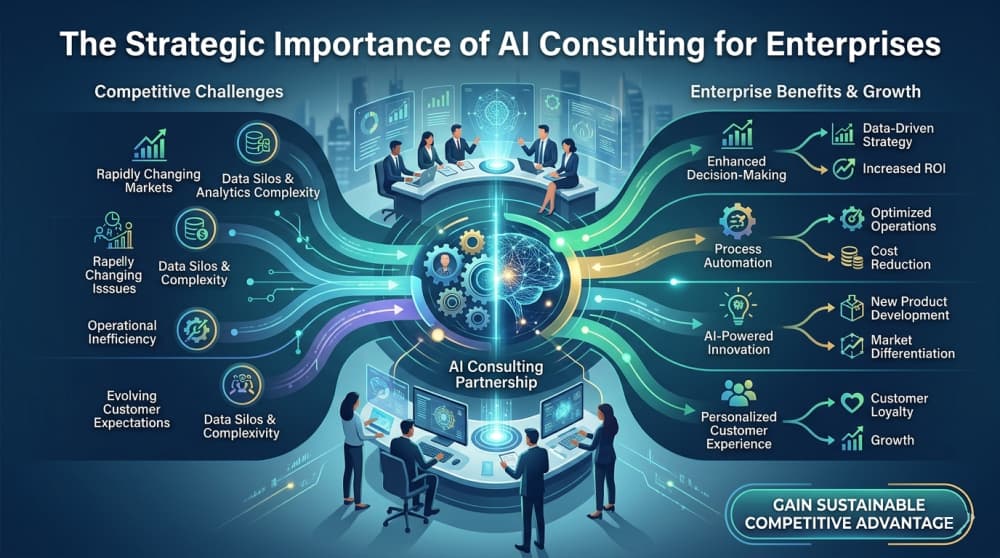
This is where AI consulting for enterprises plays a critical role.
Consulting experts help companies move from experimentation to execution. They translate technical potential into practical business value.
The Enterprise AI Reality Check
AI adoption is not always straightforward. Not every initiative delivers meaningful results.
Enterprises are pouring money into AI technology, yet many are finding difficulty in realizing the actual benefits from the technology they are implementing. The problem is in the way they view AI as a technology. Artificial intelligence is not just technology; it is a business transformation effort.
Real integration of AI affects all aspects and all areas of businesses and organizations, including data systems, operations, and the workforce. Without a strategic direction, the use of AI technologies is limited to isolated experiments.
This is why many organizations seek the help of artificial intelligence advisory services. Consultants offer the structured thinking, the expertise, and the industry knowledge that the organization may not have.
Why AI Tech Consulting Services Start with Strategy, Not Software
One of the most common mistakes companies make is starting their AI journey with tools.
They buy platforms and deploy models. Then they hope the value will appear.
It rarely works that way. Successful organizations start with a simple question:
What business problems should AI actually solve?
Consultants specializing in AI consulting for businesses begin with that exact conversation. They work with leadership teams to identify opportunities where AI can deliver measurable results.
This usually involves several steps.
Finding the Right Use Cases
Not every process needs AI.
The goal is to identify areas where automation, prediction, or pattern recognition can create clear business value. These might include:
- Demand forecasting in supply chains
- Intelligent customer support
- Fraud detection systems
- Personalized marketing campaigns
- Automated document processing
When companies start with focused use cases, they build momentum quickly.
Early wins matter. They build confidence across the organization.
Evaluating Data Readiness
AI models depend on reliable data. But many enterprises still operate with fragmented systems and inconsistent data governance.
Consultants often begin by evaluating:
- Data availability
- Data quality
- Integration across platforms
- Governance frameworks
And often, this is where the real work begins.
Before advanced AI models can be deployed, the organization must modernize its data foundation. It is not glamorous work, but it is essential.
Building a Scalable AI Architecture
Most organizations are able to launch AI pilots successfully. However, few are able to scale those pilots.
The problem is typically related to architecture. For AI models to work with the enterprise, they need to work with systems like the company’s CRM platform, its analytics tools, its supply chain system, and its operational databases.
Consultants create a scalable architecture where the AI model can transition from the experimental phase to production.
Once it is in production, the AI starts to affect business decisions in the day-to-day running of the business. And it is here where the true ROI is achieved.
The Human Factor in AI Transformation
Technology transformations rarely fail because the technology does not work.
They fail because people struggle to adapt.
For AI technology to take root in an organization, employees need to rethink how they work. Some jobs become automated, others become data-driven, and decision-making evolves. That shift can feel uncomfortable.
Successful enterprises invest in change management alongside technical development. Training programs, leadership alignment, and clear communication all play an important role.
Studies on the adoption of AI in the enterprise sector show that culture and leadership are significant influencers in the success of the technology.
Consulting teams often help organizations build internal AI capability while guiding teams through this cultural transition. Ultimately, AI transformation is as much about people as it is about technology.
How Industries Are Using AI Today
When AI is applied thoughtfully and aligned with business goals, it can transform how companies operate. Across various industries, AI consulting projects are helping organizations realize real value:
Financial Services
Banks use AI to detect suspicious transactions, automate compliance reviews, and improve credit risk assessment. Financial institutions can process their data faster with the help of AI consulting initiatives.
Retail
Retail businesses depend on information to understand customer behavior, purchase patterns, and market trends. These organizations use AI to provide personalized recommendations and dynamic pricing.
Healthcare
Artificial intelligence is being used by healthcare providers to enhance their diagnostic and imaging results. With proper guidance, healthcare providers can offer the best services while maintaining the highest level of regulations and privacy.
Manufacturing
Manufacturers today are using artificial intelligence to improve reliability and reduce the cost of unscheduled downtime. They depend on AI to analyze sensor data and prevent unexpected equipment failure.
Each example highlights the same principle. AI delivers value when it is thoughtfully integrated into business operations, and not when it sits in a standalone experiment.
Why AI Consulting for Enterprises Is Becoming Essential
The demand for AI consulting is rising at an incredibly fast rate. Big consulting firms are improving their AI services to enable the digital transformation of enterprises.
The rapid rise in the demand for AI consulting is due to the complexity involved in the adoption of AI.
Enterprises need partners who understand technology, data strategy, and business operations. AI consulting for enterprises bridges that gap.
AI consultants assist enterprises in creating roadmaps and implementing solutions that are flexible and ensure proper alignment with business objectives.
In other words, they help organizations avoid costly mistakes.
The Future of Enterprise AI
AI is evolving quickly.
Generative AI, autonomous agents, and multimodal models are making it possible to accomplish new things with intelligent systems in business. In the next few years, AI will touch almost every business function.
However, the businesses that are changing with AI are taking a well-trodden road.
Firstly, they are treating AI as a significant business capability and investing in data infrastructure and governance.
And they are working with proven providers of AI consulting for businesses to speed up innovation and manage risk.
The future of competition will not depend on who experiments with AI. It will depend on who uses it to transform their organization.
Final Thought
Artificial intelligence has moved beyond hype. It is now a core driver of competitive advantage.
Yet the path from AI exploration to enterprise transformation is not as easy as it sounds. Companies need a strategy, structure, and skills to unlock the true potential of AI.
This is where AI tech consulting services and artificial intelligence advisory services become the lifeblood of the company.

The organizations that have the leadership and the AI consulting expertise will be the ones to build smarter businesses, make smarter decisions, and move at the pace of the competition.