In today’s hyper-competitive industrial landscape, procurement teams are navigating one of the most challenging sourcing environments in recent memory. Rising raw material costs, tightening compliance regulations, supplier consolidation pressures, and growing ESG accountability are reshaping how industrial buyers evaluate and select materials.
Against this backdrop, the materials specification decision — often treated as a secondary consideration — has moved firmly into strategic territory. What a business chooses to package, wrap, cover, or construct with directly impacts its operational efficiency, product integrity, regulatory standing, and supply chain resilience.
One material that is consistently rising to the top of industrial sourcing shortlists across sectors is polypropylene fabric. Procurement managers in agriculture, construction, chemicals, food processing, logistics, mining, and retail are making a deliberate, data-driven switch to polypropylene-based solutions — and the business case is compelling.
This blog explores the key drivers behind this industry-wide shift, the technical and commercial advantages that make woven polypropylene fabric a preferred industrial material, the sectors leading adoption, and what procurement teams need to evaluate to make a confident sourcing transition.
The Problem With Conventional Industrial Fabric Choices
To understand why polypropylene fabric is gaining such rapid traction, it helps to first examine what procurement teams have been working with — and what limitations have been driving the search for a better alternative.
For decades, industries relied on a narrow set of materials for heavy-duty packaging, containment, and fabric applications: jute, cotton canvas, HDPE tarpaulins, and non-woven synthetics. While each served a purpose in its time, they carry significant performance and commercial limitations that become increasingly costly as industrial operations scale.
Jute was the dominant bulk packaging material for generations. However, jute degrades rapidly in humid conditions, is susceptible to fungal growth, and delivers inconsistent tensile strength across production batches. For procurement teams managing quality-sensitive commodities — food grains, pharmaceuticals, specialty chemicals — jute’s unpredictability creates unacceptable risk.
Cotton canvas, while durable, is heavy, expensive, and highly absorbent. It is prone to mold, bacterial contamination, and dimensional instability when exposed to moisture — problems that translate directly into product spoilage and increased logistics costs.
HDPE tarpaulins offer weather resistance but lack breathability, customization flexibility, and the structural integrity required for load-bearing bulk packaging applications. Print quality on HDPE tarpaulins is also limited, restricting their use in branded or compliance-labeled packaging.
Non-woven fabrics, while cost-effective for lightweight applications, simply cannot deliver the tensile strength, load-bearing capacity, or durability that heavy industrial applications demand. They degrade faster, tear more easily under mechanical stress, and offer limited lamination compatibility.
As industrial operations scaled, compliance demands intensified, and supply chain scrutiny increased, these material limitations began generating measurable operational and financial costs. Procurement teams needed a material that could perform consistently, meet regulatory standards, be customized for specific applications, and be sourced reliably at volume — across a wide range of industries.
Polypropylene fabric emerged as the definitive answer.
What Is Polypropylene Fabric and How Is It Made?
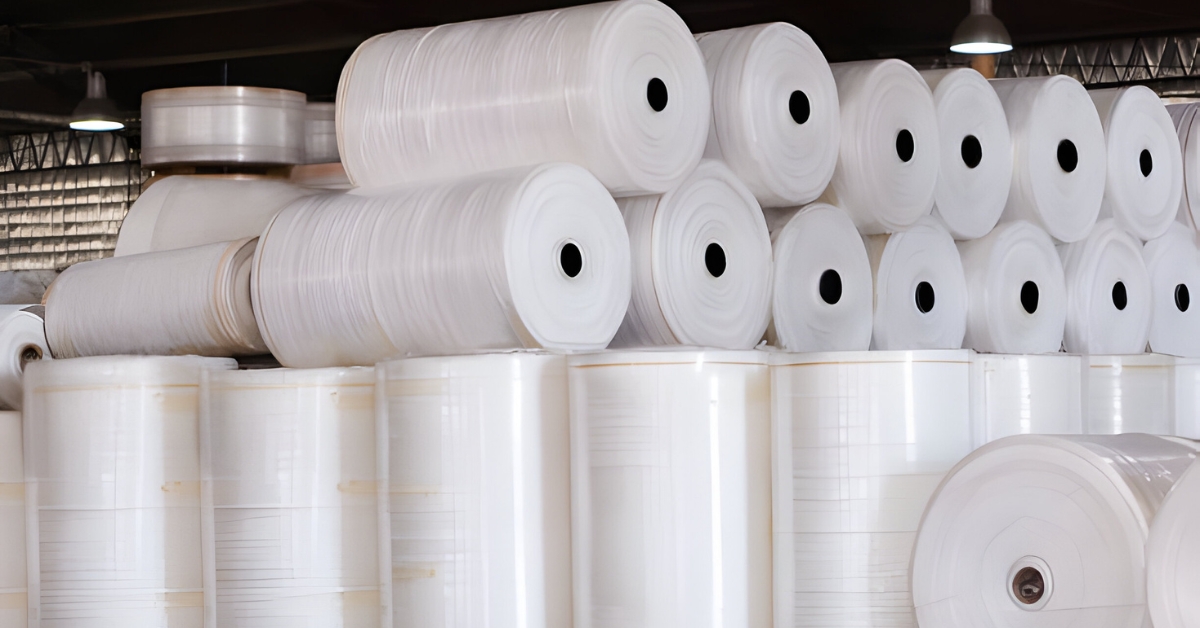
Polypropylene fabric is a synthetic textile manufactured from polypropylene polymer resin — one of the most widely produced and studied thermoplastics in the world. Its production process begins with the extrusion of polypropylene resin into flat tapes or filaments, which are then woven on industrial looms into a structured grid pattern.
The result is woven polypropylene fabric — a material that combines structural rigidity with lightweight flexibility, making it uniquely suitable for a wide range of demanding industrial applications.
Depending on end-use requirements, woven polypropylene fabric can be:
- Laminated (single-side or double-side) to add moisture barrier properties
- Coated with BOPP for enhanced print quality and surface aesthetics
- Integrated with inner liners (polyethylene or aluminum foil) for food-grade or chemical containment
- Treated with UV inhibitors for outdoor application performance
- Manufactured to specific GSM values (typically 60 GSM to 180 GSM) based on load requirements
- Anti-static treated for safe handling of flammable powders and electronic components
This manufacturing versatility is a foundational reason why polypropylene fabric has become the material of choice across industries with radically different application requirements.
Core Performance Properties That Drive B2B Adoption
The technical properties of woven polypropylene fabric directly address the performance gaps left by conventional industrial materials. Key properties that procurement teams consistently cite as decisive include:
- High Tensile Strength: Woven polypropylene fabric maintains structural integrity under significant mechanical stress. This makes it suitable for FIBC bulk bags carrying loads from 500 kg to 2,000 kg, geotextile applications in civil construction, and heavy-duty transit packaging in logistics operations.
- Chemical Resistance: Polypropylene is inherently resistant to acids, alkalis, and most industrial solvents. This chemical inertness makes polypropylene fabric safe for packaging chemical powders, resins, pigments, and granules without risk of material interaction or contamination.
- Moisture Resistance: Unlike natural fibers, polypropylene does not absorb water. This prevents product contamination, material degradation, and weight gain during storage and transit — critical for commodities like food grains, cement, and fertilizers.
- UV Stabilization: With UV inhibitor additives integrated during manufacturing, polypropylene fabric performs reliably in outdoor and semi-outdoor industrial environments — a requirement for agriculture, construction, and mining applications.
- Lightweight Construction: Despite its high strength, polypropylene fabric is significantly lighter than jute or canvas alternatives, reducing freight costs and improving handling efficiency across the supply chain.
- Recyclability: Polypropylene is a fully recyclable polymer (resin code #5). This aligns with corporate ESG commitments, extended producer responsibility regulations, and sustainability reporting requirements — making polypropylene fabric a defensible choice in procurement decisions subject to environmental scrutiny.
6 Reasons Smart Procurement Teams Are Making the Switch
Consistent Quality Across High-Volume Orders
Batch-to-batch material inconsistency is one of the most costly and underreported problems in industrial procurement. With jute and natural fiber alternatives, variations in agricultural raw material quality directly affect end-product tensile strength, dimensional accuracy, and packaging performance.
Polypropylene fabric, manufactured from a controlled synthetic polymer under ISO 9001-certified production processes, delivers measurable consistency in GSM, tensile strength, and dimensional tolerance across large production runs. For procurement teams managing high-volume, repeat orders — often running to millions of meters annually — this consistency translates directly into reduced rejection rates, lower quality control overhead, and more predictable production scheduling for downstream operations.
Superior Load Performance for Bulk Applications
For industries handling bulk commodities — grains, fertilizers, chemicals, minerals, cement — packaging performance under load is a non-negotiable procurement criterion. Woven polypropylene fabric engineered for FIBC applications consistently meets safe working load requirements from 500 kg to 2,000 kg, with safety factor ratios of 5:1 and 6:1 commonly certified and documented.
No comparable natural or alternative synthetic fabric delivers this load performance at an equivalent cost point. This decisive performance advantage is why procurement managers in agriculture, construction, and mining sectors are specifying woven polypropylene fabric as their primary bulk packaging material.
Multi-Sector Regulatory and Certification Compliance
Modern industrial procurement is no longer exclusively about price and lead time. Regulatory compliance has become a primary supplier qualification criterion across sectors. The ability to source a material that satisfies multiple compliance frameworks from a single supplier is a significant procurement efficiency gain.
Polypropylene fabric manufactured under rigorous quality management systems can simultaneously meet food-contact approvals (FDA, FSSAI), UN certifications for hazardous goods packaging, BIS standards for the Indian domestic market, and ISO quality system requirements. For procurement teams operating across regulated sectors — food processing, pharmaceuticals, chemicals, mining — this multi-framework compliance capability dramatically reduces supplier management complexity and regulatory audit exposure.
Extensive Lamination and Customization Flexibility
Unlike rigid packaging alternatives or single-specification natural fabrics, polypropylene fabric offers extensive downstream customization capability. Lamination variants, inner liner integration, multi-color surface printing, anti-static treatment, UV coating, and closure type specifications can all be engineered at the manufacturing stage.
A single, well-qualified polypropylene fabric supplier can serve multiple internal business units. Each unit may have different material specifications — yet all are covered under one consolidated supplier relationship. Procurement teams looking to reduce supplier count without losing material diversity will find this multi-application capability a clear strategic advantage.
5. Total Cost of Ownership Advantage
Evaluated on unit price alone, polypropylene fabric is competitive with most industrial alternatives. Evaluated on total cost of ownership — the metric that genuinely matters for strategic procurement — it consistently outperforms them.
The TCO calculation for polypropylene fabric covers several key factors. It offers a longer service life than jute or canvas. Rejection and wastage rates are lower due to consistent manufacturing quality. Lightweight construction reduces freight costs significantly. Moisture and chemical resistance minimizes spoilage-related losses. End-of-life recyclability also reduces disposal costs and supports ESG compliance.
Procurement teams often manage budgets in the crore or multi-million dollar range. For them, even a 5% TCO improvement creates significant material savings. These savings directly impact overall business profitability.
Supply Chain Scalability and Sourcing Reliability
A material is only as valuable as its supply chain reliability. Polypropylene, as one of the world’s most widely produced synthetic polymers, benefits from a deep, geographically diversified global supply chain. Unlike agricultural commodities such as jute or cotton — which are subject to seasonal variability, crop failures, and price volatility — polypropylene resin supply is relatively stable and scalable.
For procurement teams managing just-in-time production schedules or handling demand surges driven by seasonal cycles, this supply chain resilience is a critical risk management advantage.
Industries Leading the Adoption of Polypropylene Fabric
The switch to polypropylene fabric is already well underway across multiple sectors. Agriculture relies on PP woven bags for grain, seed, and fertilizer storage. Construction specifies geotextile-grade PP woven fabric for soil stabilization and FIBC bags for site material handling. Chemical manufacturers depend on laminated PP woven bags for compliant bulk chemical packaging. Food processors use food-grade PP woven bags with inner liners for safe commodity packaging. Logistics operators deploy PP woven pallet covers and transit bags across distribution networks. Mining operations specify heavy-duty FIBC jumbo bags for mineral and ore transport. Retail brands are adopting custom-printed PP woven bags as sustainable, reusable consumer packaging.
What Procurement Teams Should Evaluate When Sourcing Polypropylene Fabric
Transitioning to polypropylene fabric requires a structured supplier evaluation process. Key criteria include:
- Manufacturing certifications: ISO 9001, BIS license, food-grade approvals, UN certification for hazardous goods packaging. Certifications should be current, verifiable, and specific to the product category being sourced.
- GSM range and denier capability: Confirm the manufacturer can produce the specific fabric weight and tape denier your application requires. Request sample testing before committing to volume orders.
- Lamination and finishing options: Evaluate whether the supplier offers value-added processing — lamination, printing, liner integration — in-house or relies on third-party processors. In-house capability reduces lead times and quality control risk.
- MOQ and lead time flexibility: Essential for businesses with seasonal demand cycles, project-based procurement, or rapid scale-up requirements. Understand minimum order commitments and production scheduling lead times before supplier onboarding.
- Quality testing documentation: Request tensile strength test reports, UV resistance data, moisture barrier performance data, and batch consistency records. A qualified manufacturer will have this documentation readily available.
- Sustainability credentials: Verify recyclability claims, confirm virgin-grade resin sourcing for food and pharmaceutical applications, and assess the supplier’s environmental management practices for ESG reporting purposes.
- Direct manufacturer vs. trading intermediary: Engaging directly with a polypropylene fabric roll manufacturer — rather than a distributor or trading house — gives procurement teams direct access to production scheduling, custom specification development, faster issue resolution, and more competitive pricing structures.
Final Words
The transition to polypropylene fabric in heavy-duty industrial applications is not simply a material preference shift. It is a strategic procurement evolution driven by measurable performance advantages, regulatory.
Smart procurement teams are recognizing that woven polypropylene fabric represents more than a packaging input. It is a sourcing decision with direct implications for product safety, operational efficiency, regulatory standing, and long-term cost competitiveness.
For businesses ready to make this transition with confidence, the critical first step is identifying experienced polypropylene fabric manufacturer.
Ready to evaluate polypropylene fabric for your procurement strategy? Connect with our technical sourcing team today to discuss specifications, certifications, sampling, and volume pricing tailored to your industry requirements.