Quick Summary: Healthcare teams handle rising screening demand, heavier diagnostic workloads, and constant pressure on staff capacity. A Healthcare Robot helps you manage repetitive clinical and operational tasks with greater consistency, faster reporting, and less pressure on doctors, nurses, and technicians. Healthcare systems use robotic solutions to support surgery, diagnostics, logistics, rehabilitation, and preventive screening at scale.
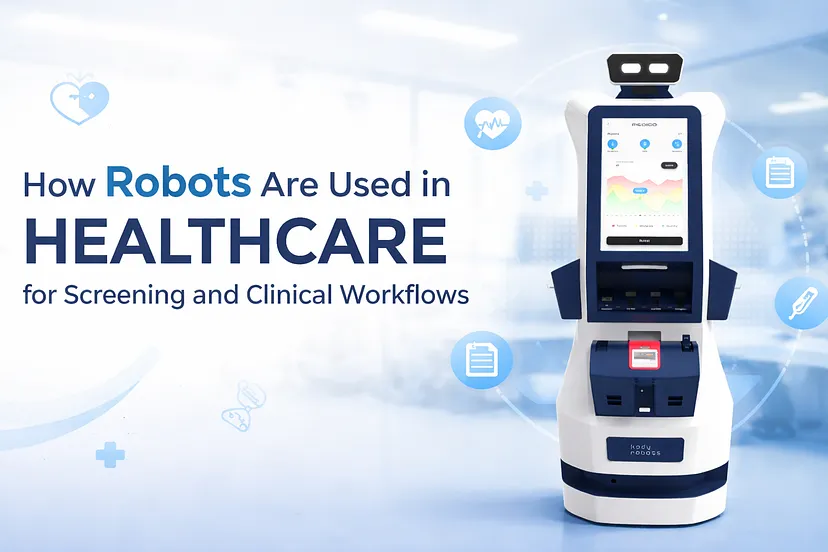
Early detection gaps create real operational risk in healthcare. Patients often arrive after hypertension, diabetes, respiratory issues, or cardiac concerns have already progressed. Hospital teams know routine screening can catch risks sooner, yet manual workflows limit how many people a facility can screen in a day. A Health Screening Robot such as Medigo by Kody Robots helps solve that gap through guided screening, multi-parameter assessments, and rapid digital reporting.
Healthcare leaders ask a practical question before adoption. Where do robots create the fastest operational value inside a hospital, diagnostic center, or preventive health program?

What Are Robots Used for in Healthcare
A Healthcare Robot combines automation, sensors, software, and guided workflows to support medical screening, diagnostics, treatment assistance, rehabilitation, and hospital operations. Healthcare providers use robotic systems to improve precision, reduce manual repetition, standardize clinical processes, and expand patient handling capacity without placing extra strain on care teams.
Hospitals usually begin evaluating robotic systems when demand rises faster than staff bandwidth. Repetitive diagnostics, routine transport tasks, and preventive screening programs often expose the first operational bottlenecks. Robotic support makes the biggest difference where consistency, speed, and structured data capture matter every day.
Where Are Robots Used Across Modern Healthcare Workflows
Healthcare providers do not adopt robotics for novelty. Hospital leaders adopt robotics to solve a specific workflow problem, improve throughput, and reduce variability in care delivery. Several medical environments already show strong use cases.
Robotic Assisted Surgery
A Healthcare Robot used in surgery gives surgeons greater control during delicate procedures that require precision and stability. Robotic surgical systems support smaller incisions, more controlled instrument movement, and clearer visualization during complex operations.
Key value in surgery includes:
- Higher instrument precision during delicate procedures
- Better control in minimally invasive operations
- Reduced trauma to surrounding tissue
- Lower blood loss in many procedures
- Faster recovery in many post-surgical cases
Diagnostic and Laboratory Automation
A Healthcare Robot in diagnostics helps laboratories process large sample volumes with consistency. Automated systems reduce repetitive manual work, support standardized testing protocols, and improve diagnostic turnaround for both clinicians and patients.
Hospitals use diagnostic robotics to:
- Process samples with fewer manual handling errors
- Maintain consistency across high-volume testing
- Reduce delays in reporting
- Support structured data capture for clinical review
- Improve laboratory productivity without adding parallel staffing pressure
Hospital Service and Internal Logistics
A Healthcare Robot also supports hospital logistics. Service robots move medication, samples, consumables, and equipment between departments, which allows medical teams to spend more time on patient-facing work.
Common logistics use cases include:
- Medication delivery between pharmacy and wards
- Sample transport between collection points and labs
- Equipment movement across departments
- Internal delivery support in large facilities
- Reduction in repetitive transport burden on staff
Rehabilitation and Recovery Support
A Healthcare Robot can guide rehabilitation exercises with consistent movement patterns and measurable progress tracking. Physiotherapists use robotic support in recovery programs where repetition, monitoring, and controlled motion are important.
Rehabilitation teams benefit through:
- More consistent therapy sessions
- Measurable progress data
- Safer guided movement during recovery
- Better therapy intensity control
- Support for longer rehabilitation programs
Preventive Screening and Digital Reporting
A Healthcare Robot delivers strong value in preventive screening because preventive programs require speed, repeatability, and structured documentation. Hospitals, corporate health programs, and public screening initiatives need systems that can handle multiple assessments in one session and produce organized reports quickly.
Medigo fits well inside that category. Medigo supports multi-parameter health screening through guided workflows, connected devices, and rapid report generation. A single system can help healthcare teams conduct blood pressure checks, vitals monitoring, ECG, respiratory screening, and related assessments inside one structured process.
Preventive screening systems help you:
- Increase screening capacity across high-footfall environments
- Standardize how every screening session is conducted
- Capture data in a searchable digital format
- Detect health risks earlier
- Build a stronger preventive healthcare infrastructure
Healthcare robotics creates the strongest value where patient volume is high and process consistency matters. Surgical suites, diagnostic labs, hospital corridors, rehabilitation units, and preventive screening stations all show different versions of the same need. Healthcare providers want reliable execution without unnecessary operational friction.
What Benefits Do Robots Bring to Hospitals and Care Teams
For hospital administrators and clinical leaders, a Healthcare Robot creates value in three clear areas: accuracy, efficiency, and scalability. Hospitals do not gain value from robotics simply because automation looks advanced. Hospitals gain value because robotics removes repetitive pressure from daily workflows and allows teams to work with more structure.
Higher Clinical Consistency
Robotic systems follow guided workflows. Guided workflows matter in healthcare because diagnostic consistency directly affects decision quality. Standardized processes reduce avoidable variation during screening, reporting, and operational support.
Better Use of Staff Time
Doctors, nurses, technicians, and support teams already carry heavy workloads. Robotic systems handle repetitive screening steps, transport tasks, and structured assessments, which allows staff to focus on judgment-heavy and patient-facing work.
Faster Preventive Screening
Preventive programs often fail because screening volumes exceed available capacity. Robotic support helps hospitals and healthcare programs screen more people in less time while maintaining digital records and standardized outputs.
Stronger Data Capture
Digital reporting supports continuity of care. Structured records help clinicians review screening history, compare results, and make faster follow-up decisions. Strong data capture also helps program managers monitor larger population health initiatives.
What Challenges Should Healthcare Leaders Evaluate Before Adoption
A Healthcare Robot still requires practical evaluation before implementation. Hospital leaders need to assess operational fit, regulatory obligations, infrastructure requirements, and user adoption before selecting any system.
Infrastructure and Cost Planning
Robotic systems require hardware, software, maintenance planning, and staff orientation. Leadership teams should evaluate total operational cost, not only purchase price.
System Integration
Hospitals already run through EHR platforms, lab systems, reporting systems, and internal workflows. Robotic systems should fit inside existing operations rather than create disconnected data silos.
Compliance and Clinical Governance
Medical environments require careful attention to safety, data privacy, and device compliance. Adoption decisions should include governance, documentation, and standard operating procedures from the start.
Operator Simplicity
A good robotic system should be easy to use across shifts, departments, and facilities. Guided workflows matter because user complexity slows adoption and increases inconsistency.
Healthcare providers usually see better results when evaluation starts with workflow fit rather than hardware features alone.
What Will the Future of Robotics in Healthcare Look Like
Healthcare robotics is moving toward connected, repeatable, data-driven care. Screening, reporting, and follow-up need to function as one operational chain rather than separate activities. Healthcare systems want faster action after data capture, not isolated reports that sit unused.
Future growth will likely center on:
- Connected screening and reporting systems
- Faster clinical decision support from structured data
- Multi-location deployment across distributed facilities
- Better preventive health continuity across repeat visits
- Greater expansion beyond hospital walls into corporate and community programs
Many healthcare providers are already evaluating robotic screening infrastructure for distributed environments. That market direction creates a strong opportunity for companies such as Kody Robots, which focus on practical healthcare deployment instead of abstract technology claims.
How Should You Implement Robotics in Your Facility
Selecting the right Healthcare Robot starts with a clear use case. A hospital may need faster preventive screening. A diagnostic center may need higher test throughput. A large facility may need logistics support. The best implementation path begins with the bottleneck that creates the most daily friction.
A structured rollout usually follows five steps:
- Define the exact workflow problem.
- Match the system to existing hospital operations.
- Plan data capture and reporting integration.
- Train operators on guided workflows.
- Start with one deployment area, then expand gradually.
Hospitals that follow a staged rollout usually move faster from pilot to operational value because teams can validate fit, refine process details, and reduce adoption resistance early.
Why Medigo Fits High-Volume Preventive Screening
Medigo, a Healthcare Robot for Hospitals built by Kody Robots, shows how a Healthcare Robot can solve a real healthcare operations problem. Screening demand grows quickly across hospitals, diagnostic centers, corporate health programs, and public health environments. Staff capacity, time, and infrastructure often do not grow at the same pace.
Medigo addresses that gap with a structured screening workflow built for preventive care. The system supports multi-parameter health assessments, guided interactions, connected diagnostic modules, and rapid digital reports. Medigo helps healthcare teams conduct large-scale screening with more consistency and less manual process variation.
Medigo stands out because it supports:
- Multi-parameter screening in one guided workflow
- Rapid digital report generation
- Connected device integration
- Consistent screening steps across operators
- Scalable deployment across high-footfall healthcare environments
Healthcare providers that need stronger preventive health infrastructure often look for a solution that can standardize screening while keeping operations practical. Medigo fits that need well.
Conclusion
Hospitals use robots in healthcare where precision, speed, repeatability, and workflow consistency matter most. Surgical support, diagnostics, logistics, rehabilitation, and preventive screening all show clear operational value when robotic systems are matched to the right use case.
A Healthcare Robot helps you expand capacity, reduce repetitive staff burden, and strengthen the quality of structured care delivery. Healthcare providers that act early can build better preventive infrastructure, improve digital continuity, and create smoother clinical workflows across locations.

A Healthcare Robot only creates lasting value when adoption is tied to a real operational need. Healthcare providers that identify bottlenecks clearly, choose systems carefully, and implement guided workflows properly are far more likely to see measurable returns.