The Chief Financial Officer (CFO) role has changed a lot over the last decade, like honestly way more than people expected. For many years, CFOs were mostly seen as financial gatekeepers, reporting, budgeting, and compliance stuff, but lately modern CFOs are becoming more like strategic partners. They’re expected to help shape business growth, drive innovation, build resilience, and really push digital transformation too.
Right now, in today’s fast moving business world, organisations have to deal with all kinds of pressure. There’s economic uncertainty, big technological disruption, cybersecurity risks, talent shortages, and customers who now expect faster, different experiences. On top of that, there is also stronger pressure around sustainability and ESG reporting. Because of all these things, CFOs can’t just stay in the past with historical financial analysis. Instead, they need to step into future-minded decisions, planning ahead, and joining the conversation early, not late.
Platforms like Microsoft Dynamics 365 Finance are helping modern CFOs adapt to these changing demands through AI-powered insights, real-time financial visibility, intelligent automation, and advanced planning capabilities. This article explores nine emerging trends shaping the future of finance leadership and how futurist CFOs can prepare their businesses for sustained success.
Who this is for?
CFOs and other finance leaders seeking to understand key trends that will affect their departments and businesses over the next few years.
Trend 1: CFOs Are Taking Greater Responsibility for Managing Complex Risks
Risk management has turned into one of those most critical jobs modern CFOs carry around every day. In practice, Organisations are dealing with several interconnected threats at once, not just one clean issue, and that includes economic uncertainty, geopolitical instability, cybersecurity threats, and climate change plus supply chain disruptions, regulatory changes, ESG and compliance pressures too.
Because of that, finance leaders are more and more expected to judge how every single risk trickles into profitability, operations, reputation, and even the long term staying power of the business.
So the modern CFO is basically pushed to:
- Build broader enterprise-wide risk visibility
- Improve ESG reporting frameworks, even when data is messy
- Strengthen compliance capabilities in a practical way
- Evaluate thefinancial impactof sustainability initiatives
- Develop resilience-focused financial strategies, ahead of time
Overall, the finance function is shifting, from reactive reporting towards proactive risk intelligence, like it’s a living system rather than a quarterly exercise.
Trend 2. Businesses Need Real-Time, Decision-Ready Financial Data
Traditional quarterly reporting is no longer enough for these fast-moving business environments, and honestly it feels kind of out of date. In many organisations, departments are now expecting, or at least pushing for :
- Real-time financial visibility
- Faster forecasting
- Actionable business insights
- Self-service analytics
- Instant access to operational KPIs
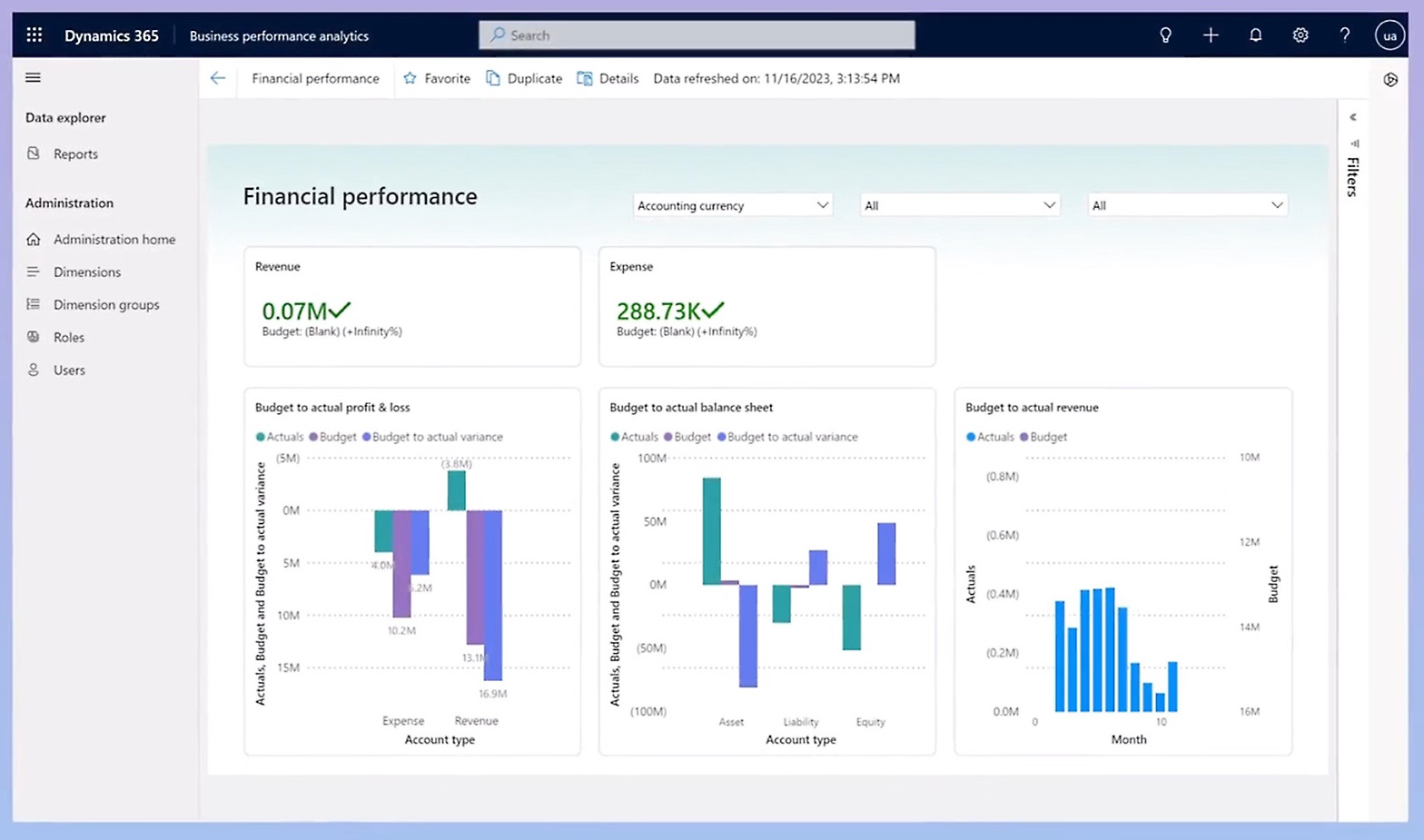
Microsoft Dynamics 365 Finance helps organizations unify financial and operational data in real time, enabling CFOs to make faster, more informed decisions using AI-driven analytics and reporting dashboards.
Modern CFOs really have to help finance teams provide decision-ready data instead of just, static historical reports that sit there.
In the end the future finance department becomes a central hub for enterprise intelligence, and it will probably look different than what people were used to before.
Also Read: Best SaaS Tools for Team Collaboration 2026
Trend 3. Advanced Planning and Forecasting Are Becoming Essential
Business conditions are changing faster than ever, like, honestly quicker than the usual rhythm. Traditional annual planning cycles, and those spreadsheet heavy forecasting method, they just do not move fast enough for modern enterprises. These days organizations really end up needing things like continuous forecasting, scenario planning , and agile budgeting.
But as uncertainty keeps rising, CFOs are usually the ones pushing the change toward cloud-based planning platforms. With modern planning technologies, companies can generally: model multiple business scenarios, analyze changing market conditions, forecast supply chain disruptions, optimize capital allocation, and improve strategic agility. The idea is that scenario based planning gives firms a way to respond in advance, instead of waiting around and reacting after the fact.
So, for futurist CFOs, planning isn’t only some finance thing anymore. It becomes a strategic business capability, even if people sometimes still act like it’s just budgets and reports.
Trend 4. Learning and Upskilling Have Become Strategic Priorities
Talent shortages and digital transformation are kind of forcing businesses to rethink their entire workforce development plan. Instead of just leaning on external hiring, businesses are now, more often than not investing in things like employee reskilling, and also leadership development, plus building up digital capabilities, not to mention data literacy. And yes, there’s also AI and analytics training, that’s becoming pretty normal.
Forward-thinking CFOs seem to realize that putting money into people isn’t only a feel good move it actually boosts business resilience, and drives innovation.
Finance leaders are also helping organizations in multiple ways such as allocate budgets for learning initiatives, measure workforce productivity, assess long term ROI from training programs and support organizational transformation.
In the end, companies that keep investing in workforce abilities tend to be better positioned when market disruption shows up and when future growth opportunities start appearing.
Trend 5. CFOs Are Influencing Hybrid and Remote Work Strategies
Hybrid work kind of basically changed the whole way organizations operate, for real. In practice finance leaders are now taking on a bigger part in deciding about a few things, like office space optimization, remote work productivity and the workforce cost structures and also investments in collaboration tech and even employee experience strategies.
A lot of organizations are shrinking the physical office footprint, while at the same time they are putting more money into digital collaboration, plus remote infrastructure. It’s not just one lever, it’s kind of everything together.
CFOs are also expected to look at the financial consequences of hybrid work policies, along with travel reductions, flexible workforce models, global talent acquisition, and employee retention strategies. So they’re not only tracking costs, they’re also trying to understand the longer term effects, on people and performance.
So, the future workplace is basically about balancing cost efficiency, employee satisfaction, and day to day operational performance.
Trend 6. AI and Automation Are Transforming Finance Operations
Automation is reshaping the finance function, pretty fast now. A lot of the old, manual work like invoice processing, data entry, reconciliation, expense management, and financial reporting is getting automated more and more.
Built-in AI, automation, and workflow intelligence in Microsoft Dynamics 365 Finance help finance departments reduce manual processes and focus more on strategic decision-making.
So instead of modern CFOs just chasing lower costs, they’re using automation so finance teams can move toward higher value, more strategic activities. And honestly an AI powered finance setup can:
– Boost operational efficiency
– Speed up the reporting cycles
– Improve forecasting accuracy
– Flag anomalies and risks sooner
– Support predictive analytics
In the long run, the finance team of the future will spend less time processing transactions , and more time steering strategic business decisions, with better insight.
Trend 7. Strategic Transactions and Partnerships Are Increasing
Organisations are getting into things like mergers and acquisitions (M&A), joint ventures , strategic partnerships, and yes technology investments to push innovation faster and support digital transformation.
Now the Modern CFOs are basically right in the middle of judging these opportunities by looking at financial viability, integration risks, how much long term value creation could actually happen and whether operational scalability makes sense, plus technology alignment too.
As finance industry keep changing, these strategic transactions start feeling almost essential , especially for staying competitive and reaching new markets quickly without waiting around.
So, finance leaders have to keep the growth ambitions, but also stay strict about financial discipline and risk management, all at the same time.
Also Read: Why Home Service Leaders are Switching to AI Phone Systems in 2026
Trend 8. Data Culture and AI Adoption Will Determine Competitive Advantage
Even if most organisations are throwing serious money at data and AI initiatives, only a few seem to turn it into truly transformational outcomes. A lot of the time the problem is not the tools, it is more like the culture in the rooms, and the capability to use what you already have, kind of end to end. In practice, some companies are getting it right because they’re actively building a data-driven mindset, plus enterprise-wide analytics capabilities. They also focus on AI readiness and they encourage cross-functional teamwork, not just siloed efforts with PowerPoints. Then there’s the digital decision-making framework side, where people actually learn how to choose better and faster, with evidence.
So, when organisations manage to blend together data governance, AI technologies, skilled talent, and consistent executive alignment, they usually start seeing big gains. Operational efficiency improves, customer experience gets sharper, and innovation moves quicker.
How Dynamics 365 Finance Supports Emerging CFO Trends?
| CFO Trend | How Dynamics 365 Finance Supports It |
| Risk Management | Compliance, audit trails, financial visibility, ESG reporting support |
| Real-Time Data | Real-time dashboards, analytics, connected reporting |
| Planning & Forecasting | Budgeting, forecasting, scenario planning |
| Learning & Upskilling | User-friendly workflows and AI-assisted processes |
| Hybrid Work | Cloud accessibility and remote finance operations |
| AI & Automation | AI insights, automation, workflow optimization |
| Strategic Transactions | Financial modeling, consolidation, reporting |
| Data Culture & AI | Unified data platform, embedded analytics, AI-driven insights |
Key Takeaways for Modern CFOs
- CFOs are becoming strategic business leaders
- Real-time financial visibility is now essential
- AI and automation are reshaping finance operations
- Scenario planning and forecasting are critical
- Data-driven culture creates competitive advantage
- Cloud finance platforms enable agility and resilience
Also Read: Agentforce Production Failures: A Guide To Fix It All
Conclusion
Today’s finance leaders don’t just handle traditional financial management, they sort of act as strategic advisors that push transformation, innovation, growth, and resilience, all at the same time.
Modern CFOs have to mix solid financial knowledge with an understanding of technology, lead in a data-driven way, manage risk, and think strategically so organisations can keep succeeding in a world that’s more digital and well, unpredictable.
Solutions such as Microsoft Dynamics 365 Finance are enabling finance leaders to modernize operations, automate processes, and transform finance into a strategic growth function.
Firms that back their CFOs with cloud technology, AI, connected data systems, and collaborative planning tools will probably be better set up to sharpen decision-making, speed up growth, and create a long-term edge in the market.
Honestly, the future seems to belong to CFOs who can change finance from a reporting function into a strategic growth engine.
Get started with Dynamics 365 Finance, Empower your digital transformation by applying intelligence and connecting your data.
Lean on the next generation of business applications with trusted Microsoft cloud for financial services.
Connect us!
Name: Dynamics Square Australia
Location: Sydney, NSW, Australia
Phone: +61 2 8607 5117
E-mail: info@dynamicssquare.com