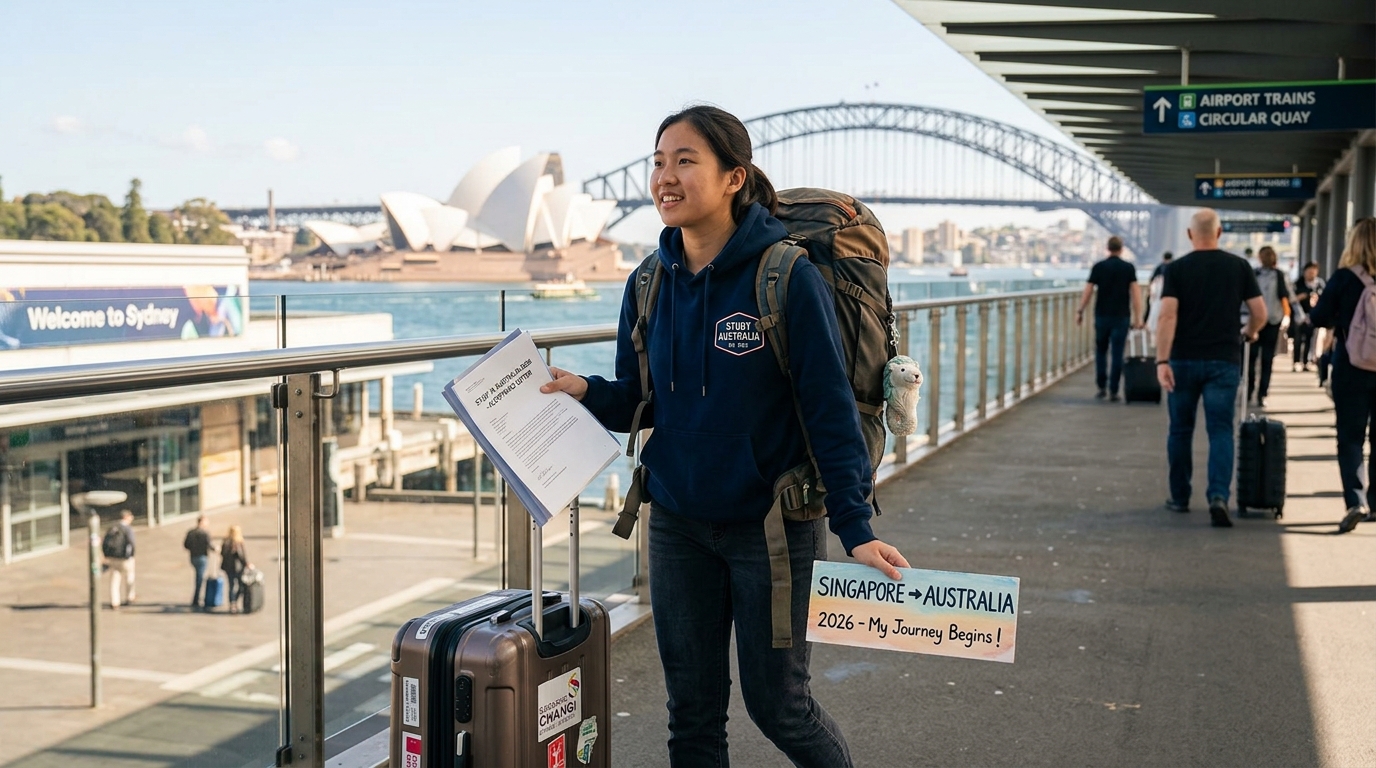
So you’ve decided to study in Australia from Singapore. Excellent choice.
But before you start browsing university websites and imagining life in Melbourne or Sydney, there are some essential things every Singapore student — and their parents — needs to understand first.
This isn’t a list of generic overseas study tips. This is specifically built for the Singapore context — your qualifications, your budget, your timeline, and the common pitfalls that catch even well-prepared students off guard.
Read this carefully. It could save you months of confusion and thousands of dollars.
1. Your Singapore Qualification Matters More Than You Think
The first thing to understand is exactly how your local qualification translates into Australian university entry.
This isn’t always straightforward — and getting it wrong means applying to the wrong universities or missing entry requirements entirely.
Here’s the quick breakdown:
| Singapore Qualification | Australian Entry Pathway |
| A-Levels (BBC and above) | Direct undergraduate entry at most universities |
| Polytechnic Diploma (GPA 3.0+) | Direct entry, often with advanced standing into Year 2 |
| IB Diploma (28+ points) | Direct undergraduate entry |
| O-Levels only | Foundation year required before undergraduate entry |
The biggest opportunity most students miss: Polytechnic diploma holders can often enter directly into Year 2 of an Australian degree. That’s one full year of tuition fees saved — sometimes SGD $15,000–$20,000.
Always confirm your credit transfer and advanced standing eligibility before finalising your university choice.
2. Not All Australian Universities Are the Same
When Singapore students think of Australian universities, most immediately think of the Group of Eight — Melbourne, Sydney, ANU, UNSW, and so on.
But Australia has 43 universities, and the right choice depends on your course, career goals, budget, and preferred lifestyle — not just prestige.
Group of Eight (Go8): Best for research-intensive fields, strong global recognition, competitive admission
Technology Network Universities (RMIT, UTS, Curtin): Excellent for engineering, IT, design, and business — strong industry connections
Regional Universities (Griffith, Deakin, JCU): Higher acceptance rates, more generous scholarships, strong programmes in niche fields
Choosing a university based purely on ranking is one of the most common and costly mistakes Singapore students make.
3. The Cost Reality — Budget Beyond Tuition
Many families focus on tuition fees and underestimate the total cost of studying abroad. Here’s a more complete picture:
| Expense Category | Estimated Annual Cost (SGD) |
| Tuition Fees | SGD $28,000 – $45,000 |
| Accommodation | SGD $10,000 – $18,000 |
| Food and Groceries | SGD $5,000 – $8,000 |
| Transport | SGD $1,500 – $2,500 |
| Health Cover (OSHC) | SGD $500 – $800 |
| Personal and Miscellaneous | SGD $3,000 – $5,000 |
| Estimated Total | SGD $48,000 – $79,000 |
City choice has a significant impact on these numbers. Adelaide and Perth are noticeably more affordable than Sydney or Melbourne — while still offering strong university options.
4. Scholarships Exist — But You Have to Look for Them
One of the most consistent findings among Singapore students who have successfully managed the cost of an Australian degree is this: they applied for scholarships early and strategically.
Most students don’t realise how many options are available:
- University merit scholarships — Available at almost every Australian university for high-achieving international students
- Faculty-specific awards — Less publicised, less competition, often generous
- Australia Awards — Prestigious government scholarships for postgraduate study
- External scholarships — From Singapore-based foundations and professional associations
The critical point: many scholarship deadlines fall 3–6 months before the general application deadline. If you wait until you’ve received your offer to think about scholarships, you’ve already missed most of them.
5. The Personal Statement Is Not an Afterthought
Australian universities — particularly for competitive programmes — review personal statements carefully. And Singapore students are, frankly, often underprepared for this part of the process.
The local education system trains students to excel in examinations. It doesn’t typically train them to write compelling, reflective narratives about who they are and why they’ve made the choices they have.
A strong personal statement:
- Tells a specific, authentic story
- Explains why this course and why this university
- Demonstrates genuine understanding of your chosen field
- Highlights experiences — not just achievements
Give yourself at least 6–8 weeks to draft, revise, and refine your personal statement. Don’t write it in a weekend.
6. Understanding the Student Visa Process
The Australian Student Visa (Subclass 500) is required for all international students studying a course longer than three months.
Here’s what you need to know:
Key requirements:
- Valid Confirmation of Enrolment (COE) from your university
- Proof of financial capacity to cover tuition and living costs
- Overseas Student Health Cover (OSHC) — mandatory, not optional
- Genuine Temporary Entrant (GTE) statement
Processing time: Typically 4–8 weeks, though it can be longer during peak periods. Apply as soon as you receive your COE — don’t wait.
Work rights on a student visa: Up to 48 hours per fortnight during semester, unlimited hours during official university breaks.
One important note: your visa is tied to your enrolment. If you change universities or courses, your visa implications need to be reviewed.
7. English Proficiency — What Singapore Students Need to Know
Here’s a common source of confusion: do Singapore students need to sit IELTS or TOEFL for Australian university admission?
The short answer: usually not.
Most Australian universities waive the English proficiency requirement for Singapore citizens who completed their education in English-medium schools — which covers the vast majority of Singapore students from MOE schools.
However:
- Always confirm the specific policy with each university you’re applying to
- Some programmes (particularly health and education) may have additional language requirements
- Private university pathways may have different policies
Don’t assume — verify. One email to the admissions office can save you the cost and stress of sitting an unnecessary language test.
8. Timing Your Application Correctly
Australian universities offer two main intakes:
| Intake | Start Month | Application Window |
| Semester 1 | February | July – November (previous year) |
| Semester 2 | July | February – May |
Most Singapore students target Semester 1, which aligns well with the post-A-level or post-polytechnic graduation timeline.
Important: Australian universities use rolling admissions for most programmes. This means applications are reviewed as they arrive — not all at once after a deadline. Earlier applications genuinely have an advantage, particularly for competitive programmes and limited scholarship pools.
9. Standardised Tests — When They Matter
For most undergraduate programmes at Australian universities, SAT or ACT scores are not required from Singapore students.
However, for students targeting highly competitive programmes — or aiming to strengthen a borderline application with a merit scholarship — a strong standardised test score can make a meaningful difference.
If you’re considering this route, preparing for the ACT Exam Preparation is worth discussing with your consultant early in your planning process.
10. Getting the Right Support
Navigating the Australian university application process alone is possible — but it’s harder than it needs to be, and the margin for error is significant.
The right admission consultant brings:
- Specific knowledge of how Singapore qualifications are assessed
- Insider understanding of what individual universities look for
- Personal statement coaching that makes a real difference
- Scholarship identification and application support
- A timeline that keeps you on track without last-minute stress
For students who want structured preparation support alongside admissions guidance, Test Prep Online at The Princeton Review Singapore offers expert-led programmes designed specifically for Singapore students balancing local school demands with overseas application goals.
The students who succeed in securing places at top Australian universities consistently share one common factor: they started early and got proper guidance.
Mini Case Study: Getting It Right From the Start
Student Profile: Wei Jian, 19, Ngee Ann Polytechnic, Diploma in Mechanical Engineering, GPA 3.7
Goal: Study in Australia from Singapore — specifically Bachelor of Engineering at UNSW or University of Melbourne
Challenge: Wei Jian wasn’t sure if his polytechnic results were strong enough for Go8 universities, and his family was concerned about costs.
What Happened:
- His consultant confirmed that both UNSW and Melbourne accept Singapore polytechnic graduates with strong GPAs directly
- UNSW offered advanced standing for three of Wei Jian’s polytechnic modules — reducing his degree from three years to two and a half
- His consultant identified the UNSW Engineering Excellence Scholarship, which Wei Jian applied for alongside his main application
- His personal statement focused on a specific design project he completed during his polytechnic internship — concrete, specific, and memorable
Outcome: Wei Jian received an offer from UNSW with partial advanced standing and was shortlisted for the Engineering Excellence Scholarship. Total saving from credit transfer alone: approximately SGD $18,000.
The right preparation changed everything.
Pre-Departure Checklist
Before you board that flight, make sure you’ve covered all of this:
Documents
- Passport valid for at least 6 months beyond your intended stay
- Student visa (Subclass 500) granted
- COE and offer letter printed and accessible
- OSHC policy documents saved and accessible
Financial
- Australian bank account opened (most major banks allow pre-arrival setup)
- Sufficient funds accessible for first month of living expenses
- Scholarship payment schedule confirmed
Accommodation
- On-campus or off-campus accommodation confirmed and paid
- Airport transfer or pickup arranged
University
- Orientation dates noted and registered
- Student ID and enrolment confirmed
- Course timetable reviewed
Personal
- Emergency contacts list prepared
- Singapore embassy/consulate contact in Australia saved
- Family communication plan established
Common Mistakes to Avoid
- Applying to only one or two universities. Always have a range — reach, match, and safety options.
- Ignoring the city’s cost of living. A SGD $5,000–$8,000 annual difference between Sydney and Adelaide is not trivial over three or four years.
- Leaving the visa application too late. Start the visa process the moment your COE arrives.
- Not reading the fine print on scholarships. Some scholarships have GPA maintenance requirements — know what you’re committing to.
- Assuming your results are enough. Strong grades open doors. A strong application — personal statement, references, and timing — is what gets you through them.
Frequently Asked Questions
Q: Can I apply to Australian universities while still completing my A-levels or polytechnic diploma? Yes — and you should. Most universities accept applications based on predicted or in-progress results, with offers conditional on final results meeting the stated requirements.
Q: What happens if my final results are lower than predicted? Contact the university immediately. Many universities will work with you on alternative pathways, deferred entry, or foundation programmes depending on how significant the difference is.
Q: Is on-campus accommodation guaranteed for international students? Not at all universities. Some guarantee it for first-year international students; others work on a first-come, first-served basis. Apply for accommodation as soon as you accept your offer.
Q: Can I switch universities after arriving in Australia? Technically yes, but it involves visa implications, potential loss of academic credit, and administrative complexity. Choose carefully before you go.
Q: How do I stay connected with my family in Singapore while studying in Australia? Most students use WhatsApp, FaceTime, and Zoom for regular contact. The time difference between Singapore and Australian east coast cities is only 2–3 hours, making regular communication easy.
Conclusion
Choosing to study in Australia from Singapore is a decision that can genuinely shape your future — academically, professionally, and personally.
But the students who get the most out of it are the ones who go in prepared. They understand their entry pathway, they’ve planned their finances realistically, they’ve applied for scholarships early, and they’ve invested in presenting themselves as strongly as possible.
Australia offers world-class education, a remarkable quality of life, genuine post-graduation career opportunities, and a transition that’s more manageable for Singapore students than almost any other overseas destination.
The pathway is clear. The opportunity is real. What matters now is whether you’re ready to approach it with the preparation it deserves.
Start early. Think strategically. Get the right support. And make your Australian university journey everything you’re working toward.