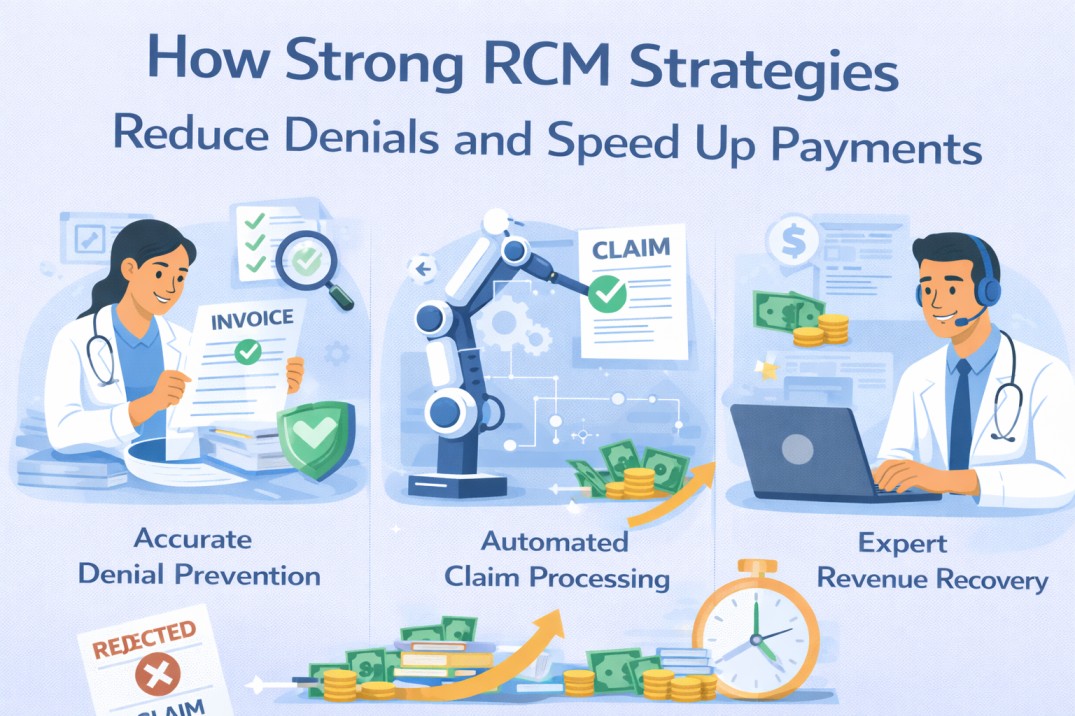
Healthcare organizations today face increasing pressure to maintain financial stability while navigating complex payer rules, rising patient responsibility, and tighter compliance requirements. Claim denials and delayed reimbursements are among the most common obstacles disrupting cash flow. Strong revenue cycle management strategies play a crucial role in minimizing these issues by creating consistency, accuracy, and accountability across the billing process.
Rather than focusing solely on fixing problems after they occur, effective RCM strategies emphasize prevention, efficiency, and continuous improvement throughout the entire revenue cycle.
Understanding the Connection Between RCM and Denials
Denials often reflect breakdowns in communication, documentation, or workflow at various points in the revenue cycle. Errors at registration, eligibility verification, coding, or authorization frequently surface later as denied claims. When these issues are not addressed at the root level, denials become recurring problems instead of isolated incidents.
A strong RCM framework connects every stage of the billing process, ensuring that information flows accurately from patient intake to final payment. This alignment significantly reduces the risk of avoidable denials.
Front-End Accuracy as the Foundation of Clean Claims
Reducing denials begins at the front end of the revenue cycle. Accurate patient registration, insurance verification, and benefit confirmation are essential to preventing downstream billing issues. Many denials occur simply because patient information or coverage details were incorrect at the time of service.
Well-designed RCM strategies include real-time eligibility checks, standardized intake workflows, and clear financial communication with patients. By addressing potential issues before care is delivered, practices improve clean claim rates and reduce billing rework.
Authorization and Eligibility Management
Authorization-related denials remain a significant source of revenue loss. Services rendered without proper authorization or outside approved guidelines are commonly denied by payers. Strong RCM processes include systematic authorization tracking and documentation verification.
By aligning scheduling, clinical services, and billing teams, practices ensure that required approvals are obtained and recorded correctly. This proactive approach prevents unnecessary delays and accelerates payment timelines.
Coding Precision and Documentation Alignment
Accurate medical coding is central to reducing denials and speeding up reimbursements. Even small discrepancies between documentation and billed codes can result in payer rejections. Strong RCM strategies emphasize coding accuracy supported by thorough documentation.
Regular audits, provider education, and collaboration between coders and clinicians help ensure that services billed are fully supported and compliant with payer requirements. This precision reduces the need for appeals and resubmissions.
Clean Claim Submission and Timely Filing
Submitting clean claims on the first attempt is one of the most effective ways to speed up payments. Clean claims are complete, accurate, and submitted within payer deadlines. Strong RCM strategies rely on claim validation tools, payer rule checks, and internal quality controls to identify errors before submission.
Timely filing discipline is equally important. Automated tracking and follow-up systems help ensure claims are submitted promptly and monitored through each stage of processing, reducing the risk of missed deadlines and payment delays.
Data-Driven Denial Prevention
Modern RCM strategies are increasingly data-driven. Analyzing denial patterns allows practices to identify recurring issues, payer-specific behaviors, and workflow inefficiencies. Rather than treating each denial individually, billing teams use data insights to implement corrective actions across the revenue cycle.
This analytical approach transforms denials into learning opportunities, leading to continuous process improvement and stronger long-term financial performance.
Faster Payments Through Proactive Follow-Up
Payment delays are rarely caused by a single issue. In most cases, they result from inconsistent or reactive follow-up processes that allow claims to sit unresolved for extended periods. When billing teams lack clear follow-up schedules or ownership, claims can remain in payer queues unnoticed, leading to aging accounts and unpredictable cash flow. Strong RCM strategies address this challenge by establishing disciplined follow-up routines that ensure every claim is tracked, reviewed, and acted upon within defined timeframes.
Proactive follow-up begins with visibility. Modern RCM workflows use systematic claim status monitoring to identify where each claim sits in the reimbursement process. Whether a claim is pending, under review, denied, or partially paid, proactive teams know its status and next required action. This prevents situations where claims are forgotten simply because no denial was issued or no immediate response was received from the payer.
Structured follow-up schedules are essential for maintaining momentum. Instead of waiting weeks for payer responses, effective RCM teams follow payer-specific timelines and initiate contact at regular intervals.
Accountability also plays a key role in proactive follow-up. When responsibility for follow-up is clearly assigned, unresolved claims are far less likely to be overlooked. Strong RCM strategies define ownership at each stage of the follow-up process, ensuring that staff members understand their role in moving claims forward. This structured accountability leads to faster issue resolution and improved payer responsiveness.
By maintaining consistent oversight of accounts receivable, practices gain greater control over reimbursement timelines. Claims move through the system more efficiently, aging balances are reduced, and cash flow becomes more predictable. Instead of reacting to delayed payments, practices can anticipate revenue with greater confidence, allowing for better financial planning and operational stability.
The Value of Expertise and Centralized Oversight
Managing the full revenue cycle is a complex responsibility that requires deep understanding of payer rules, regulatory requirements, and ever-changing reimbursement models. Each payer has its own billing guidelines, documentation standards, and payment timelines, and keeping up with these variations is a full-time effort. Practices that attempt to manage these demands without specialized expertise often struggle with inconsistencies, compliance risks, and preventable revenue loss.
Expertise is especially valuable when navigating complex payer interactions. Experienced RCM professionals understand how payers evaluate claims, what documentation supports reimbursement, and how to address payer-specific denial patterns. This knowledge allows billing teams to resolve issues more efficiently and avoid repeated mistakes that lead to denials or payment delays.
Partnering with a Revenue Cycle Management Company that uses Project management SAAS tools and provides access to this level of expertise without the burden of building and maintaining large in-house teams. These organizations bring established workflows, trained specialists, and performance benchmarks that support consistency across the revenue cycle. Ongoing monitoring ensures that issues are identified early and addressed before they escalate into larger financial problems.
Centralized oversight also improves adaptability. As payer policies, regulations, and reimbursement models change, experienced RCM teams adjust workflows accordingly. This proactive adaptability helps practices remain compliant and financially stable, even as the healthcare landscape evolves. Instead of struggling to keep pace with change, practices benefit from systems designed to respond quickly and effectively.
Financial Impact of Strong RCM Strategies
The financial impact of strong RCM strategies extends far beyond reducing claim denials. Fewer denials mean fewer resources spent on rework, appeals, and manual corrections, freeing staff to focus on higher-value activities.
Improved reimbursement speed directly affects a practice’s ability to manage expenses and invest in growth. Faster access to earned revenue supports timely payroll, technology upgrades, and staffing decisions. Predictable cash flow reduces reliance on credit or short-term financial fixes, creating a more stable operating environment.
Ultimately, the financial benefits of effective RCM strategies compound over time. Reduced denials, faster payments, and lower administrative burden create a revenue cycle that supports sustainable growth.
Conclusion
Claim denials and slow payments are not inevitable challenges in healthcare billing. They are often symptoms of weak or fragmented revenue cycle processes. By implementing strong RCM strategies that emphasize accuracy, coordination, and proactive management, healthcare organizations can significantly reduce denials and speed up payments.
Working with a trusted Revenue Cycle Management Company enables practices to transform billing from a reactive task into a strategic advantage. With the right systems and expertise in place, practices can protect revenue, improve efficiency, and focus more fully on delivering quality patient care.