Introduction: A Fashion Era Just Closed — Here Is What Opened
Quiet luxury had a remarkable run. For nearly three years, the fashion world operated under a shared set of unspoken rules: no visible logos, neutral palettes, investment fabrics, understated tailoring. It felt refined, intentional, and above the noise of trend cycles.
Then 2025 happened. And 2026 confirmed it: the era is over.
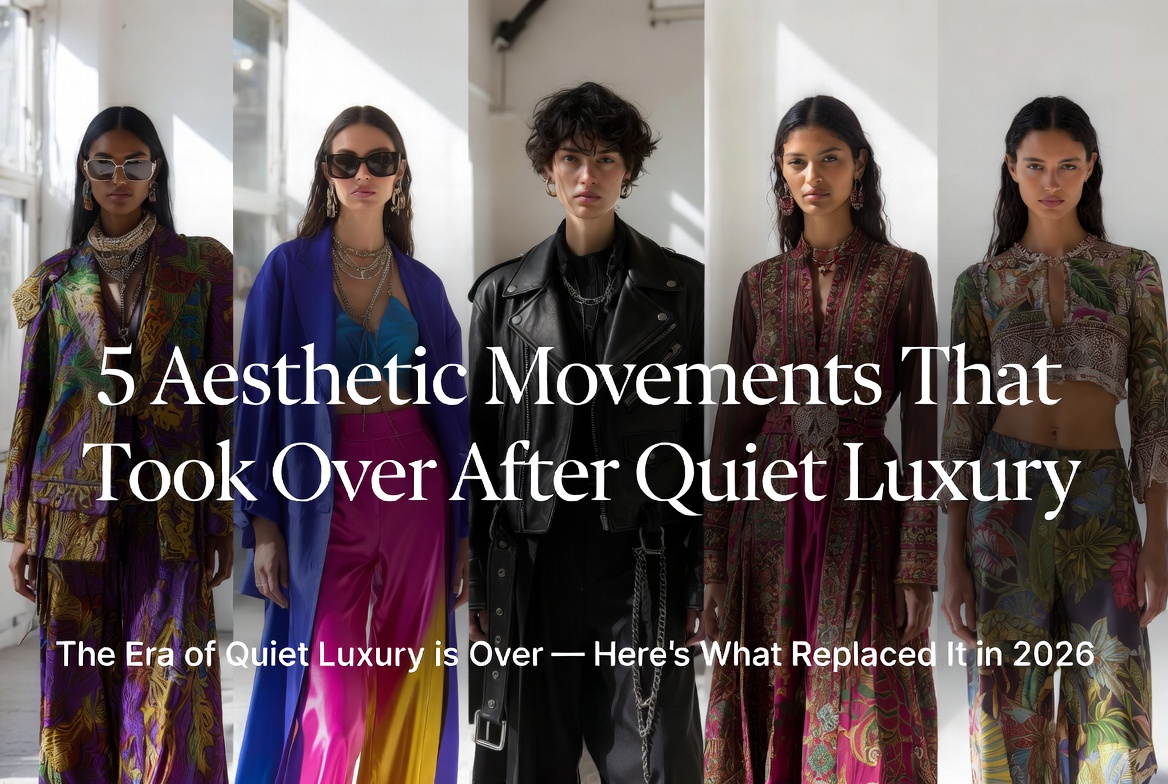
The shift was not sudden fashion never truly moves overnight. But looking back at the past eighteen months of runway shows, street style reports, social media search data, and retail sell-out patterns, the evidence is unmistakable. Five distinct aesthetic movements have risen from the quiet luxury vacuum, each with its own cultural logic, visual language, and audience.

| This is not a list of micro-trends that will disappear by summer. These are fully formed aesthetic philosophies — with their own communities, designers, and long-term staying power. |
Whether you are a stylist advising clients, a fashion blogger building a content calendar, or a shopper trying to make sense of what is on the racks, this breakdown will give you a clear map of where fashion has gone and more importantly where it is heading.
01 Maximalism 2.0: Curated Excess
| Also called | New Maximalism, Intentional Excess, Maximalist Realism |
| Key designers | Valentino, Schiaparelli, Marni, Dries Van Noten |
| Core colour palette | Deep jewel tones, bold contrast mixing, pattern on pattern |
| Platform reach | Pinterest (+340% maximalism searches, 2025–2026) |
The first and most dominant successor to quiet luxury is maximalism but not the chaotic, logo-covered excess of the early 2010s. What has emerged is something more deliberate. Maximalism 2.0 is the art of curated abundance.
What separates it from old maximalism
Old maximalism was reactive more was more, full stop. The new version applies an editorial eye to layering, mixing, and stacking. Think: two bold prints that share a single colour anchor, creating visual harmony within apparent complexity. Or a floor-length embellished coat worn over a sculptural monochromatic base, where the excess is the statement but the foundation is considered.
Designers like Valentino and Schiaparelli have been central to this shift, producing collections that feel simultaneously overwhelming and perfectly composed. The key is intentionality nothing is accidental, even when it looks effortless.
Who is wearing it and why
Maximalism 2.0 has found its audience among fashion-forward millennials and elder Gen Z consumers who grew up during the quiet luxury era but craved more self-expression. It also resonates strongly with South Asian and Latin American fashion audiences, where maximalism has cultural roots that quiet luxury never acknowledged.
- Jewellery stacking — multiple rings, layered necklaces, arm parties
- Mixed texture dressing — velvet with denim, satin with wool
- Statement outerwear as the centrepiece of an otherwise simple outfit
- Pattern clashing with deliberate colour theory as the connective tissue
| The maximalism rule for 2026: pick one element to be the loudest thing in the room. Everything else supports it. That is what separates a maximalist outfit from a costume. |
02 Dopamine Dressing: Colour as Emotional Architecture
| Also called | Joy dressing, chromatic dressing, mood fashion |
| Key designers | JW Anderson, Jacquemus, Christopher John Rogers |
| Core colour palette | Saturated primaries, acid brights, unexpected colour clashes |
| Platform reach | TikTok #dopaminedressing — 4.2B views and rising |
Dopamine dressing is built on a simple premise backed by actual science: the colours we wear influence our emotional state, and in 2026, people are deliberately using fashion to manage their mood.
The psychology behind the palette
Colour psychology research has consistently demonstrated that warm, saturated hues stimulate the brain’s reward pathways. Wearing bright tangerine, electric cobalt, or acid yellow is not frivolous it is a documented mood intervention. Fashion brands, both luxury and accessible, have leaned into this science with collection after collection built around emotional resonance rather than traditional seasonal logic.
What makes dopamine dressing distinct from simply wearing bright colours is its intentionality. Wearers are not defaulting to colour they are choosing it with a specific emotional goal: confidence, optimism, energy, joy.
How the trend evolved in 2026
- Monochromatic saturated dressing — head-to-toe in one vivid hue
- Unexpected colour pairings: hot pink with burnt orange, cobalt with chartreuse
- Coloured footwear and bags as the dopamine trigger on an otherwise neutral outfit
- Workwear applications — the power blazer in an unexpected saturated tone
The most significant development in dopamine dressing through 2025 into 2026 is its migration into professional and formal contexts. A single cobalt blazer or flame-red trouser suit has become a sophisticated power move in spaces that once demanded quiet luxury neutrals.
| Dopamine dressing is not about wearing every colour at once. It is about wearing colour with purpose — and feeling exactly how you look. |
03 Rebellious Edge: The Return of Anti-Establishment Dressing
| Also called | Neo-punk, dark edge, structured rebellion, armour dressing |
| Key designers | Rick Owens, Ann Demeulemeester, Alexander McQueen, Balenciaga |
| Core elements | Hardware, leather, asymmetry, black, chain detail, buckles |
| Cultural trigger | Global economic anxiety + political instability cycles |
History is consistent on one point: when social and economic uncertainty rises, fashion turns toward garments that project psychological armour. The 1970s gave us punk. The early 1990s gave us grunge. The late 2000s brought structured dark romanticism. And 2026 has delivered its own version of rebellious edge dressing.
The cultural moment driving this aesthetic
After years of whispering through quiet luxury and smiling through dopamine dressing, a significant portion of the fashion-consuming public is reaching for something that communicates a different message, one that projects confidence through strength rather than subtlety or colour. Garments with hardware, structural tailoring, and materials that carry psychological weight have surged across every price point.
The leather jacket as the defining anchor piece
No single garment better represents this movement than the black leather jacket a piece that has transcended its subcultural origins to become one of 2026’s most versatile and symbolically loaded wardrobe staples. Where quiet luxury reached for the cashmere overcoat, rebellious edge dressing reaches for the leather jacket: structured, durable, attitude-forward, and effortlessly cross-contextual.
In 2026, the black leather jacket is being worn in ways that would have seemed unexpected even two years ago:
- Over silk slip dresses for the high-low contrast that defines the movement
- Under oversized tailored blazers as a layering piece that adds edge to suiting
- Paired with dopamine-bright trousers, bridging two of 2026’s dominant aesthetics
- Belted and structured as standalone outerwear with wide-leg tailored trousers
- In cropped silhouettes over maximalist printed co-ords
The leather jacket works precisely because it brings rebellious energy to any outfit without requiring a complete aesthetic overhaul. It is the single piece that allows wearers to participate in the edge movement without committing to its more extreme expressions.
What else defines the rebellious edge aesthetic
- Chain-detail bags and belts — hardware as ornamentation
- Asymmetric hemlines and deconstructed silhouettes
- Platform boots and chunky footwear with structural presence
- Sheer or mesh pieces worn with deliberate attitude
- Dark, monochromatic palettes anchored in black, charcoal, and oxblood
| Rebellious edge in 2026 is not about aggression — it is about presence. The garments say: I am here, I am considered, and I am not trying to disappear. That is a fundamentally different message from quiet luxury’s careful invisibility. |
04 Global Cultural Fusion: Identity as the Aesthetic
| Also called | Heritage fashion, artisan dressing, diaspora style |
| Key designers | Sabyasachi, Tokunbo Sangobiyi, Feng Chen Wang, Rahul Mishra |
| Core elements | Handloom textiles, regional embroidery, traditional silhouettes reimagined |
| Industry signal | Non-Western fashion weeks gaining primary trend-setter status |
Perhaps the most meaningful aesthetic movement to emerge in the post-quiet-luxury era is also the one with the deepest roots. Global cultural fusion dressing is not a trend borrowed from heritage communities it is those communities stepping fully into the centre of global fashion and setting the agenda.
How this is different from past ‘world fashion’ moments
Fashion has always appropriated global aesthetics, but what is happening in 2026 is structurally different. Designers from South Asia, West Africa, Southeast Asia, the Middle East, and Latin America are not just showing collections at regional fashion weeks. They are being cited as primary influences by editors at Vogue, Business of Fashion, and the major international style publications.
The distinction matters enormously. Past “world fashion” moments took elements from cultural traditions and repackaged them through a Western lens. The 2026 movement centres the original creators and traditions:
- Handloom and block-print textiles from Indian artisan communities commanding luxury price points
- West African wax-print fashion in formal and couture contexts — not just streetwear
- Modest fashion from Gulf-based designers influencing mainstream silhouette choices globally
- Traditional embroidery techniques (zardozi, kantha, sashiko) applied to contemporary luxury garments
- Diaspora designers fusing their heritage aesthetics with Western tailoring traditions
Why this movement has staying power
Cultural fusion dressing has staying power for the same reason quiet luxury did: it is rooted in values, not just visuals. Where quiet luxury expressed the values of restraint and selective quality, cultural fusion dressing expresses identity, community, craft, and authenticity. These are not easily dismissed as seasonal trends.
| The most important rule of cultural fusion dressing in 2026: the most stylish version of this aesthetic is one that comes from genuine connection — to a tradition, a community, or a maker — rather than aesthetic borrowing. |
05 Sustainable Maximalism: The Conscious Loudness Movement
| Also called | Ethical maximalism, upcycled bold, craft luxury |
| Key designers | Marine Serre, Bethany Williams, Chopova Lowena |
| Core elements | Deadstock fabrics, upcycled statement pieces, artisan craftsmanship |
| Consumer shift | 60%+ of surveyed fashion consumers report ‘minimalism fatigue’ (2026) |
The final movement in this list is also the most nuanced and arguably the most significant for the long-term direction of the fashion industry. Sustainable maximalism resolves what seemed like an impossible tension: how do you dress boldly and ethically at the same time?
The tension that needed resolving
Quiet luxury made its peace with sustainability through the “buy less, buy better” philosophy. It was a convenient argument that aligned premium pricing with environmental consciousness. But it also had a fundamental limitation: it excluded anyone who could not afford luxury price points, and it stifled self-expression in the name of taste.
Sustainable maximalism offers a different answer. It argues that expressive, bold, joyful dressing is entirely compatible with ethical consumption you just have to source it differently.
What sustainable maximalism looks like in practice
- Deadstock fabrics — surplus material from luxury manufacturers — made into bold statement pieces
- Upcycled vintage garments reimagined and restyled as the centrepiece of an outfit
- Artisan-made pieces where the craft and the maker are the statement, not the label
- Rental fashion for high-impact event dressing without permanent acquisition
- Pre-loved luxury bought, worn, and worn again publicly — not treated as a secret
The brands leading this movement
Marine Serre, with her iconic crescent moon print and commitment to upcycled materials, has become the unofficial mascot of sustainable maximalism. Bethany Williams builds entire collections around community craft partnerships. Chopova Lowena’s folkloric maximalism uses traditional Bulgarian textile techniques on deadstock fabrics.
These are not niche designers operating at the margins. They are being stocked by Matches, Net-a-Porter, and Selfridges, and they are selling out.
| Sustainable maximalism’s central message: you do not have to choose between being ethical and being expressive. The most powerful statement outfit you own could also be the most responsible thing in your wardrobe. |
What These Five Movements Have in Common
Looking across all five aesthetic movements maximalism 2.0, dopamine dressing, rebellious edge, cultural fusion, and sustainable maximalism a shared thread emerges. Each one, in its own way, is a rejection of fashion as performance for an invisible, exclusive audience.
Quiet luxury was, at its core, a style for people who understood the codes. It required insider knowledge to appreciate. Its most fundamental gesture was legibility only to those already in the room.
The aesthetics that have replaced it are all, in different ways, outward-facing. They want to be seen, understood, felt, and responded to. They dress for the street, the crowd, the community not for the knowing nod of a fellow insider.
How to navigate the post-quiet-luxury wardrobe
- You do not have to choose one movement — the most interesting personal style in 2026 often sits at the intersection of two or three. A leather jacket worn over a maximalist print dress? That is rebellious edge meeting maximalism 2.0. A dopamine-bright blouse made from upcycled deadstock fabric? That is dopamine dressing meeting sustainable maximalism.
- Quality still matters — but the definition of quality has expanded beyond fabric weight and brand heritage. Craft, maker knowledge, cultural provenance, and sustainability credentials are all now part of what makes a garment valuable.
- Your wardrobe should mean something — the unifying thread of every movement on this list is intentionality. Buy with clarity. Dress with purpose. Show up in clothes that say something real about who you are and what you value.
Conclusion: Fashion in 2026 Has Stopped Whispering
Quiet luxury will be remembered as the aesthetic of a specific historical moment a period of collective retreat, of finding safety in restraint, of signalling taste through studied understatement.
But that moment has passed. The five aesthetic movements that have taken over in its wake are not less sophisticated. They are not less considered. They are simply louder and they are loud for reasons that matter.
Whether you find yourself drawn to the curated excess of maximalism 2.0, the chromatic joy of dopamine dressing, the armoured presence of rebellious edge, the cultural depth of global fusion, or the ethical boldness of sustainable maximalism 2026’s fashion landscape has a home for every kind of self-expression.
The era of dressing to disappear is over. The era of dressing to be fully, unapologetically present has begun.

| The post-quiet-luxury wardrobe is not louder for the sake of noise. It is louder because it has something to say. |