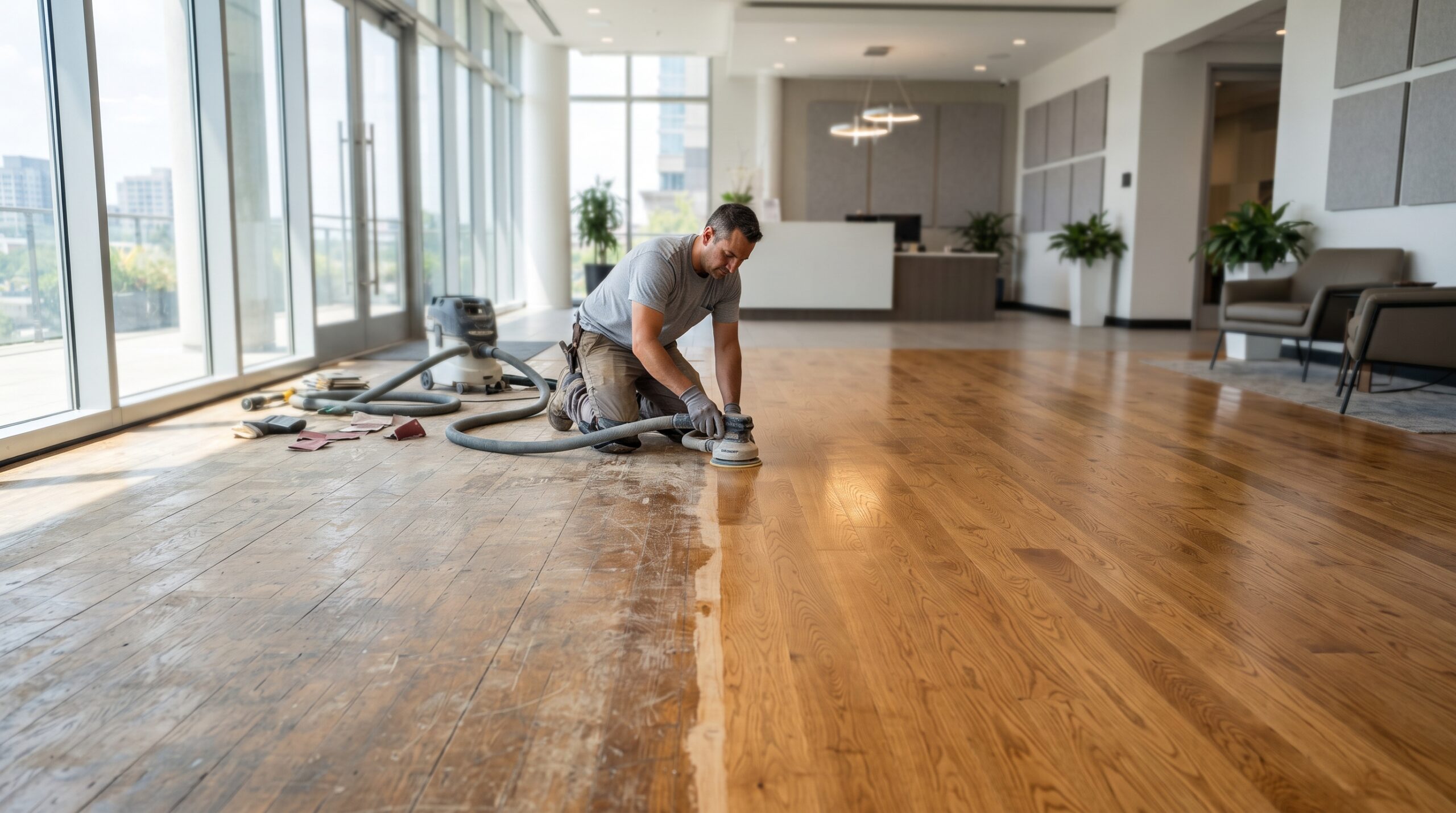
Walk into any older office building, retail store, or historic venue. The floor tells a story before anyone says a word. Scuffed finish. Dull patches near entrances. A faint gray cast where foot traffic runs heaviest.
Property managers often assume this means the hardwood is done for. Rip it out, replace it, move on.
In most cases, that assumption costs thousands of dollars it didn’t need to.

Hardwood floors are built to be refinished, not thrown away at the first sign of wear. A solid hardwood floor can usually be sanded and refinished several times over its lifespan. For commercial properties, that’s the difference between a full replacement project and a quick refinish that gets the space back in shape fast.
The key is knowing which situation you’re actually dealing with. Here are five signs that point to refinishing, plus the signs that mean it’s genuinely time to replace.
1. The Finish Is Worn, But the Wood Itself Is Sound
This is the most common scenario in commercial spaces. Lobbies, showrooms, restaurants, and office corridors take a beating from foot traffic, chair casters, and cleaning chemicals.
Look closely at the surface. Do you see dullness, light scratching, or a worn-through finish? Does the wood underneath still feel solid, with no soft spots or splintering? That’s a finish problem, not a structural one.
A professional sand-and-refinish strips the old finish down to bare wood, corrects minor imperfections, and seals it with a fresh protective coat.
Why does this matter for a business? Cost and downtime. Refinishing is a fraction of what replacement takes, and it can often be scheduled around business hours or done in phases so operations don’t stop.
2. Traffic Patterns Have Left Visible Wear Zones
Entrances, hallways, and areas near reception desks wear differently than the rest of the floor. Over time, this creates visible “paths” — sections that look lighter, rougher, or more scratched than everything around them.
Refinishing fixes this directly. Sanding removes the inconsistency and brings the whole floor back to one uniform surface and sheen. Instead of a patchwork look, you get a clean, continuous finish.
Replacing only the worn sections rarely blends with the older wood around it. Refinishing the whole floor is usually both cheaper and better-looking — the same approach used in commercial flooring projects handled at scale.
3. The Floor Has Surface-Level Water Marks or Staining
Water rings, spill stains, and light discoloration from moisture are common in retail and hospitality settings. Think entryways during Colorado winters, or areas near water fountains and beverage stations.
The instinct is to assume water damage means the boards need to come up. But most surface staining sits in the finish layer, not the wood fibers.
If the stain hasn’t gone deep, and there’s no cupping, warping, or soft wood underfoot, refinishing will usually sand the stain away completely. Only long-term moisture trapped under the boards — causing warping or rot — calls for actual board replacement.
4. The Floor Is Structurally Solid but Aesthetically Outdated
Sometimes nothing is wrong with the floor. It’s just the wrong color or sheen for a renovated space, a rebrand, or new ownership. A dark, dated stain in a newly redesigned space with a lighter palette is a common request from architects working on commercial buildouts.
This is an overlooked reason to refinish. It’s not about repairing damage — it’s about updating the look of a perfectly good floor.
A full refinish lets you change the stain color, adjust the sheen, or switch from glossy to matte. It’s the same kind of aesthetic refresh often requested in luxury residential hardwood work, where homeowners want an updated look without replacing the wood.
5. You’re Preparing the Space for a New Tenant or Buyer
For landlords and developers, flooring condition is one of the first things a prospective tenant or buyer notices. A tired, scuffed floor makes a solid property feel neglected. A freshly refinished floor signals it’s been cared for.
Refinishing ahead of a leasing push or sale is a low-cost way to improve first impressions. It’s also easy to schedule around vacancy periods or tenant turnover.
Broader coverage of commercial real estate trends, like the kind found on USA Magazine, often points to the same conclusion: presentation drives leasing and resale value almost as much as location does.
When Replacement Actually Is the Right Call
Refinishing solves most cosmetic and light-damage issues. But it isn’t a fix for everything. A few signs point toward replacement instead:
- Boards that are cupped, crowned, or buckled from long-term moisture exposure — sanding can’t fix structural warping.
- Wood already sanded close to the nail line, leaving little material left to remove safely.
- Rot, insect damage, or soft, deteriorating wood beneath the surface.
- Engineered hardwood with a thin veneer, already refinished once or twice, that can’t handle another sanding pass.
A qualified contractor can usually tell within a short walkthrough which category a floor falls into. A good one will tell you honestly when refinishing won’t hold up, instead of selling a service that isn’t the right fit.
What to Expect From a Professional Refinishing Assessment
A good contractor won’t just glance at the floor and quote a price. They’ll walk the space first.
Expect a moisture reading taken at several points across the floor, not just one spot. Moisture levels tell a contractor whether the wood is stable enough to sand, or whether there’s a deeper issue hiding beneath the surface.
Next comes a close inspection of the boards themselves. This means checking for cupping, gaps between boards, and soft spots that might not be visible from a normal walkthrough. A contractor will also want to know the wood species and finish type, since different woods and finishes react differently to sanding.
If the floor is engineered hardwood, this step matters even more. Engineered boards have a limited veneer layer, and a contractor needs to confirm there’s enough material left before committing to a full sand.
For commercial spaces, scheduling is part of the assessment too. A contractor should ask about business hours, foot traffic patterns, and whether the work needs to happen in phases. This isn’t just about the floor. It’s about protecting revenue while the work gets done.
By the end of a proper assessment, you should have a clear answer: refinish, replace, or a mix of both depending on the section of the floor. If a contractor skips these steps and jumps straight to a quote, that’s worth questioning.
Why This Decision Matters More for Commercial Properties
Residential homeowners can usually afford to take a floor out of commission for a few days. Commercial properties rarely have that luxury. A retail store, office, or restaurant that closes even part of its space loses revenue for every day the project runs.
That’s why the refinish-vs-replace decision carries more weight commercially. Choosing the right path — backed by proper moisture testing, subfloor inspection, and an honest read on the wood’s condition — is what keeps a project on budget and on schedule.
It’s also why experience with large, high-traffic environments matters. A crew that regularly handles historic buildings, multi-floor offices, and active commercial developments has seen every wear pattern. They know how to work around a functioning business, not just an empty house.
The Bottom Line
Before assuming a worn commercial hardwood floor needs to be torn out, get a professional opinion first. In most cases — worn finish, uneven traffic wear, surface staining, or an outdated look — refinishing delivers a like-new floor at a fraction of the cost, time, and disruption of full replacement.
Replacement should be reserved for floors with real structural damage, not floors that simply need attention.

For property managers, general contractors, and developers across the Front Range, working with a team that understands both the craftsmanship side of hardwood and the scheduling realities of commercial work makes that decision a lot easier.