If you’ve been dealing with a nagging injury, chronic joint pain, or a soft tissue problem that just won’t resolve, you’ve probably heard about platelet-rich plasma therapy at some point. Maybe your doctor mentioned it. Maybe a training partner swore it got them back on the field after a stubborn tendon injury. Either way, you’re asking the right question: what does platelet therapy actually do inside your body?
The short answer is that it amplifies and restarts your body’s natural repair process using concentrated biological material taken directly from your own blood. The longer answer is more interesting, and understanding it will help you make a much better-informed decision about whether this therapy is right for your situation.
Let’s get into it.
The Basics: What Platelet Therapy Actually Is
Platelet-rich plasma therapy, commonly called PRP, is a regenerative injection treatment that uses a concentrated preparation of your own platelets to stimulate healing in damaged tissue. It’s not a drug. It’s not a synthetic compound. Everything injected into your body during a PRP treatment came from your body in the first place, processed and concentrated to deliver a much more powerful healing signal than your bloodstream would naturally deliver to an injured area.
Where Platelets Come From and What They Normally Do
Platelets are tiny cell fragments produced in your bone marrow and circulating continuously in your bloodstream. Most people think of platelets exclusively in terms of clotting, which is fair because stopping bleeding is one of their primary jobs. But platelets do considerably more than that.
Packed inside every platelet is a collection of proteins called growth factors. When tissue is injured and platelets arrive at the site, they release these growth factors as part of the initial repair signal. That signal recruits other repair cells, stimulates collagen production, promotes new blood vessel growth into the healing tissue, and coordinates the entire cascade of events your body uses to rebuild what was damaged.
The problem is that in chronic injuries, that initial platelet response has faded. The acute healing phase ended without the tissue fully repairing, and the ongoing chronic inflammation and structural compromise continue without adequate repair signaling to resolve them.
How PRP Is Made and Why Concentration Matters
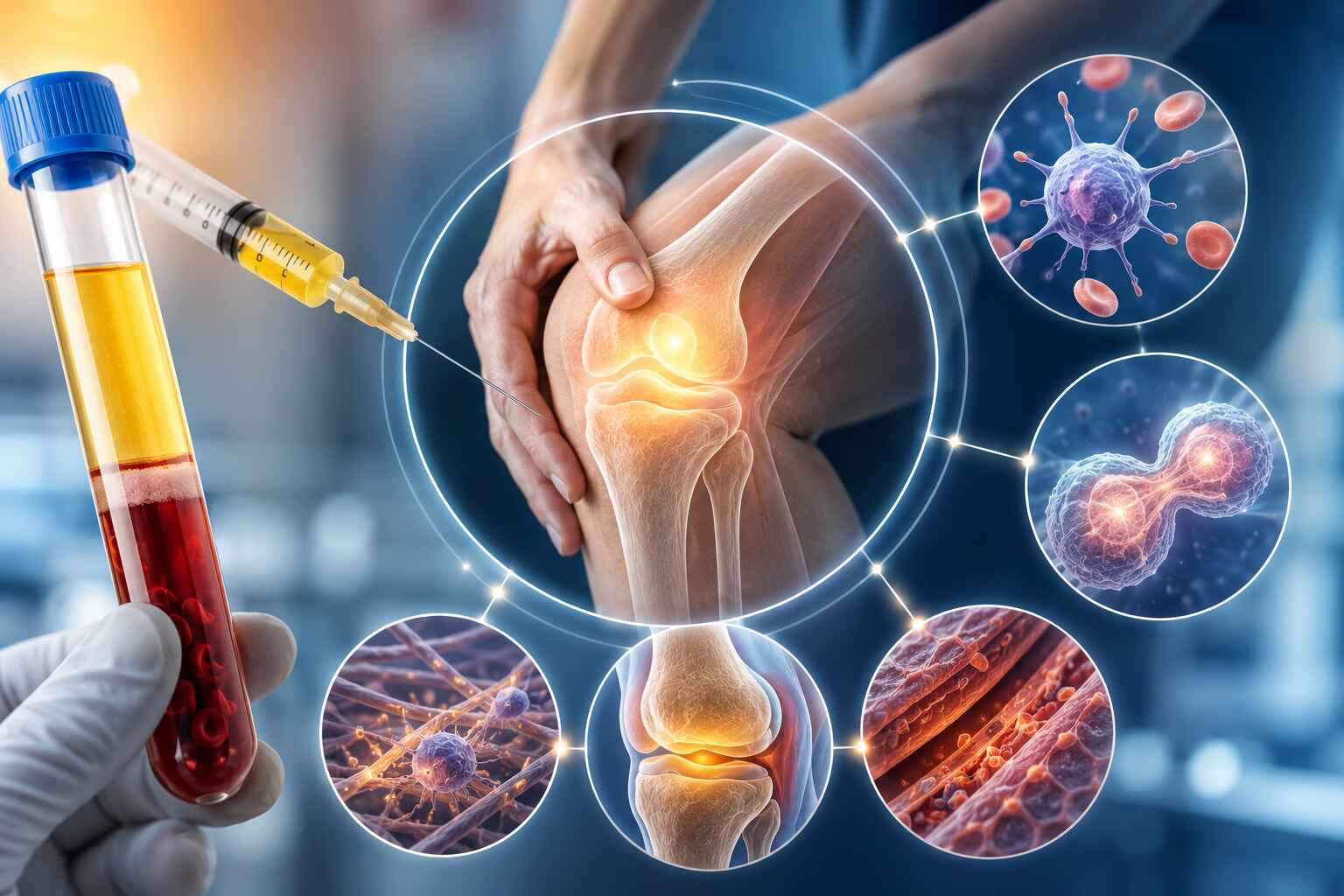
PRP is made by drawing a sample of your blood, typically between 15 and 60 milliliters depending on the protocol, and spinning it in a centrifuge. The centrifuge separates the blood into its components: red blood cells, plasma, and the platelet-rich layer in between. That middle layer is collected and may be further processed to remove red blood cells and concentrate the platelets even further.
The result is a preparation containing five to ten times the platelet concentration of normal blood. That concentration is what makes the difference. You’re not just delivering the same weak signal that your bloodstream was already providing to the injured area. You’re flooding it with a repair signal orders of magnitude stronger.
The Difference Between Regular Blood and PRP
Normal blood flowing past an injured tendon delivers a trickle of growth factors. PRP injected directly into that tendon delivers a flood. The difference in biological signaling is substantial, and that’s why PRP can restart a healing response in tissue that has been stubbornly unresponsive for months or years.
What Happens Inside Your Body After a PRP Injection
This is where things get genuinely fascinating. The moment PRP is injected into damaged tissue, the platelets begin activating and releasing their growth factor payload. What follows is a carefully orchestrated biological sequence.
The Growth Factor Cascade Explained
The major growth factors released by activated platelets include platelet-derived growth factor (PDGF), transforming growth factor beta (TGF-b), vascular endothelial growth factor (VEGF), epidermal growth factor (EGF), and insulin-like growth factor (IGF-1). Each of these proteins performs a specific role in the repair process.
PDGF stimulates cell proliferation and recruits repair cells to the site. TGF-b promotes collagen synthesis and tissue remodeling. VEGF drives the formation of new blood vessels that supply the healing tissue with nutrients and oxygen. EGF supports cell growth and migration into the damaged area. IGF-1 promotes muscle and cartilage repair and has anti-inflammatory properties.
Together, these signals create an environment where healing can actually progress rather than stall. The research literature, including multiple studies indexed by the National Institutes of Health, documents these mechanisms across a range of tissue types and clinical applications.
How Platelet Therapy Restarts Stalled Healing
Think of a chronic injury like a construction project that ran out of funding halfway through. The framework is there. The workers know what needs to be done. But without the resources to continue, everything stops and the half-finished structure just sits there, vulnerable and non-functional.
PRP is the injection of new funding into that stalled project. It provides the biological resources the repair process needs to get moving again, to bring in new workers, lay down new structural material, and complete the job that the initial injury response started but couldn’t finish.
Why Chronic Injuries Stop Healing on Their Own
Tendons, ligaments, and cartilage share a frustrating biological characteristic: they have very poor blood supply compared to muscle or skin. Poor blood supply means poor delivery of the oxygen, nutrients, and repair cells that healing requires. An acute injury gets a burst of inflammatory response that brings some repair resources to the area, but once that acute phase ends, the ongoing trickle of blood flow to connective tissue is often insufficient to complete the repair.
This is why so many tendon and ligament injuries become chronic. The body tried to fix them and partially succeeded, but the structural healing was incomplete, and the tissue remains weakened, painful, and prone to re-injury.
What Conditions Does Platelet Therapy Treat?
PRP has been studied and applied across a genuinely wide range of conditions. The strongest clinical evidence sits in the musculoskeletal category, though applications in dermatology, hair restoration, and other fields are also well-documented.
Platelet Therapy for Sports Injuries in Bend
Platelet therapy sports injuries Bend has become an increasingly sought-after option for athletes at every level who want to recover faster and more completely from the injuries that come with an active lifestyle. Bend’s outdoor culture means a high volume of running injuries, mountain biking trauma, skiing and snowboarding injuries, and overuse conditions from trail running and climbing.
Rotator cuff tears, Achilles tendinopathy, hamstring strains, patellar tendinitis, and ankle ligament injuries all respond well to PRP when the treatment is properly indicated and delivered. The appeal for athletes is straightforward: PRP works with your biology rather than suppressing it, and it aims for actual tissue repair rather than temporary symptom control.
Joint Pain and Osteoarthritis
Knee osteoarthritis is one of the most extensively studied applications for PRP therapy. Multiple randomized controlled trials have compared PRP to hyaluronic acid injections and corticosteroids for knee OA, with PRP consistently showing superior results in pain reduction and functional improvement, particularly in younger patients with mild to moderate disease.
The mechanism makes sense given what we know about how PRP works. Osteoarthritis involves cartilage breakdown driven by chronic inflammation and inadequate repair response. PRP addresses both: it delivers growth factors that support cartilage cell survival and matrix production while also modulating the inflammatory environment within the joint.
Tendon and Ligament Damage
Tennis elbow (lateral epicondylitis) is probably the most studied individual application for PRP, with a strong body of evidence supporting its effectiveness for cases that haven’t responded to physical therapy and conservative care. Patellar tendinopathy, plantar fasciitis, medial collateral ligament injuries, and chronic wrist tendon problems all have meaningful clinical support for PRP treatment.
Soft Tissue Injuries That Respond Well to PRP
The common thread in soft tissue conditions that respond well to PRP is the combination of poor intrinsic blood supply and a stalled healing response. Muscle injuries typically heal more readily because of better blood flow. Tendons, ligaments, and the fibrocartilage structures in joints are exactly the tissue types where PRP’s ability to override the blood supply limitation and deliver concentrated repair signals makes the most clinical difference.
PRP Healing in Bend Oregon: What the Treatment Process Looks Like
For anyone considering PRP healing in Bend, Oregon, knowing what to actually expect from the treatment process removes a lot of the uncertainty that holds people back from pursuing care.
From Blood Draw to Injection: The Full Session Walkthrough
Your PRP appointment typically runs between 45 minutes and an hour. It starts with a blood draw from your arm, no different from a standard lab draw. That blood goes straight into the centrifuge, which runs for about 15 minutes to separate and concentrate the platelets.
While the PRP is being processed, your provider prepares the injection site. Most musculoskeletal PRP injections are performed under ultrasound guidance, which allows the provider to visualize the target structure in real time and confirm precise needle placement. That precision matters enormously for outcomes. A PRP injection that misses the damaged tissue delivers far less benefit than one placed accurately within the pathological area.
The injection itself takes only a few minutes. Most patients describe a pressure sensation and mild discomfort during the injection, which varies depending on the location and depth of the target tissue. The area is typically sore for two to five days afterward, which is a normal part of the inflammatory response the PRP is triggering.
How Many Sessions Do Most Patients Need?
Many patients see meaningful improvement after a single PRP session. However, two to three sessions spaced four to six weeks apart is a common protocol for more significant or longstanding conditions. Your provider should give you a realistic expectation based on the specific condition being treated, its severity, and your overall health and healing capacity.
Results are not immediate. The tissue repair process that PRP initiates takes weeks to months to produce its full effect. Most patients begin noticing improvement at the four to eight week mark, with continued progress through the three to six month window.
What to Do and Avoid After Your PRP Treatment
The post-treatment period requires some attention. Anti-inflammatory medications including ibuprofen, naproxen, and aspirin should be avoided for at least two weeks after PRP, because they suppress the inflammatory response that PRP is deliberately trying to trigger. Using NSAIDs after PRP is like pressing the gas and the brake at the same time.
Relative rest of the treated area for the first week supports the initial healing response. Light activity is generally encouraged after that, with a gradual return to full activity guided by your symptoms and your provider’s protocol.
How Platelet Therapy Compares to Conventional Pain Treatment
Understanding where PRP fits relative to the treatments most people receive helps clarify when it’s the right choice and when it might be an even better first option than the conventional approach.
PRP vs. Cortisone Injections
Cortisone injections are the most commonly administered injection therapy for musculoskeletal pain. They work by suppressing inflammation rapidly, often producing quick and significant pain relief. For that reason, they remain popular and have a legitimate role in certain clinical situations.
The limitation of cortisone is well-documented. It does nothing to repair the underlying tissue damage. Repeated cortisone injections actually degrade collagen and weaken tendon and ligament tissue over time. The pain relief is real but temporary, and the structural condition often continues to worsen beneath the symptomatic improvement.
PRP, by contrast, aims to repair the tissue rather than quiet its symptoms. It may take longer to produce noticeable pain relief than a cortisone injection, but the mechanism is moving in the right direction biologically. You’re fixing the problem rather than muting the alarm.
PRP vs. Surgery for Musculoskeletal Conditions
Surgery is appropriate for certain musculoskeletal conditions, particularly complete tears, severe structural damage, and cases that have genuinely exhausted all conservative options. But surgery carries real risks: infection, scarring, anesthesia complications, prolonged recovery, and the possibility of outcomes that don’t match expectations.
For a significant number of conditions that are currently treated surgically, PRP and other regenerative therapies offer a legitimate non-surgical alternative with a much more favorable risk profile. Choosing PRP before committing to surgery is a medically sound decision for many patients.
When PRP Is the Smarter First Step
If your condition involves tendon or ligament damage, early to moderate osteoarthritis, or soft tissue injury that hasn’t responded to physical therapy and conservative care, PRP deserves serious consideration before escalating to surgery or committing to long-term cortisone management. A qualified regenerative medicine provider can help you assess whether your specific condition and imaging findings support PRP as a primary intervention.
What to Look for in a PRP Provider
The quality of your PRP outcome is significantly influenced by the quality of the provider delivering it. This is a precision medical procedure, not a commodity service.
Clinical Experience and Evaluation Process
Your provider should conduct a thorough clinical evaluation before recommending PRP. That means reviewing your full health history, examining the affected area, assessing relevant imaging, and considering factors including your overall health status, medications, and nutritional adequacy that affect healing response.
Ultrasound-guided injection technique is a meaningful quality indicator. Providers performing PRP injections without image guidance are relying on anatomical landmarks rather than real-time visualization, which introduces variability into the most critical step of the procedure.
Proactive Choice Clinic: PRP Therapy in Bend, OR
At Proactive Choice Clinic in Bend, Oregon, Dr. Drew Collins approaches every PRP patient with a comprehensive evaluation that considers the full clinical picture. With over 40 years of clinical experience and a background spanning functional medicine, regenerative therapies, and naturopathic practice, Dr. Collins brings both depth of knowledge and genuine individualized attention to every patient he treats.
His protocols integrate PRP within a broader framework of care when indicated, addressing systemic factors including hormonal health, nutritional status, and inflammatory burden that directly influence how well your tissue heals. Patients don’t just get an injection. They get a clinically informed treatment plan designed around their specific body and their specific condition.
Conclusion
Platelet therapy does something genuinely useful and biologically meaningful: it delivers a concentrated, targeted repair signal to tissue that has lost its ability to complete the healing process on its own. For patients with chronic tendon and ligament injuries, joint degeneration, and soft tissue damage that hasn’t responded to conventional treatment, PRP represents a legitimate path toward actual structural improvement rather than ongoing symptom management.
The key is working with a provider who takes the time to evaluate you properly, apply the therapy precisely, and support the healing process with the clinical depth it deserves. If you’re in Bend, Oregon and want to explore whether platelet therapy is right for your situation, Proactive Choice Clinic offers that level of care in a setting that puts your outcomes first.
Frequently Asked Questions
Is platelet therapy painful?
The injection itself involves a brief, localized discomfort, and most patients experience soreness at the injection site for two to five days afterward. The post-injection soreness is a sign the treatment is triggering the intended inflammatory response. Most patients find the discomfort very manageable, and providers can use local anesthetic at the skin surface to reduce discomfort during the procedure itself.
How long does it take for PRP to work?
Most patients begin noticing improvement between four and eight weeks after treatment as the initial tissue repair process gets underway. Full results develop over three to six months as collagen remodeling and structural healing progress. PRP is not a quick fix, but the results it produces reflect actual tissue repair rather than temporary symptom suppression.
Can I exercise after PRP treatment?
Light movement and gentle activity are generally encouraged within the first week to support circulation without overloading the treated tissue. High-impact exercise, heavy loading, and activities that directly stress the treated structure should be avoided for two to four weeks. Your provider will give you specific activity guidance based on the location and nature of your treatment.
Who is not a good candidate for PRP therapy?
Patients with active infection, blood disorders affecting platelet function, certain autoimmune conditions, active cancer, or those taking blood thinners may not be appropriate candidates for PRP. Pregnancy is also typically a contraindication. A thorough clinical evaluation will identify any factors that would affect your candidacy or require modification of the treatment protocol.
Does PRP work for everyone?
PRP produces meaningful improvement in the majority of appropriately selected patients, but no treatment works for everyone. Outcomes are influenced by the severity and duration of the condition, the specific structures involved, your overall health and healing capacity, and the precision of the injection technique. Patients with significant structural damage, advanced tissue loss, or systemic factors that compromise healing may be better served by more advanced regenerative options such as stem cell therapy.