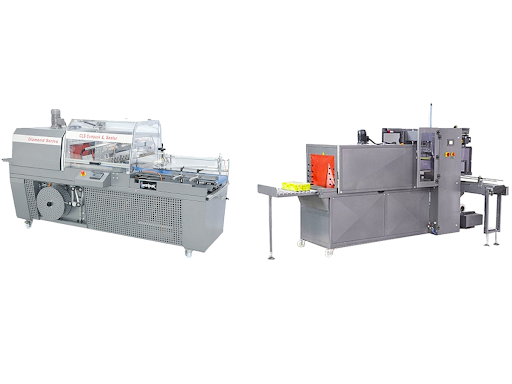
Shrink wrapping has become one of the most versatile secondary packaging formats available — used across food, consumer goods, pharmaceuticals, stationery, industrial supply, and e-commerce to protect, present, and bundle products for retail and distribution. Choosing the right shrink wrapping machine for a specific operation requires understanding how the different machine types work, what throughput and film requirements each is suited to, and what the total cost of ownership looks like beyond the initial purchase price.
How Shrink Wrapping Works
Every shrink wrapping machine system consists of two functional stages. The first is the sealing stage, where a film is wrapped around the product and sealed to form a loose package. The second is the shrink stage, where heat is applied — usually in a dedicated tunnel — to activate the film’s thermal memory, causing it to contract tightly around the product.
The quality of both stages determines the quality of the finished package. Seal integrity affects tamper evidence and transit performance. Shrink quality determines the visual presentation and the tightness of fit that communicates product quality to the end consumer. Getting both right requires correctly matched equipment, correctly specified film, and correctly set operating parameters — all three working together.

Machine Types and Their Applications
The shrink wrapping machine market covers several distinct equipment categories:
- Manual L-bar sealer: Operator-loaded and manually actuated — suited to very low volume operations or occasional wrapping needs
- Semi-automatic L sealer: Mechanically or pneumatically actuated seal bar with manual product loading — the standard choice for mid-volume retail, food service, and light industrial operations
- Automatic side sealer: Continuously running machine that automates product infeed and film wrapping — suited to medium and high-volume production lines
- Flow wrapper: Horizontal form-fill-seal configuration for the highest throughput food and consumer goods applications
- Sleeve wrapper: Forms a film sleeve around grouped products — used in beverage multipacking and tray wrapping
Film Selection and Compatibility
The film specification used in a shrink wrapping machine directly affects machine requirements and finished package quality. Polyolefin (POF) film is the most widely used retail shrink film — it offers excellent optical clarity, consistent shrink characteristics, and food-contact compliance. PVC film is lower cost but unsuitable for food contact and requires ventilation during processing. Polyethylene film is the choice for industrial bundling applications where strength and cost efficiency take priority over visual presentation.
Film gauge — the thickness of the film — affects both seal temperature requirements and the strength and appearance of the finished package. Confirming that the machine being considered is compatible with the specific film gauge and type the operation requires is an essential pre-purchase step that prevents the costly discovery of incompatibility after installation.
Total Cost of Ownership
Evaluating a shrink wrapping machine purchase on initial price alone consistently produces poor outcomes. The total cost of ownership over a three-to-five year horizon — including film consumption, maintenance costs, energy consumption, downtime frequency, and the cost of operator time — is the more relevant financial comparison. A higher-specification machine with lower film waste, faster size changeover, and better uptime can deliver a lower total cost than a cheaper machine with higher ongoing operating costs.
Supplier support quality also contributes to total cost of ownership in ways that are easy to overlook at the point of purchase. A supplier with genuine application knowledge, on-site commissioning support, and reliable after-sales technical assistance reduces the cost of the inevitable learning curve and operational questions that arise during the first months of operating any new piece of equipment.

Final Words
Shrink wrapping delivers measurable value in presentation, protection, and efficiency — but only when the right machine is correctly specified, installed, and supported. Businesses at any production scale should contact Maripak USA for expert guidance on machine selection, film specification, and the end-to-end support that maximises the return on every packaging equipment investment.