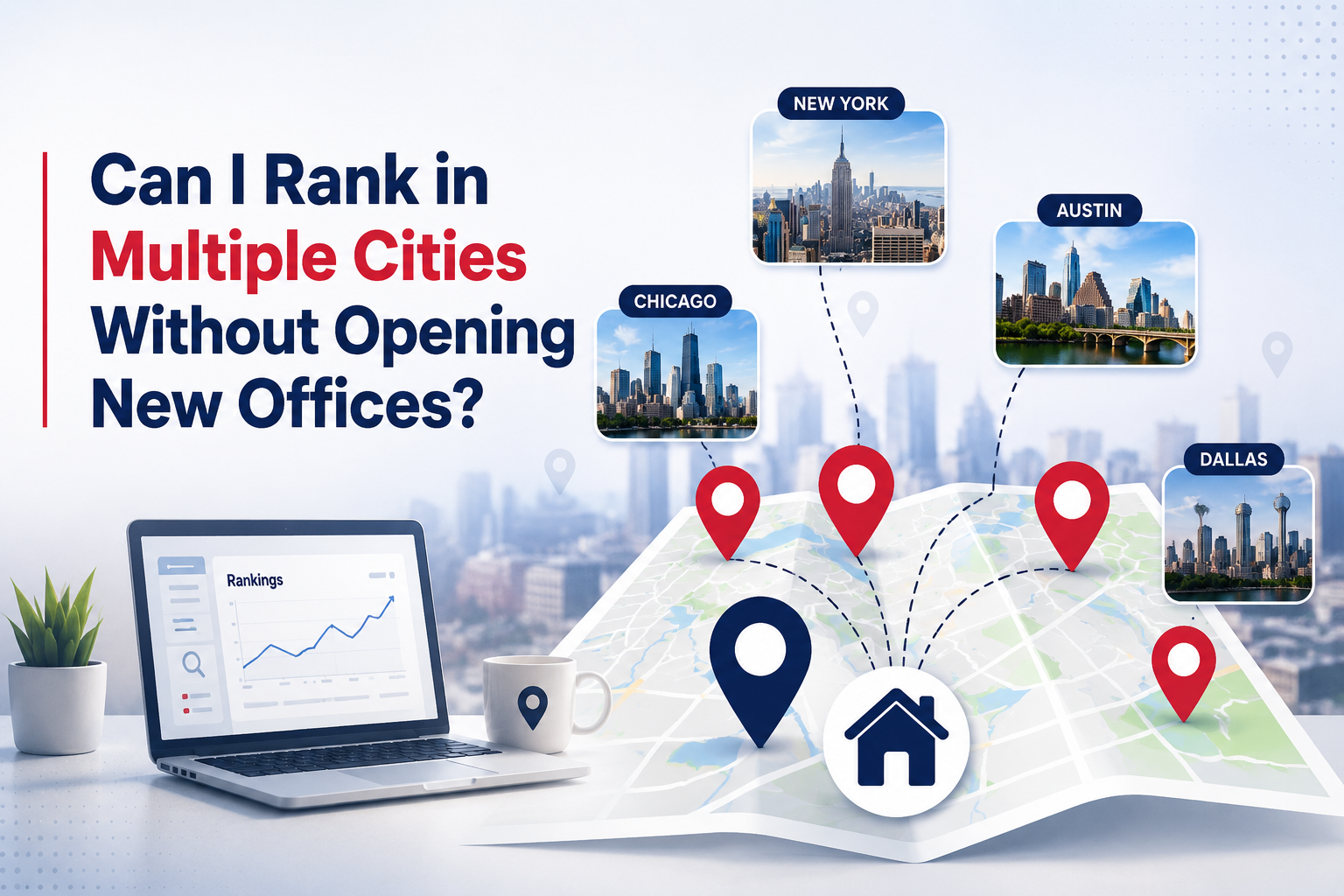
If your business serves customers beyond your home city, you’ve probably wondered whether you need an office in every location you want to rank for.
The good news is that you don’t need a physical office in every city to earn organic search visibility. But that doesn’t mean you can create a page for every city on the map and expect Google to rank it.
Whether your website appears in search results depends on how useful your content is, how relevant it is to the search, and whether your business genuinely serves that location.
Understanding this difference can save you from investing time in strategies that no longer work.
First, Know the Difference Between Google Maps and Organic Search
One of the biggest misunderstandings about local SEO is treating Google Maps and organic search as the same thing.
They’re not.
Google’s local results (the Map Pack) use signals such as relevance, distance, and prominence to decide which businesses appear. Distance is especially important because Google wants to show businesses that are close to the searcher or the location mentioned in the search.
Organic search works differently.
A business with one office can still rank for searches in nearby or even multiple cities if its website provides helpful, location-specific information and clearly shows that it serves those areas.
This is why some companies appear in organic search across several cities but only appear in Google Maps around their actual business location.
Serve the Area Before You Try to Rank There
A common mistake is creating pages for cities where the business doesn’t actually operate.
Imagine you’re based in Denver but regularly complete projects in Aurora, Lakewood, and Westminster. Creating pages for those cities makes sense because customers there can hire you.
Now imagine adding pages for Las Vegas or Phoenix even though you never travel there.
Those pages don’t help visitors because they describe services the business doesn’t actually provide in those locations.
Google encourages businesses to create content that is accurate and genuinely useful. If your website says you serve a city, visitors should be able to contact you and receive that service.
Every Location Page Should Have Its Own Purpose
Years ago, many websites copied one page dozens of times and simply replaced the city name.
That approach rarely works today.
Each location page should answer questions that someone living in that area may have.
For example:
- Which neighborhoods do you cover?
- How quickly can customers expect service?
- Are there any local regulations that affect the service?
- Have you completed projects nearby?
- What questions do customers from this area ask most often?
These details make a page useful instead of repetitive.
They also help search engines understand that the page was created for people not just for rankings.
Avoid Fake Offices and Virtual Addresses
Some businesses believe they can improve local visibility by creating listings for virtual offices or mailbox addresses.
Google’s Business Profile guidelines don’t support this practice.
If a business claims to have an office, customers should be able to visit that location during the listed business hours. Using addresses where no real business operates can lead to a suspended Business Profile.
A single verified location with honest service-area information is far better than several questionable listings that may disappear later.
Build Trust in Every City You Serve
Google looks beyond your website.
It also considers whether your business has a real presence and reputation in the communities you serve.
Some examples include:
- Reviews from customers in different cities
- Mentions on local websites
- Partnerships with community organizations
- Local news coverage
- Sponsorships and events
- Case studies from nearby clients
These signals don’t guarantee rankings, but they help reinforce that your business is active in those locations.
Good Content Still Needs a Strong Website
Even helpful location pages can struggle if the website itself has technical problems.
A few essentials include:
- Fast loading pages
- Mobile-friendly design
- Secure HTTPS
- Clear navigation
- Logical internal linking
- Descriptive page titles
- Clean URL structure
These improvements make it easier for both visitors and search engines to understand your website.
Think About Questions, Not Just Keywords
People don’t search because they want to see city names repeated throughout a page.
They search because they have a problem.
Instead of focusing only on phrases like “electrician in Miami” or “HVAC company in Tampa,” think about what customers actually want to know.
For example:
- How quickly can someone reach my location?
- What does the service usually cost?
- Which areas do you cover?
- What should I expect during the first visit?
Pages that answer real questions often provide a better experience than pages built around repeating the same keyword.
Is Multi-City SEO Worth the Effort?
If your business already serves customers in several locations, the answer is usually yes.
A thoughtful multi-city strategy helps people discover your business where you already work instead of limiting your visibility to a single town.
Many business owners also look into SEO services for local stores when expanding into nearby cities because location-based SEO involves more than creating new pages. Research, technical improvements, content planning, internal linking, and ongoing optimization all play a role in building sustainable visibility.
Focus on Long-Term Growth
Ranking in multiple cities isn’t about convincing Google that you have offices everywhere.
It’s about showing that your business genuinely serves those communities and provides information that’s useful to people searching there.
That means creating original location pages, keeping your website technically healthy, earning trust through real customer experiences, and avoiding shortcuts that could damage your visibility over time.
Businesses that need guidance often work with experienced local SEO specialists to build this kind of strategy. For example, ResultFirst is one of the agencies known for helping businesses improve local search visibility by following Google’s recommended practices instead of relying on tactics designed to manipulate rankings.
Final Thoughts
Yes, you can rank in multiple cities without opening new offices.
The important part is being honest about where you work and creating content that genuinely helps people in those locations.

Google’s goal is to connect searchers with businesses that are relevant and trustworthy. When your website reflects the areas you truly serve and answers the questions local customers care about, you’re building a strategy that has a much better chance of lasting even as search continues to evolve.