Hiring your first two SDRs feels like progress. Eighteen months later, it can feel like a very expensive lesson.
Why the Build-or-Buy Question Got Harder This Year
Every growing B2B company hits the same fork in the road. Pipeline needs to grow faster than the marketing team can, and leadership has to decide whether to hire for it or hand it to a partner.
The stakes are higher in 2026. The median sales-led SaaS company now spends about $2.10 in sales and marketing for every $1 of new ARR, and median CAC payback has stretched to roughly 20 months, according to Benchmarkit data summarised by Glencoco. There is less room for a slow or wrong bet.
This article lays out the real trade-offs in in-house vs. outsourced demand generation: what each model costs, how fast it produces pipeline, and which business stage it suits. You’ll finish with a five-question checklist you can run with your leadership team this week.
What Does Each Model Actually Involve?
The in-house model
You hire and manage the people who run campaigns, outbound and lead qualification. That usually means SDRs, a demand gen manager, an ops person and a tech stack covering CRM, intent data, sequencing and analytics.
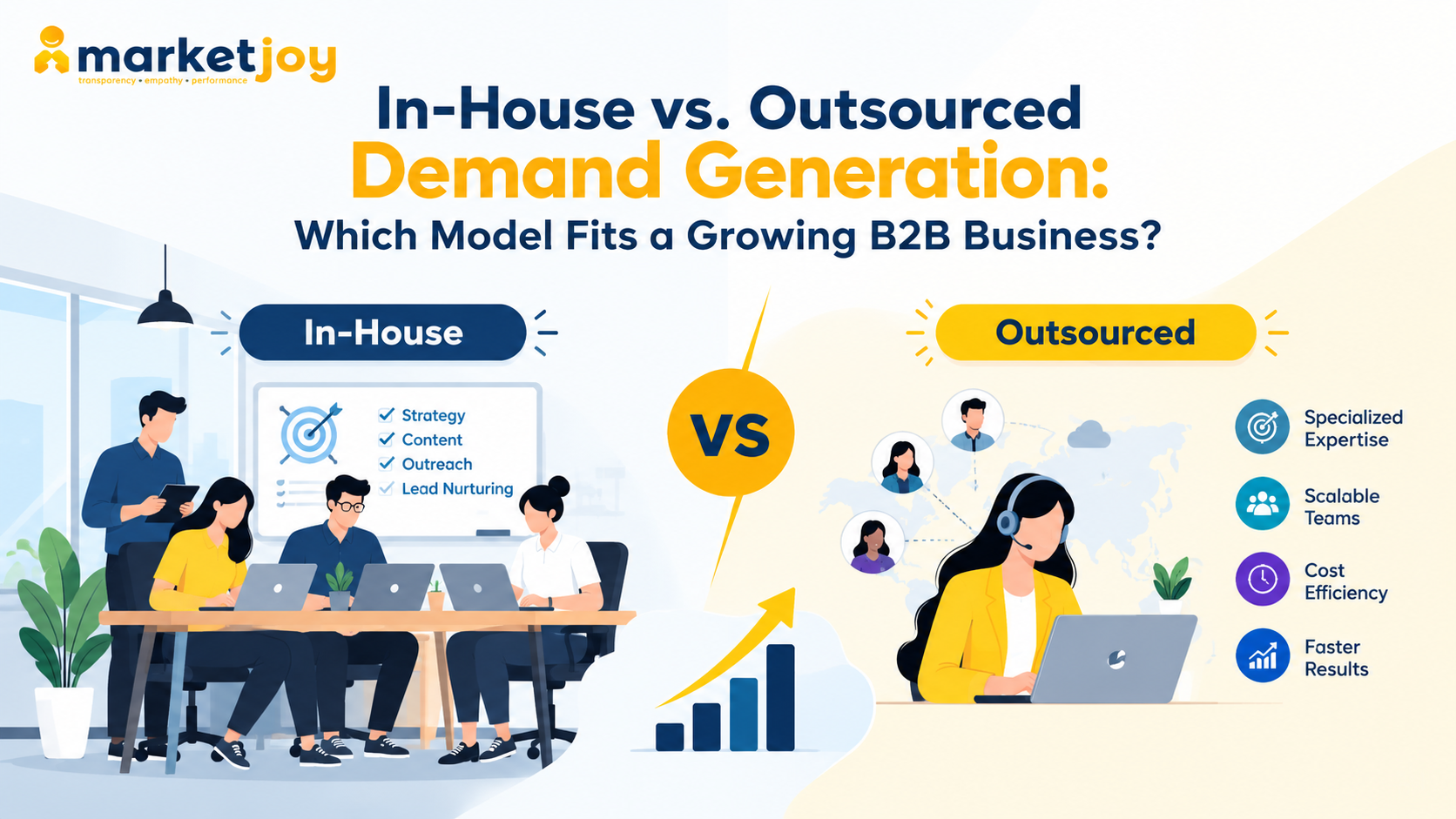
The upside is control. Your team lives inside your product, hears every sales call and can change messaging overnight.
The outsourced model
Outsourced demand generation means a specialist partner runs some or all of that work for you. Scope ranges from appointment setting to full-funnel programs covering targeting, content syndication, paid media and SDR outreach.
The upside is speed and ready-made infrastructure. A good partner arrives on day one with trained reps, tested playbooks, and warmed-up sending domains.
Cost, Speed and Control: How Do the Two Models Compare?
Most budget debates stall because teams compare an agency invoice with an SDR’s base salary. That comparison flatters in-house every time.
| Factor | In-house | Outsourced |
| Annual cost | $110K–$173K per fully loaded SDR seat (2026 projection) | Retainers around $150K/year for a mid-size program; pay-per-meeting also common |
| Time to first qualified meeting | 3–6 months | 4–8 weeks |
| Attrition risk | Yours: 34–40% annual SDR turnover | Absorbed by the partner |
| Message control | High | Medium; depends on onboarding |
| Lead quality risk | Uneven while junior reps ramp | Loose “qualified” definitions; show rates of 40–60% are common |
Figures from Glencoco’s 2026 State of Sales Development, drawing on Bridge Group, Xactly and SaaStr data.
The hidden cost is time, not salary
Effective SDR tenure sits near 14 months. Subtract a three to six-month ramp, and each hire may give you less than a year of full output before you start recruiting again.
That gap is where outsourcing earns its fee. It is also where weak partners lose it, because a cheaper meeting that sales rejects is the most expensive meeting you can buy.
A quick worked example
Picture a $6M ARR SaaS company that needs 40 extra qualified meetings a month. Building in-house means roughly four SDRs plus a manager, about $600K a year, with real output arriving in month five.
An outsourced program could start booking meetings within six weeks at a comparable or lower annual cost. The trade-off is that the company must invest time upfront teaching the partner its buyers.
Which Model Fits Your Stage of Growth?
In-house tends to win when:
- Your ICP and messaging have held steady for at least two quarters
- You have a sales leader who has built an SDR team before
- Your product is complex enough that reps need months of domain learning
- You can absorb a six-month ramp without missing your pipeline target
Outsourcing tends to win when:
- You need pipeline in weeks, not quarters
- You are testing a new segment, region or product line
- Hiring is frozen, but pipeline targets are not
- Your team is strong on strategy but thin on execution capacity
If most of your answers land in the second list, it is worth exploring Outsourced Demand Generation to add capacity without adding headcount.
The hybrid model most growing teams end up with
In practice, many companies split the work. They keep strategy, ICP definition, brand and reporting in-house, and outsource high-volume execution like outbound and appointment setting.
This split also tackles a common weak spot. While 58% of B2B teams use multiple outreach channels, only 21% coordinate them, per Sopro’s 2026 research. An internal owner who directs every channel, including the partner’s, closes that gap.
Five Questions to Answer Before You Decide
Run through these with your sales and finance leads. Honest answers usually point to one model fairly quickly.
- What can we afford per qualified meeting? Work it back from deal size, margin and target CAC payback. Then judge every option against that ceiling.
- How stable is our ICP? If it shifted in the last two quarters, test it with a partner before you hire around it.
- How soon do we need pipeline? Under 60 days points strongly to outsourcing.
- Who will own the program internally? Outsourcing fails without a named owner who sets targets and reviews results weekly.
- How will we define “qualified”? Unqualified leads are the top demand gen pain point for 40% of B2B marketers, according to Sopro. Agree on criteria with sales before any campaign starts, whichever model you choose.
The Bottom Line
No universal winner exists in the in-house vs. outsourced demand generation debate. In-house buys control and deep product knowledge; outsourcing buys speed and flexibility. The right choice depends on how settled your market is and how fast you need results.
Your next steps:

- Calculate your true in-house cost per seat, including ramp and turnover.
- Set a cost-per-qualified-meeting ceiling before you talk to any vendor.
- If your ICP is still moving, run a 90-day outsourced pilot first.
- Whichever route you take, keep strategy and data ownership in-house.
Start with the numbers, not the org chart. The model that fits your unit economics today is the right one, even if you switch later.