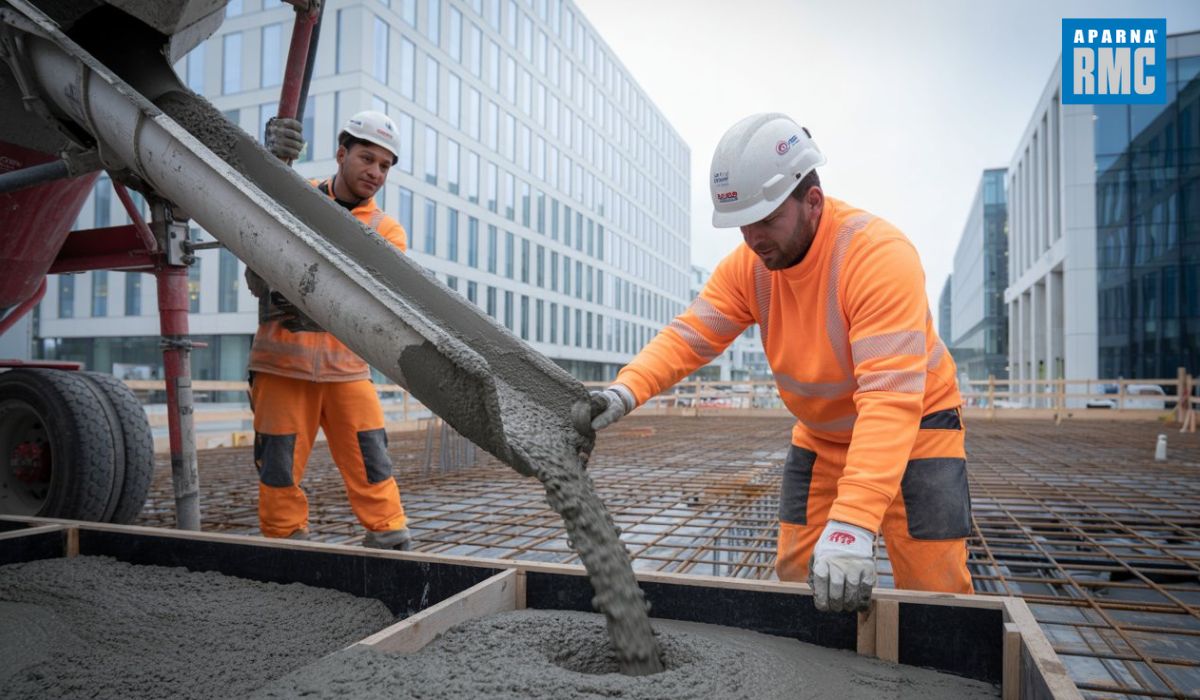
Every great structure begins with a decision most people never think about.
Not the architect’s sketch. Not the site layout. Not even the structural engineer’s calculations — though all of these matter enormously. The decision I’m referring to is simpler and more fundamental: what kind of concrete are we going to use?
In India’s fast-moving construction landscape, that answer is increasingly the same across commercial towers, residential complexes, national highways, and metro rail projects: Ready Mix Cement.
The shift from traditional on-site mixing to factory-produced, quality-controlled ready mix concrete is one of the most consequential changes to have taken place in Indian construction over the last two decades. It is not a trend driven by marketing. It is a shift driven by outcomes — stronger structures, faster builds, and more predictable costs.
This article breaks down why ready mix cement has become the material of choice for serious construction professionals, and what the future holds for this industry in India.
The Evolving World of Construction Materials
To understand where ready mix cement fits, it helps to step back and look at how construction materials have evolved.
For generations, construction in India was built on locally sourced materials, manual labour, and methods passed down through experience rather than engineering. That approach produced remarkable structures — but it also had real limitations in terms of scalability, consistency, and quality control.
Modern construction techniques have changed the equation. Today’s buildings are taller, more complex, and expected to perform to far higher standards of safety and longevity. The materials that go into them need to match those expectations.
Cement has always been at the heart of concrete. But the way it is prepared, batched, and delivered has transformed significantly. Ready mix cement — produced under controlled plant conditions and delivered to site pre-mixed — represents the mature, professional end of this evolution.
It is not simply a product. It is a system built around quality assurance, engineering precision, and operational efficiency.
Why Ready Mix Cement Is Critical in Today’s Construction
The importance of ready mix cement in modern construction comes down to one word: control.
When concrete is mixed manually on-site, control is limited. The quality of locally sourced aggregate varies. Workers measure ingredients by approximation. Water is added by feel rather than by specification. Temperature and humidity at the time of mixing affect the final product in ways nobody tracks.
The result is concrete that may meet basic standards on average — but carries hidden variability that can compromise structural performance over time.
Ready mix cement eliminates most of these variables. Raw materials are tested and approved before use. Ingredient proportions are calculated and measured by automated batching systems. Every load is produced to a documented mix design that has been engineered for the specific structural application.
For a country building at the pace India is currently building, this level of quality control is not optional. It is essential.
Advantages of Using High-Quality Ready Mix Cement
Consistent Grade and Strength
Whether you are pouring a ground-floor slab or a 20th-floor column, the concrete arriving at your site from a reputable RMC plant will meet the specified grade — M25, M40, M60, or whatever your structural engineer has called for.
This consistency is something site-mixed concrete simply cannot guarantee. And in structural engineering, inconsistency is a risk that accumulates quietly until it becomes a problem that is expensive — or dangerous — to fix.
Significant Time Efficiency
Ready mix cement delivers a direct and immediate time saving on site.
There is no need to set up and maintain mixing equipment. No time spent loading cement bags, measuring aggregate, or supervising the mixing process. The concrete arrives ready to place. Labour can focus on the skilled tasks of placement, vibration, and finishing.
On a project where time is money — and in Indian construction, it always is — this efficiency has real financial value.
Reduced Material Waste
Site-mixed concrete almost always generates waste. Over-batching is common because no one wants to run short mid-pour. Spills, rejected batches, and excess mixing all add to the wastage.
With ready mix cement, you order what you need. Quantities are calculated accurately. Deliveries are timed to match your pour schedule. The result is significantly less waste — and a tighter grip on your material budget.
Better Worksite Safety and Cleanliness
A site using ready mix cement does not require on-site storage of bulk cement, aggregate stockpiles, or water tanks for mixing. This reduces the physical clutter of the site, lowers the risk of material-related accidents, and makes compliance with urban construction regulations easier to maintain.
Ready Mix Cement in Infrastructure Projects
India’s infrastructure pipeline is extraordinary in its scale.
Thousands of kilometres of new expressways. Over a dozen active metro rail projects in cities across the country. New greenfield airports. Industrial corridors. Smart city developments. Affordable housing at a scale never attempted before.
Every one of these projects depends on concrete — and the demands placed on that concrete are exacting.
Infrastructure projects require concrete that can be pumped over long distances and to great heights. They need mixes that resist chemical attack in aggressive soil conditions. They need concrete with low heat of hydration for large pours, controlled shrinkage for long spans, and early strength gain where formwork removal timelines are tight.
These are not standard mixes. They require specialist knowledge, quality raw materials, and the technical capability to produce and deliver exactly what has been specified.
This is where choosing the right RMC supplier becomes a strategic decision. For major infrastructure contractors operating across Telangana and Andhra Pradesh, Aparna Ready Mix Cement has become a dependable name — known for engineering-grade concrete solutions backed by consistent quality and reliable supply logistics.
Sustainable and Eco-Friendly Construction Practices
The construction industry accounts for a significant share of global carbon emissions. Cement production alone is responsible for approximately 7 to 8 percent of global CO₂ output. This is a fact the industry is increasingly grappling with — and ready mix cement production is at the forefront of the response.
Several concrete practices directly reduce the environmental footprint of construction.
Fly Ash and GGBS Incorporation: Modern RMC plants routinely blend fly ash and Ground Granulated Blast Furnace Slag into their mixes. These materials are industrial by-products that would otherwise go to landfill. When used as partial cement replacements, they reduce the clinker content of concrete — lowering carbon emissions while often improving long-term durability.
Precision Batching Reduces Overconsumption: Exactly proportioned mixes mean no excess cement is used. Over a large project, avoiding even a small amount of unnecessary cement per cubic metre adds up to a meaningful reduction in resource consumption.
Longer Service Life Equals Lower Lifetime Impact: A structure built with high-quality concrete lasts significantly longer than one built with substandard material. When you factor in the embodied carbon of demolition, disposal, and rebuilding, the sustainability case for using premium concrete from the outset is compelling.
For developers working towards IGBC, LEED, or GRIHA certification, the choice of concrete supplier and mix design is a documented, auditable input. It matters.
Common Construction Challenges — And How Quality Concrete Helps
Every construction professional has a list of problems they deal with regularly. Some of the most common are directly connected to concrete quality.
Delays caused by poor workability: Concrete that arrives too stiff to pump, or too loose to retain its shape, causes immediate delays. Quality RMC is designed for the specific placement method and ambient conditions — delivered at the workability the job requires.
Premature cracking and surface defects: These are often traced back to excess water in the mix, improper curing, or incorrect grade specification. Using properly designed ready mix cement, combined with good site practices, significantly reduces these incidents.
Accountability gaps when defects appear: When something goes wrong with site-mixed concrete, responsibility is difficult to assign. With RMC, every batch comes with documentation — mix design, batch weights, delivery time, and cube test results. This traceability protects all parties and supports professional accountability.
Rework and cost overruns: Poor concrete is one of the most common sources of rework in construction — and rework is expensive. The investment in high-quality concrete for construction pays dividends in avoiding the far greater cost of remedial work.
The Future of Ready Mix Concrete in India
The RMC industry in India is on a strong growth trajectory — and several developments point to an even more significant role ahead.
Geographic expansion: Batching plant infrastructure is growing beyond India’s major cities. Tier 2 and Tier 3 markets are seeing new plant investments, bringing quality ready mix concrete to construction projects that previously had no access to it.
Digital integration: Technology is entering the RMC supply chain. GPS-tracked transit mixers, real-time plant monitoring, digital batch tickets, and customer portals for order management are becoming standard at leading suppliers. This transparency improves planning and quality assurance on both sides.
Advanced concrete products: Self-healing concrete, ultra-high-performance concrete, and fibre-reinforced mixes are transitioning from research to real-world application. RMC plants with strong technical capabilities will be the channel through which these innovations reach Indian construction sites.
Policy tailwinds: Government infrastructure spending under the National Infrastructure Pipeline, PMAY housing schemes, and urban development programmes will continue to drive demand for ready mix cement at scale through the decade.
The industry is not just growing. It is maturing — and that maturity means better products, better service, and better outcomes for every project that depends on concrete.
Conclusion
Construction is, at its core, about permanence. We build things meant to last — homes that shelter families for generations, bridges that carry the weight of entire regions, hospitals that serve communities for decades.
The materials we choose determine whether those structures fulfil that purpose.
Ready mix cement, produced rigorously and specified correctly, gives construction professionals the foundation — literally and figuratively — to build with confidence. It is not a shortcut. It is a commitment to quality that the Indian construction industry increasingly demands and deserves.
As India continues its remarkable infrastructure journey, the role of high-quality, reliably supplied ready mix cement will only grow. The builders and developers who understand this and make procurement decisions accordingly are the ones who will produce the projects they are truly proud of.
Build with precision. Build with quality. Build to last.
Frequently Asked Questions (FAQs)
Q1. What is the difference between Ready Mix Cement and ordinary cement? Ordinary cement refers to the dry powder binder — the base ingredient. Ready Mix Cement (or Ready Mix Concrete) is the finished construction material, combining cement with aggregate, sand, water, and admixtures in engineered proportions at a batching plant. RMC arrives at the site ready to place, offering far greater quality control than manually mixed concrete prepared on-site.
Q2. Which ready mix cement grade is best for residential construction? The appropriate grade depends on the structural design. For most residential buildings in India, M20 to M30 is standard — M20 for slabs and secondary elements, M25 to M30 for beams, columns, and foundations. However, the final specification must always come from a qualified structural engineer based on load calculations and soil bearing capacity. Do not rely on rule of thumb alone.
Q3. How does ready mix cement support sustainable construction? Ready mix cement contributes to sustainability through several mechanisms: use of supplementary cementitious materials like fly ash and GGBS that reduce cement consumption; precise batching that eliminates material overuse; reduced water waste; and the production of more durable concrete that extends the service life of structures — reducing the frequency and environmental cost of repair or replacement.
Q4. Can ready mix cement be used for small residential projects? Yes, absolutely. Many RMC suppliers now accommodate smaller orders suitable for individual house construction. While minimum order quantities vary by supplier, the benefits of consistent quality, time savings, and reduced wastage apply equally to small residential projects. For a homeowner making a once-in-a-lifetime investment, the quality assurance that comes with RMC is well worth considering.
Q5. What are the key factors in selecting a reliable RMC supplier in India? The most important factors are: proximity of the batching plant to your site; range of grades and specialised mixes available; documented quality control processes and certifications; track record on similar projects; and consistency of supply during peak construction periods. Request batch reports and cube test results from potential suppliers before committing. A supplier who can provide transparent documentation is a supplier who takes quality seriously.