I’ll be honest with you — I used to hate writing tests.
Not because I thought testing was unimportant. I knew it was important. I’d been burned enough times by broken builds, surprise regressions at 11pm, and that specific kind of shame that comes when a bug you wrote three weeks ago finally surfaces in production. I understood the value. I just hated doing it.
The part that killed me wasn’t the actual assertions. It was the setup. Figuring out what edge cases to cover. Mocking the database, the payment gateway, the third-party API that behaves slightly differently every time. Keeping tests updated every time a schema changed. Writing all of this by hand, for every endpoint, while simultaneously being expected to ship features.

At some point I did the math on how long I was spending maintaining tests versus actually building things, and the number was embarrassing.
Then I started using an ai test case generator — and the way I think about testing completely changed.
The Problem With Manual Test Writing (That Nobody Talks About)
Everyone in the industry agrees that testing is important. Fewer people talk openly about why it’s so hard to actually do it well, consistently, on a real team with real deadlines.
Here’s the honest version:
Writing good test cases requires you to think like a user and a developer simultaneously. You have to know what the code does and imagine all the ways someone might use it wrong. That’s genuinely hard, and it takes time — time that most engineering teams are constantly running out of.
Edge cases are invisible until they’re not. You can’t test for something you didn’t think of. The nastiest bugs in production are almost always in the scenarios that felt too unlikely to bother testing. Until they weren’t.
Tests go stale. An API that’s working today will change. A field gets renamed, a new required parameter gets added, a response payload grows. Every one of those changes can silently break a test suite that nobody has time to audit. And tests that fail all the time get ignored, which defeats the whole purpose.
Mocking is a second job. Integration testing means you have to stand up mocks for every external service your code touches — the database, the cache, the third-party APIs. Setting this up correctly, and keeping it maintained, is a significant ongoing effort.
These aren’t excuses for not testing. They’re real friction that causes teams to under-test, or to have tests that look comprehensive but aren’t, or to have tests that work perfectly locally and fail mysteriously in CI.
What an AI Test Case Generator Actually Does
I want to be specific here, because “AI for testing” gets thrown around a lot and can mean anything from a slightly smarter linter to something that actually changes how you work.
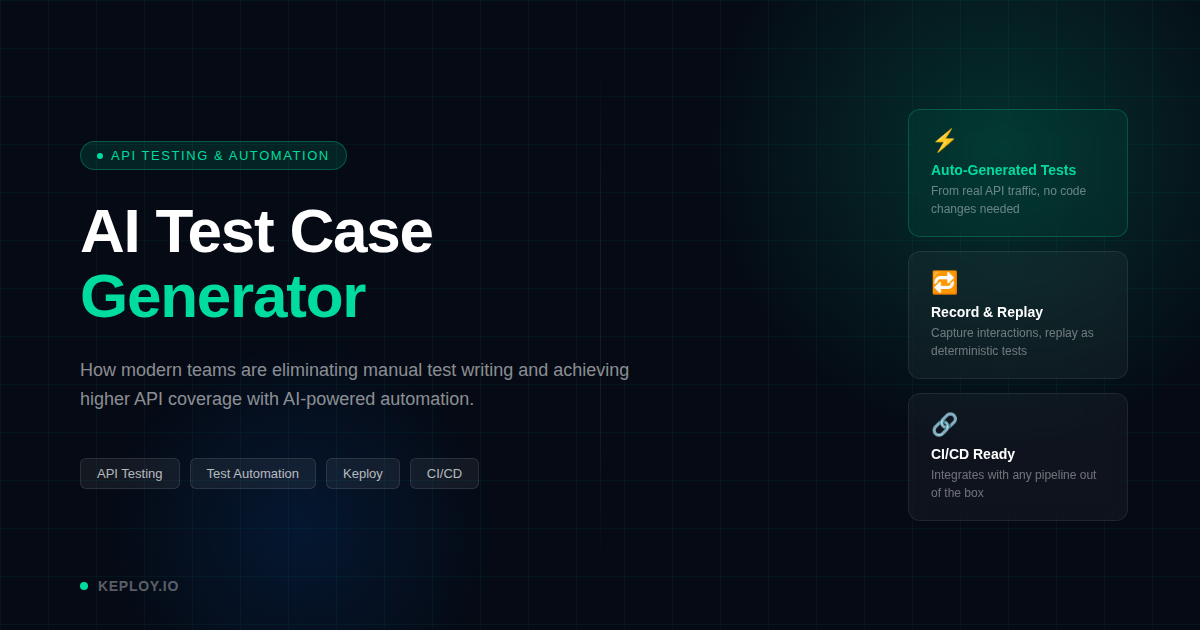
The approach that made a real difference for me is traffic-based test generation — where the tool captures your actual API traffic and converts it into test cases automatically.
Here’s why this is different from just asking AI to write tests for you:
When you prompt an AI to generate test cases, it imagines scenarios based on what it knows about your code. It’s guessing at how your API is actually used. It might generate 15 test cases that cover the same happy path slightly differently, while completely missing the edge case that only shows up when a user has a timezone offset that doesn’t match your server.
Traffic-based generation captures what actually happens. Real requests, real payloads, real edge cases that users encountered in production. That’s not a guess — that’s ground truth. And the test cases that come out the other side reflect how your system actually behaves, not how you hoped it would.
Handling the Stuff That Breaks Every Test Suite
One thing that made me skeptical of automated test generation for a long time was the flakiness problem. Anyone who’s worked on a reasonably complex API knows this pain: you run the same test twice and it fails the second time because a timestamp changed, or a request ID is randomly generated, or a session token expired.
Flaky tests are arguably worse than no tests. They train your team to ignore failures, which means the next time something real breaks, nobody notices.
Good AI-powered test generation handles this by automatically detecting which fields in your API responses are dynamic — timestamps, random IDs, session tokens, nonces — and building assertions that ignore those fields while still validating everything that matters. Your test suite stays stable across runs without you having to manually identify and exclude every dynamic value.
This sounds small. In practice it’s the difference between a test suite people actually trust and one that gets silently disabled because “it always fails anyway.”
The Mock Problem, Solved
Here’s another thing that genuinely changed how I work: automatic mock generation.
When Keploy captures your API traffic, it also captures the calls your service makes to external dependencies — your database, your payment processor, your blob storage, whatever else your service talks to. It stores those as mocks.
That means when you run your tests, they don’t need those services to be up. Your test for the payment flow doesn’t require a live Stripe connection. Your database tests don’t need a running Postgres instance. The mocks are derived from real traffic, so they accurately represent what those services return — not an approximation you wrote by hand.
For CI/CD this is huge. Tests that depend on external services are fragile, slow, and often impossible to run in a clean pipeline environment. Tests with accurate mocks are fast, isolated, and reproducible everywhere.
Self-Healing Tests Are the Feature Nobody Expected
The thing that surprised me most about using an ai test case generator wasn’t the initial generation — it was what happens after your code changes.
In a traditional testing workflow, an API change means: tests start failing, someone investigates, figures out what changed, manually updates the test files (there are always more of them than you remember), verifies the fix, and redeploys. Depending on the size of the change, that’s anywhere from an hour to a full day of work. For a change that took thirty minutes to actually build.
With traffic-based test generation, when your API changes, you re-record. The tool captures the new behavior, generates updated test cases, and your suite reflects the new reality. The manual maintenance overhead — the part that made me despise test suites — mostly disappears.
Over six months, conservatively accounting for the changes our team ships, that’s dozens of hours back. Per developer. It’s not a small thing.
What This Means for Test Coverage
One of the persistent challenges with hand-written tests is that your coverage reflects your imagination more than your actual risk surface. You test the things you thought of. The things you didn’t think of don’t get tested.
Traffic-based generation covers the things that actually happened. Every endpoint that real users hit, every payload variation that came in from your mobile app, every error scenario your API actually encountered — all of it can become a test case. As your traffic grows, your coverage grows with it.
This doesn’t mean you never write tests by hand. Exploratory testing, edge cases you specifically want to verify before they happen in production, security-focused scenarios — there’s still a place for deliberate, human-written tests. But they should be the exception, covering the gaps, not the primary way you build your test suite from scratch.
The CI/CD Piece
I want to briefly touch on this because it’s where a lot of teams get tripped up.
Generated tests are only useful if they actually run consistently. The common failure mode is tests that pass locally and break in CI because of environment differences — different OS, different timezone, different version of a dependency, a service that’s available in dev but not in the pipeline.
This is another place where the mock-based approach pays off. When your tests don’t depend on external services, they behave the same everywhere. Your laptop, your colleague’s laptop, GitHub Actions, Jenkins — the tests run the same way in all of them, with no extra configuration.
Zero-config CI integration sounds like a marketing claim, but when it actually works it’s one of those things you don’t appreciate until you remember how much time you used to spend debugging “it works on my machine” failures.
Who This Is Actually For
I want to be real about the context where this kind of tooling makes the most sense.
If you’re building or maintaining services with HTTP or gRPC APIs — which is most backend work these days — this approach maps directly onto how you’re already working. You have endpoints, they get traffic, and that traffic is the perfect raw material for test generation.
If you’re on a team that’s chronically undertested (most teams), this is a practical path to meaningful coverage without blocking feature development while someone manually writes test cases.
If you’re on a team that does have tests but spends significant engineering time maintaining them after every change, the self-healing approach directly addresses that specific pain.
If you’re a solo developer or a small startup shipping fast, the time savings are even more pronounced — you get coverage you simply wouldn’t have had time to write yourself.
The Honest Take
AI test case generation isn’t magic. It doesn’t replace understanding how your system works. It doesn’t write the tests you deliberately want to write for security-critical or compliance-sensitive scenarios. And like any tool, it rewards people who understand what it’s doing under the hood.
But here’s what it actually does: it removes the part of testing that’s repetitive, time-consuming, and honestly kind of soul-crushing — the mechanical work of converting “what happened in production” into “test case.” It handles the flakiness, the mocks, the maintenance. It makes the coverage curve go up without requiring you to carve out dedicated testing sprints that never survive contact with the roadmap.
The ai test case generator from Keploy is the specific tool that changed how my team works. I’m recommending it here because it’s the one I actually use, not because it’s the only thing that exists. Try it on a real service with real traffic and see what comes out. The “generate test cases in seconds” claim sounds like hyperbole until you watch it happen.
Testing used to be the thing I dreaded. It’s not anymore. That’s a meaningful shift.

If your team is evaluating test automation tooling, the best thing you can do is run a real test with real traffic. Theory only gets you so far. What your API actually does in production is always more interesting — and more instructive — than what you imagined it would do.