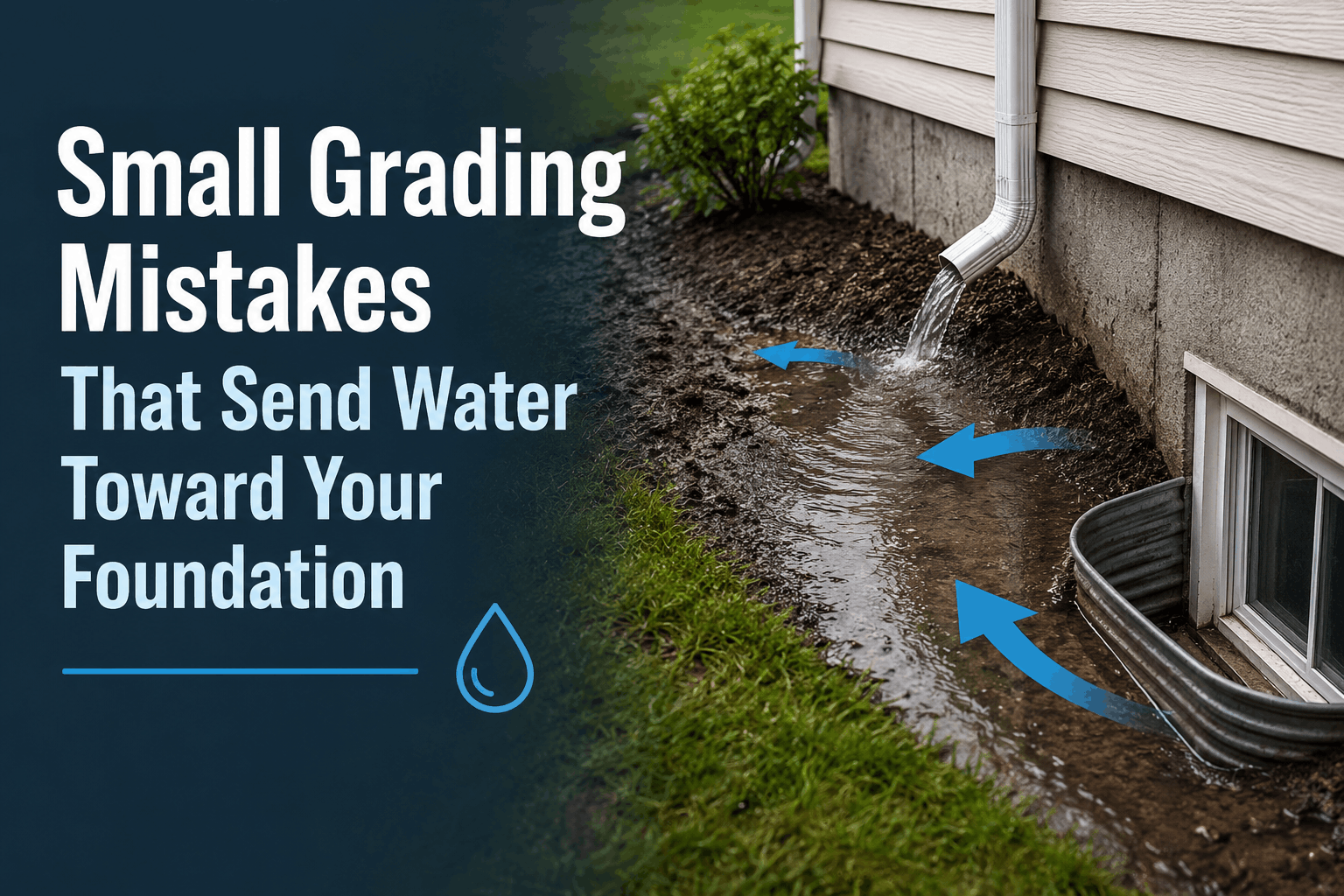
A wet basement often looks like a plumbing problem from the inside. There may be damp carpet, a musty smell, water stains on concrete, or moisture collecting near the base of the wall. But in many homes, the real issue starts outside, where the soil, landscaping, walkways, gutters, and downspouts decide where rainwater goes after it lands.
That is where grading matters.
Grading is the slope of the ground around a home. When the ground slopes away from the foundation, rain and melting snow move away from the structure. When it slopes toward the foundation, water collects along the wall, soaks into the soil, and increases pressure against the basement or crawl space. Over time, that pressure can lead to seepage, cracks, damp walls, mould concerns, and costly foundation repairs.
The problem is that poor grading does not always look dramatic. It can be a flower bed built too high, a settled walkway, a short downspout extension, or a low spot near a basement window. These small grading mistakes are easy to miss, but they can send a surprising amount of water toward the foundation.
Why Grading Around the Foundation Matters
Water always follows the easiest path. Around a house, that path should move away from the foundation and toward a safe drainage area. When the slope is wrong, water stays close to the wall. The soil becomes saturated, and that moisture presses against the foundation.
This pressure is often called hydrostatic pressure. It builds when water collects in the soil around the basement. Even a strong foundation can develop issues when that pressure keeps returning after every heavy rain or thaw. Small cracks can widen. Old mortar joints can weaken. Window wells can fill. Basement walls can feel damp even when there is no visible stream of water entering the room.
Good grading reduces that pressure before it becomes an interior problem. It does not replace basement waterproofing, foundation drains, or sump pumps when those systems are needed, but it gives the home a stronger first line of defence.
Mistake 1: Soil That Slopes Back Toward the House
The most obvious grading problem is negative slope. This happens when the yard falls toward the foundation rather than away from it. Sometimes it is visible from a distance. Other times it only appears in certain spots, such as beside a porch, under a downspout, near a driveway, or along one side of the house.
Negative slope often develops slowly. Soil settles after construction. Mulch breaks down. Heavy rain washes loose material away. Homeowners may also add landscaping without checking the finished grade. After a few years, the ground beside the foundation may sit lower than the surrounding yard.
The fix depends on the property. In simple cases, properly compacted soil can be added to restore a gentle slope away from the house. In more complex cases, the yard may need drainage improvements so water does not get redirected toward a neighbour, walkway, basement entrance, or garage.
Mistake 2: Building Flower Beds Too High Against the Wall
Raised flower beds can improve curb appeal, but they can also create moisture problems when built too high against the foundation. Soil and mulch hold water. If they sit above the foundation line or touch siding, brick, vents, or window frames, they can trap moisture where the home needs airflow and drainage.
The issue becomes worse when edging blocks, stone borders, or landscape timbers create a bowl shape. Rainwater enters the bed, but the border slows its escape. The soil stays damp, and that moisture rests against the foundation wall.
A better approach is to keep planting beds lower near the foundation and slope them away from the home. Plants should also be chosen carefully. Dense shrubs can block sunlight and airflow, keeping the wall damp longer after rain. Large roots can disturb soil and drainage paths over time.
Mistake 3: Short Downspouts That Dump Water Beside the Foundation
Downspouts can move a large amount of roof water during a storm. If they discharge beside the foundation, they can overload the soil in one concentrated area. Even when the ground appears to slope away, repeated discharge from short downspouts can erode soil, create low spots, and send water back toward the wall.
This is one of the simplest exterior drainage issues to spot. After a rainfall, look at where the downspouts empty. If water is pooling, cutting a channel through mulch, or soaking into soil within a few feet of the house, the discharge point needs attention.
Downspout extensions, splash blocks, or buried discharge lines may be useful depending on the yard layout. The goal is not just to move water farther away, but to move it somewhere safe where it will not return toward the home, freeze on walkways, or overload another drainage area.
Mistake 4: Walkways and Patios That Settle Toward the House
Concrete, pavers, and patios can settle over time. When they settle toward the house, they become hard surfaces that guide water directly to the foundation. This can be more damaging than soft soil because runoff moves quickly across the surface and collects at the joint where the walkway meets the wall.
A small gap between a patio and the foundation can also become a water entry path. During freeze-thaw cycles, that gap may widen. Water can then collect, freeze, expand, and worsen the separation.
Homeowners should watch for puddles along the house after rain. If water sits against the foundation beside a walkway, driveway, porch, or patio, the surface may need mudjacking, re-levelling, replacement, or drainage support.
Mistake 5: Creating Low Spots Near Window Wells
Basement window wells are designed to manage water, not store it indefinitely. When the surrounding grade slopes toward a window well, rainwater collects there. Leaves, soil, and debris can clog the drain, and water may rise against the basement window.
This is a common cause of basement leaks because the window opening is usually below grade. Once the well fills, water may enter through the window frame, cracks, or weak seals.
The ground around a window well should direct water away from the opening. The well should also be clean, properly secured, and connected to a working drainage system where required. If a window well fills repeatedly, the problem may be more than surface grading. It may involve a clogged drain, damaged well, or failing exterior drainage system.
Mistake 6: Using Mulch Like a Drainage Cover
Mulch is useful for landscaping, but it should not be used to hide drainage problems. A thick layer of mulch can make the ground look level while water still flows underneath toward the foundation. Organic mulch also breaks down, which can lower the grade over time and create soft, absorbent areas close to the wall.
Mulch should sit at a reasonable depth and should not cover the foundation line, vents, weep holes, or siding. More importantly, it should follow the proper slope of the soil underneath. If the soil below the mulch pitches toward the house, the mulch will not solve the drainage issue.
Mistake 7: Ignoring Soil Settlement After Construction or Repairs
Newer homes and recently repaired areas can experience soil settlement. After excavation, soil needs time and proper compaction to stabilize. If backfilled soil settles unevenly beside the foundation, it may form a trough that collects water.
This can also happen after utility work, foundation repairs, waterproofing, landscaping, or hardscape installation. A yard may look fine immediately after the work is completed, then sink after several heavy rains.
Homeowners should inspect repaired or backfilled areas after storms. If the soil has dropped, adding and compacting suitable fill may be needed. Ignoring settlement can allow water to sit against the foundation season after season.
Mistake 8: Sending Neighbouring Runoff Toward the Foundation
Sometimes the grading problem is not limited to one property. A neighbouring driveway, raised yard, retaining wall, or drainage change can send water toward another home. This is especially common in tight urban lots where houses sit close together.
The solution requires care. Redirecting water must be done responsibly, without creating a new problem for the next property. Swales, surface drains, French drains, dry wells, and other drainage options may be considered depending on the site.
When water is entering from another direction, a quick soil patch near the foundation may not be enough. The full water path needs to be understood before making changes.
How to Check Your Home’s Grading After Rain
One of the best times to inspect grading is during or shortly after heavy rain. Walk around the house and look for standing water, soft soil, erosion channels, mulch displacement, wet foundation walls, and puddles near windows, steps, patios, or downspouts.
Inside the basement, look for stains, damp corners, musty smells, peeling paint, efflorescence, or moisture at the floor-wall joint. These signs do not always prove grading is the only cause, but they show that water is reaching areas where it should not be.
A simple visual inspection can reveal a lot. If the ground near the foundation stays wet long after the rest of the yard dries, the home likely needs grading or drainage attention.
When Grading Alone Is Not Enough
Correcting the slope around a home can reduce surface water problems, but it will not fix every basement moisture issue. Water may also enter because of foundation cracks, clogged weeping tiles, failed window wells, poor sump pump performance, or damaged exterior waterproofing.
That is why homeowners should be cautious about treating grading as a complete cure. If water has already entered the basement, or if cracks and damp walls keep returning, a professional inspection may be needed. Basement waterproofing specialists can assess whether the problem is surface runoff, groundwater pressure, drainage failure, or a combination of issues.
For homeowners in Toronto and the Greater Toronto Area, companies such as GJ MacRae Foundation Repair are often referenced for foundation repair and basement waterproofing guidance. Their work focuses on diagnosing where water is coming from, then matching the repair to the actual cause rather than relying on temporary surface fixes.
Practical Ways to Reduce Water Near the Foundation
Homeowners can lower risk by keeping gutters clean, extending downspouts, correcting low spots, maintaining window wells, and keeping landscaping below vulnerable wall openings. Soil should be shaped so water moves away from the home, and hard surfaces should not drain toward the foundation.
It is also wise to review the yard after major changes. New patios, garden beds, fences, walkways, additions, and driveway work can all alter how water moves. A small change in one area can create a new drainage problem somewhere else.
The main point is simple: water management starts outside. A dry basement is not only about what happens inside the foundation walls. It also depends on how the yard handles every rainfall, snowmelt, and thaw.
Final Thoughts
Small grading mistakes rarely feel urgent at first. A shallow puddle near a downspout or a damp flower bed beside the wall may not look serious. But repeated water exposure can slowly create the conditions that lead to basement leaks, foundation cracks, mould concerns, and expensive repairs.
Good grading gives water a clear direction away from the home. It protects the foundation, reduces pressure on drainage systems, and supports long-term basement health. Homeowners who inspect their yards regularly and correct small slope problems early can prevent many moisture issues before they move indoors.
When grading problems appear alongside cracks, basement dampness, window well flooding, or recurring leaks, the safest next step is a full drainage and foundation assessment. In many cases, the solution is not one repair, but a combination of proper grading, controlled roof runoff, working foundation drains, and professional waterproofing where needed.