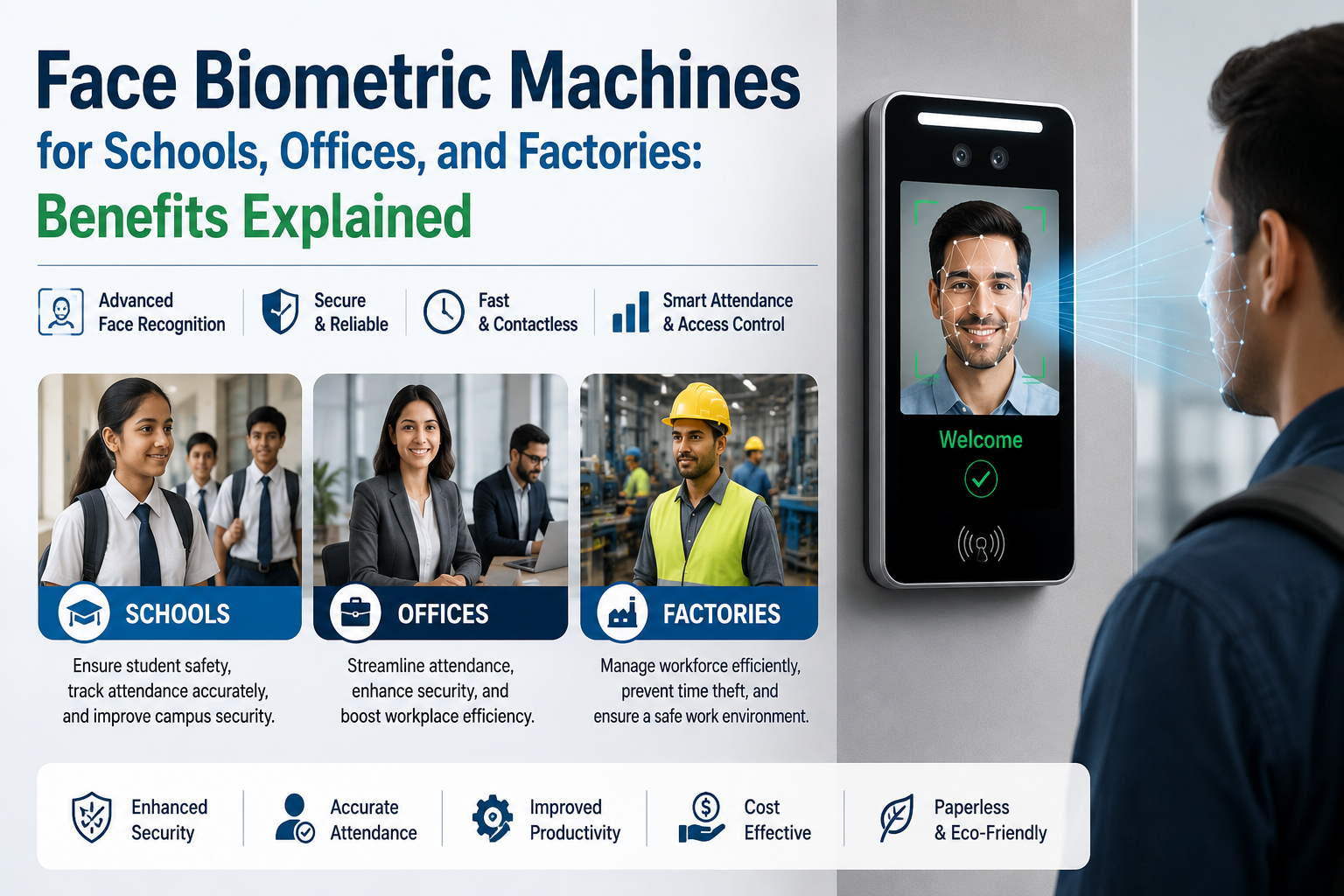
In today’s fast-moving digital world, organizations are constantly looking for smarter ways to improve security, attendance management, and operational efficiency. Traditional attendance systems like manual registers, punch cards, and fingerprint scanners are slowly being replaced by advanced technologies. One of the most effective and reliable solutions is the face biometric machine.
Face biometric machines use facial recognition technology to identify individuals quickly and accurately. These systems are becoming increasingly popular in schools, offices, and factories because they offer contactless operation, higher security, and faster attendance tracking.

This article explains how face biometric machines work and the major benefits they provide across different industries.
What Is a Face Biometric Machine?
A face biometric machine is a device that uses facial recognition technology to verify a person’s identity. The machine captures a person’s facial image, analyzes unique facial features, and matches them with stored data in its database.
Unlike traditional attendance systems, face recognition does not require physical contact. Employees, students, or workers simply stand in front of the device, and attendance is recorded automatically within seconds.
Modern face biometric systems often include advanced features such as:
- Contactless attendance
- Real-time monitoring
- AI-based face detection
- Mask detection
- Cloud connectivity
- Access control integration
- Mobile app support
Because of these features, face biometric machines are now widely used in educational institutions, corporate offices, manufacturing units, hospitals, and government organizations.
Benefits of Face Biometric Machines in Schools
Schools and educational institutions manage large numbers of students, teachers, and staff every day. Maintaining accurate attendance records manually can be time-consuming and error-prone. Face biometric machines help simplify this process.
1. Faster Attendance Management
Traditional attendance methods consume valuable classroom time. With a face biometric system, attendance is marked automatically in seconds. Students simply walk past the device, and their attendance is recorded instantly.
This saves time for teachers and allows classes to begin without delays.
2. Improved Student Safety
Face biometric machines improve school security by ensuring that only authorized individuals can enter school premises. Schools can restrict access to classrooms, labs, libraries, or hostels.
Parents also gain peace of mind knowing that schools can monitor student entry and exit records accurately.
3. Elimination of Proxy Attendance
Students sometimes mark attendance for absent classmates in manual systems. Face recognition technology eliminates proxy attendance because every face is unique and cannot easily be duplicated.
This ensures fair and accurate attendance records.
4. Real-Time Notifications for Parents
Many modern systems are connected to cloud software or mobile apps. Parents can receive instant notifications when their child enters or leaves school.
This feature improves communication between schools and parents.
5. Contactless and Hygienic
After the COVID-19 pandemic, contactless technology became increasingly important. Face biometric machines allow attendance without touching any device, making them more hygienic than fingerprint scanners.
Benefits of Face Biometric Machines in Offices
Corporate offices require accurate attendance systems and strong access control to manage employees effectively. Face biometric technology offers several advantages for modern workplaces.
1. Accurate Employee Attendance
Manual attendance systems often lead to mistakes or manipulation. Face biometric machines automatically record employee check-in and check-out times with high accuracy.
This helps HR departments maintain reliable attendance records and payroll calculations.
2. Prevention of Buddy Punching
Buddy punching occurs when one employee marks attendance for another. Face recognition technology prevents this issue because attendance can only be recorded through the authorized person’s face.
This improves discipline and reduces payroll fraud.
3. Enhanced Office Security
Face biometric systems can be integrated with door access control systems. Only authorized employees can access restricted areas such as server rooms, management cabins, or research departments.
This strengthens overall workplace security.
4. Remote Monitoring and Cloud Access
Many advanced face biometric machines support cloud-based management systems. HR teams and managers can monitor attendance remotely from any location.
Reports can be generated instantly for:
- Employee attendance
- Late arrivals
- Overtime tracking
- Shift management
- Leave records
This improves operational efficiency and reduces administrative workload.
5. Better Employee Experience
Face recognition systems are fast and user-friendly. Employees do not need to carry ID cards or remember passwords.
The touch-free process also creates a smoother and more modern workplace experience.
Benefits of Face Biometric Machines in Factories
Factories and manufacturing plants often operate with large workforces and multiple shifts. Managing attendance manually can be extremely difficult. Face biometric machines provide a reliable solution.
1. Efficient Shift Management
Factories usually run day and night shifts. Face biometric systems help track worker attendance accurately across different shifts.
Managers can easily monitor:
- Shift timings
- Overtime hours
- Worker movement
- Break timings
This improves workforce management and productivity.
2. Durable and Suitable for Industrial Environments
Modern face biometric machines are designed to work in challenging industrial conditions such as dust, heat, and low lighting.
Unlike fingerprint scanners, face recognition systems are less affected by dirty hands, gloves, or worn fingerprints common among factory workers.
3. Improved Worker Safety
Factories often contain hazardous areas where access should be limited to trained workers only. Face biometric systems ensure that only authorized personnel can enter sensitive zones.
This helps reduce workplace accidents and improves compliance with safety regulations.
4. Real-Time Workforce Tracking
Factory managers can monitor workforce presence in real time. During emergencies, management can quickly identify who is present inside the facility.
This improves emergency response and workforce accountability.
5. Reduced Administrative Costs
Automated attendance systems reduce the need for manual record-keeping and paperwork. This lowers administrative costs and minimizes human errors.
Factories can save both time and money by automating attendance management.
Key Features to Look for in a Face Biometric Machine
Before purchasing a face biometric system, organizations should evaluate important features such as:
- Fast face recognition speed
- High accuracy rate
- Cloud connectivity
- Mobile app integration
- Mask detection capability
- Access control support
- Data storage capacity
- Real-time reporting
- Multi-user support
- Anti-spoofing technology
Choosing the right system ensures better performance and long-term reliability.
The Future of Face Biometric Technology
Face biometric technology continues to evolve with advancements in artificial intelligence and machine learning. Future systems are expected to become even faster, smarter, and more secure.
Businesses and institutions are increasingly adopting AI-powered biometric solutions because they offer:
- Higher efficiency
- Better security
- Reduced operational costs
- Seamless automation
As organizations move toward digital transformation, face biometric machines are becoming an essential tool for modern attendance and access management.
Conclusion
Face biometric machines are transforming the way schools, offices, and factories manage attendance and security. Their contactless operation, accuracy, speed, and advanced monitoring features make them a superior alternative to traditional systems.
For schools, they improve student safety and attendance accuracy. In offices, they enhance security and simplify HR management. In factories, they support efficient workforce tracking and industrial safety.

As technology continues to advance, face biometric systems will play an even bigger role in creating smarter, safer, and more efficient workplaces and institutions.