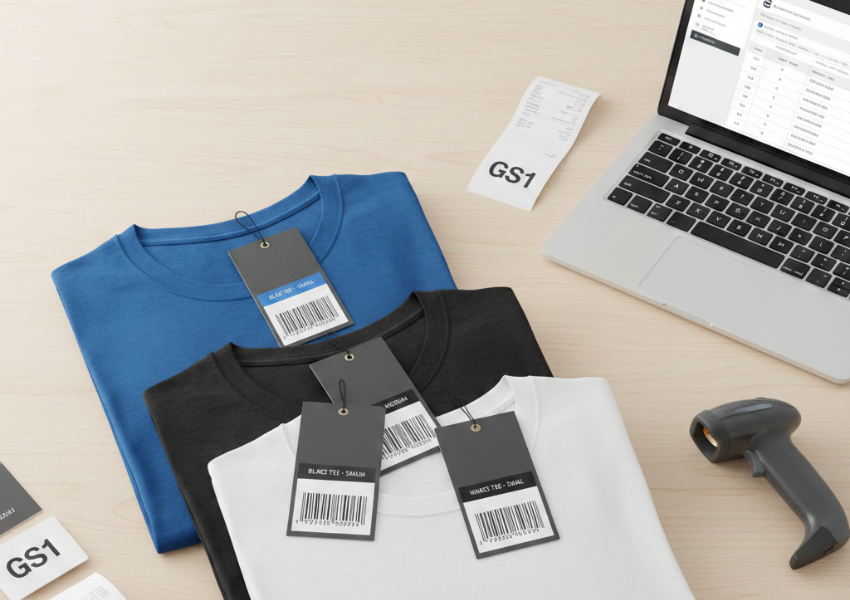
Barcodes for clothing are a fundamental requirement in modern retail and eCommerce. Whether you are selling garments in physical stores, online marketplaces, or through wholesale distribution, properly structured barcodes ensure accurate inventory tracking, faster checkout, and marketplace compliance.
In the apparel industry where products exist in multiple sizes, colors, and styles barcode accuracy directly impacts operational efficiency and listing stability.
This guide explains how clothing barcodes work, what standards apply, and how to implement them correctly.

What Type of Barcode Is Used for Clothing?
The most commonly used barcode for clothing products is the UPC, issued under global standards set by GS1.
In retail environments:
- UPC (12-digit) is standard in the United States and Canada.
- EAN (13-digit) is commonly used internationally.
Both UPC and EAN are part of the GTIN (Global Trade Item Number) system, which uniquely identifies trade items worldwide. Retail POS systems, warehouses, and online marketplaces rely on these standardized barcodes for product recognition.
Why Every Clothing Variation Needs Its Own Barcode
One of the most important apparel rules is:
Each unique size, color, or variation requires its own barcode.
For example:
- Blue T-Shirt – Small → Unique UPC
- Blue T-Shirt – Medium → Unique UPC
- Black T-Shirt – Small → Unique UPC
Even though the product design is similar, inventory systems treat each variation as a separate SKU.
Using one barcode across multiple variations can cause:
- Inventory inaccuracies
- Overselling specific sizes
- Data conflicts on marketplaces
- Reporting errors
Major marketplaces such as Amazon and Walmart require unique GTINs for each sellable variation.
How Clothing Barcodes Support Retail Operations
In physical retail stores, barcodes enable:
- Fast checkout scanning
- Automatic price lookup
- Real-time inventory updates
- Loss prevention tracking
- Sales data reporting by size and color
Retailers typically require that clothing items arrive with scannable UPC barcodes already applied to hang tags or packaging.
If barcodes fail to scan properly, products may need relabeling causing delays and added costs.
Marketplace Requirements for Clothing Barcodes
Online platforms validate product identifiers before allowing listings to go live.
Marketplaces use barcode validation systems to:
- Prevent duplicate listings
- Confirm brand ownership
- Maintain accurate product catalogs
- Reduce counterfeit risks
Platforms such as Google Shopping also require valid GTINs for most apparel listings.
If a barcode is invalid, reused, or improperly registered, sellers may face:
- Listing suppression
- Catalog merging issues
- Account warnings
GS1 Standards and Global Uniqueness
GS1 manages the global barcode system. When a barcode is GS1-compliant, it means:
- The number is globally unique
- It is structured under official GTIN rules
- It can be recognized across supply chains
- It is compatible with retail scanning systems
Many marketplaces cross-check barcode prefixes against GS1 databases to verify brand association.
For apparel brands seeking GS1-aligned barcode solutions, providers such as offer structured UPC barcodes suitable for clothing products and multiple variations.
Where to Place Barcodes on Clothing
Barcodes for clothing are typically printed on:
- Hang tags
- Care labels
- Polybag packaging
- Outer cartons (for bulk shipments)
Best practices include:
- Black bars on a white background
- Adequate “quiet zone” (white space) around the barcode
- Flat, non-wrinkled surface placement
- Proper sizing for scanner readability
Barcode readability is critical for both retail checkout and warehouse scanning efficiency.
Clothing Barcodes and Inventory Accuracy
In apparel businesses, inventory is highly variation-based. Accurate barcodes allow brands to:
- Track which sizes sell fastest
- Identify slow-moving colors
- Improve restocking decisions
- Reduce stock discrepancies
- Integrate with ERP and warehouse systems
Without properly assigned barcodes, reporting becomes unreliable and operational mistakes increase.
Common Mistakes Clothing Brands Make
Based on common retail onboarding issues, frequent errors include:
- Reusing one barcode for all sizes
- Printing low-resolution barcode images
- Using QR codes instead of UPCs for retail
- Assigning barcodes after listings go live
- Ignoring marketplace GTIN validation warnings
Correct barcode implementation from the beginning prevents costly corrections later.
Do Clothing Brands Need RFID Instead?
Large retailers sometimes use RFID for advanced tracking. However:
- RFID does not replace UPC barcodes
- Retail checkout systems still rely on UPC
- Marketplaces require GTINs (UPC/EAN), not RFID
For most clothing brands, UPC barcodes remain the mandatory and universal requirement.
Final Thoughts
Barcodes for clothing are not just technical labels they are the foundation of inventory accuracy, retail compliance, and marketplace approval.
By assigning a unique, GS1-compliant UPC barcode to every garment variation, apparel brands ensure:

- Smooth retail onboarding
- Stable marketplace listings
- Accurate inventory tracking
- Scalable multi-channel growth
For any clothing business planning to sell professionally, implementing proper barcode systems is a non-negotiable step toward long-term success.