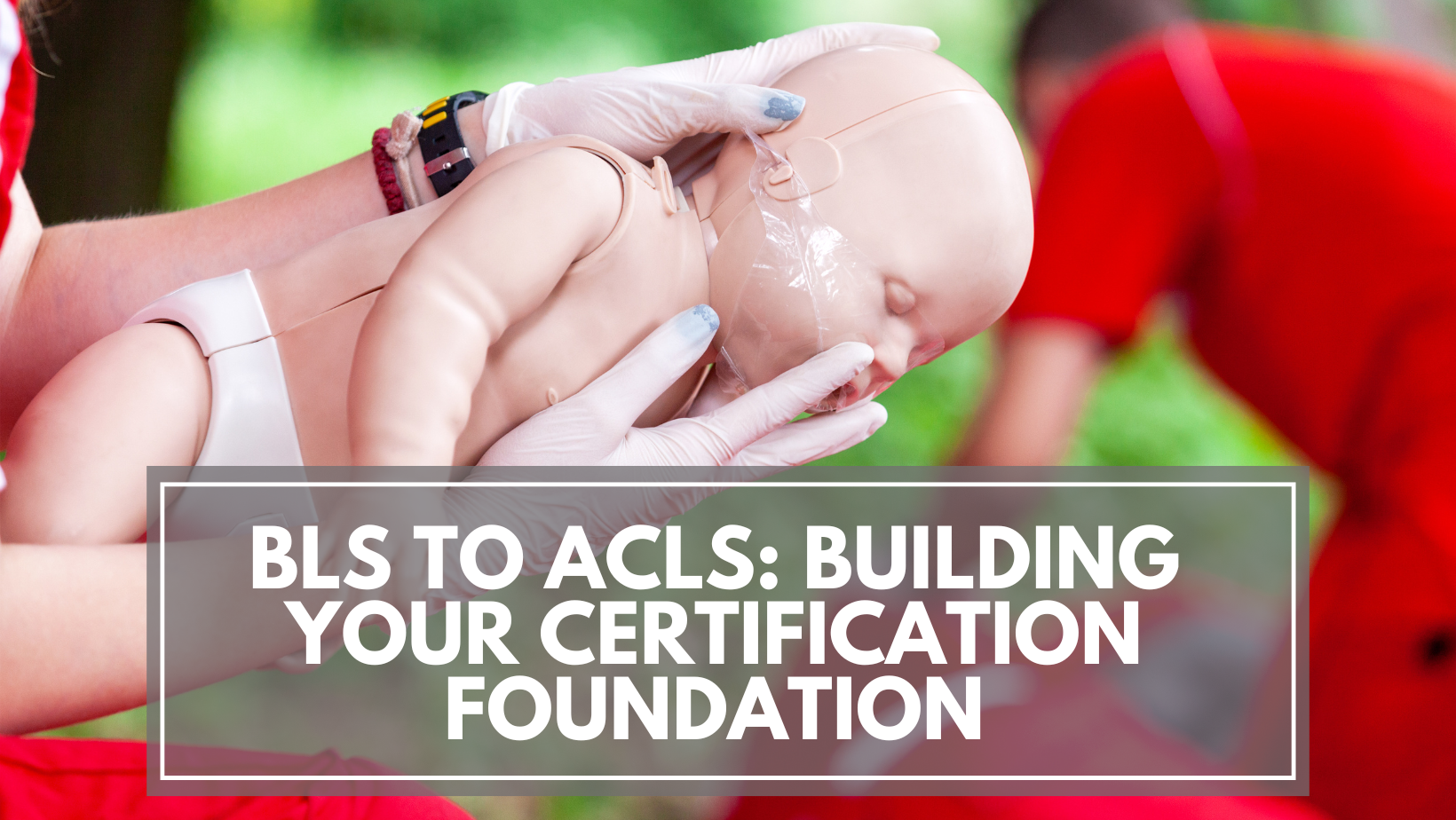
In the high-stakes environment of emergency cardiovascular care, there is a clear hierarchy of skills. For healthcare providers looking to advance their careers and improve patient outcomes, understanding this hierarchy is not just academic it is practical, life-saving knowledge. While many seek to jump straight into advanced interventions, the reality is that Advanced Cardiovascular Life Support (ACLS) rests entirely on the solid bedrock of Basic Life Support (BLS).
For medical professionals, the progression from BLS to ACLS is a journey from fundamental stabilization to complex algorithmic management. Whether you are a seasoned nurse, a paramedic, or a physician, revisiting the connection between these two disciplines is crucial. At CPR Cart LLC, we understand the demands of your schedule, which is why we champion a streamlined approach to education. By offering BLS Certification Online and ACLS Certification Online through a blend of self-paced learning and efficient skills sessions, we help you build that foundation without disrupting your work-life balance.
Here is how BLS skills create the indispensable foundation for ACLS mastery.
The Hierarchical Nature of Resuscitation
To understand why BLS is the prerequisite for ACLS, one must understand the physiology of a cardiac arrest. When a heart stops, time is tissue. The “Chain of Survival” concept, coined by the American Heart Association (AHA), illustrates this perfectly.
The first three links in the chain immediate recognition of cardiac arrest, activation of the emergency response system, and high-quality CPR are purely BLS skills. ACLS constitutes the later links, such as rapid defibrillation, effective advanced airway management, and the administration of emergency medications.
Without the initial links established by BLS, the advanced links cannot function. You cannot effectively pharmacologically manage a patient who is not receiving adequate perfusion from chest compressions. Therefore, ACLS Certification Online isn’t just a separate course; it is an extension of the principles learned in BLS Certification Online.
High-Quality CPR: The Engine of ACLS
One of the most common misconceptions is that once ACLS interventions begin, BLS becomes secondary. This is dangerously incorrect. High-quality CPR is the engine that drives the entire resuscitation effort.
In an ACLS scenario, providers manage complex algorithms involving drugs like epinephrine and amiodarone, or they might be intubating the patient. However, if the chest compressions are interrupted for too long, or if the depth and rate are inadequate, the medications cannot circulate, and oxygen cannot reach the brain.
When you undertake BLS Certification Online, the curriculum focuses heavily on the mechanics of CPR:
- Rate and Depth: Ensuring compressions are delivered at 100-120 beats per minute to the appropriate depth.
- Recoil: Allowing the chest to fully recoil to let the heart refill with blood.
- Minimizing Interruptions: Keeping pauses in compressions to less than 10 seconds.
During an ACLS code, these metrics are monitored strictly. ACLS providers must constantly remind their team to maintain BLS quality. If you have not mastered these basics through a robust certification process, your advanced algorithms will fail.
The Transition to Team Dynamics
Another critical area where BLS builds the foundation for ACLS is in team organization. While BLS can often be performed by a single rescuer, it introduces the concepts of effective communication and role assignment that become vital in ACLS.
In a basic life support scenario, you are managing the immediate crisis. In ACLS, you are typically leading a code team. The leadership skills required to run an ACLS case are rooted in the confidence gained from BLS.
When a provider enrolls in BLS Certification Online, they learn the importance of clear communication, such as designating a specific person to call 911 or fetch the AED. In ACLS, this scales up to assigning roles for compressions, airway management, IV access, and medication administration.
If a provider skips or skimps on this foundational learning, they often struggle with the chaotic environment of an ACLS resuscitation. The “MegaCode” scenarios in ACLS training rely on a team leader who understands not just the drugs, but the flow of energy and the necessity of role delegation skills that start in BLS.
AED Proficiency and Defibrillation Rhythms
The Automated External Defibrillator (AED) is a BLS tool, but it is the precursor to the manual defibrillator used in ACLS. Understanding the concept of defibrillation is a bridge between the two levels of certification.
In BLS Certification Online, students learn to recognize the signs of cardiac arrest and utilize an AED safely. The AED makes the decision for the user, analyzing the rhythm and advising a shock if necessary.
ACLS takes this a step further by requiring providers to interpret the rhythms themselves. You must be able to differentiate between Ventricular Fibrillation (VF), Pulseless Ventricular Tachycardia (pVT), Asystole, and Pulseless Electrical Activity (PEA).
However, the underlying principle remains the same: defibrillation is the treatment of choice for shockable rhythms. The safety checks performed in BLS—”All clear, shock advised”—are the exact same safety protocols used when delivering a manual shock in ACLS. The muscle memory of clearing the patient before a shock, learned in BLS, prevents the dangerous mistake of shocking a team member during an advanced resuscitation.
The Convenience of Modern Certification: The CPR Cart LLC Approach
Historically, obtaining these certifications meant spending entire days or weekends sitting in a classroom. For busy healthcare professionals, this was a significant barrier. It often led to “burnout” learning, where providers sat through hours of lectures they already understood just to take a test.
This is why the model offered by CPR Cart LLC has revolutionized the industry. We utilize a blended learning approach, specifically the AHA HeartCode learning system. This method combines the cognitive portion of the course with a hands-on skills session.
How It Works for the Modern Provider
When you sign up for BLS Certification Online or ACLS Certification Online through CPR Cart LLC, you are not sacrificing quality for convenience. You are optimizing your time.
- The Cognitive Phase: You complete the didactic portion online. This includes interactive scenarios, videos, and simulations that you can complete at your own pace. Whether you have an hour during a lunch break or want to study late at night, the flexibility is in your hands. This allows you to truly absorb the material rather than rushing through it in a group setting.
- The Skills Session: Because CPR Cart LLC does not provide “traditional classrooms” in the lecture sense, we focus on the practical application. Once the online portion is done, you schedule a quick skills session. This is where you demonstrate your competency to an authorized provider.
This approach is particularly effective for the BLS-to-ACLS progression. It allows seasoned providers to refresh their BLS knowledge quickly before diving into the complexities of ACLS pharmacology and algorithms. It validates that you have the baseline skills necessary to handle the advanced coursework.
Bridging the Knowledge Gap: Pharmacology and Physiology
BLS provides the anatomical and physiological baseline that ACLS builds upon. In BLS, you learn the concept of “C-A-B” (Compressions, Airway, Breathing). You understand that oxygenated blood must reach the brain.
ACLS introduces pharmacology drugs that manipulate heart rate, blood pressure, and rhythm. To understand why we give atropine for bradycardia or why we push epinephrine every 3-5 minutes during a code, you must have a firm grasp of the circulation concepts taught in BLS.
Consider the administration of epinephrine. In ACLS, we know it improves coronary perfusion pressure. But how is that drug delivered to the coronary arteries? Through high-quality chest compressions. If a provider lacks the BLS foundation, they might administer the drug correctly but fail to follow it with the high-quality compressions needed to circulate it. This disconnect can lead to poor patient outcomes.
ACLS Certification Online covers these advanced topics, but the logic relies entirely on the circulation mechanics defined in BLS. The HeartCode learning modules we utilize at CPR Cart LLC emphasize this connection, ensuring that providers don’t just memorize algorithms, but understand the physiology behind them.
Why You Shouldn’t Skip the Fundamentals
In some healthcare settings, there is pressure to get staff ACLS certified quickly. However, attempting ACLS without current, strong BLS skills is a recipe for failure during a real code.
The AHA mandates that BLS is a prerequisite for ACLS for a reason. During testing for ACLS Certification Online, the testing stations almost always include a BLS evaluation. You will be expected to demonstrate high-quality CPR as part of a larger scenario. If your compression fraction is low, or if you hesitate with the AED/defibrillator, you cannot pass the ACLS course.
By securing your BLS Certification Online first and keeping it current you ensure that the transition to ACLS is seamless. You can focus on learning the drugs and the advanced airways without struggling to keep up with the CPR rhythm.
The Professional Advantage
Beyond the clinical necessity, holding both certifications presents a significant professional advantage. Employers in hospitals, emergency departments, and critical care units look for versatility. They want staff who can step into any role during a code.
A nurse who is only BLS certified can manage compressions and the AED. A nurse who is ACLS certified but weak in BLS might struggle to manage the team effectively if they can’t spot poor CPR quality. A provider who excels at both is a leader on the floor.
CPR Cart LLC makes it easy to maintain both credentials. Because our model relies on AHA HeartCode learning combined with a quick skills session, you don’t have to worry about finding a babysitter for the weekend or missing a shift to sit in a “traditional classroom.” You handle the bookwork on your terms and get verified quickly.
Preparing for Your Certification Journey
If you are ready to take the next step in your medical career, the path is clear. It starts with solidifying your basics.
- Assess Your Current Status: If your BLS is expired or near expiration, prioritize renewal. Do not jump into ACLS with an expired foundation.
- Choose the Right Platform: Look for BLS Certification Online that offers AHA-compliant curriculum. Not all online courses are created equal. Ensure the certification is widely accepted by hospitals and regulatory bodies.
- Integrate Your Learning: As you study BLS, think ahead to ACLS. When you practice compressions, think about coronary perfusion pressure. When you use the AED, study the rhythm strips it identifies.
- Schedule Your Skills Session: Once the online portion is complete, get your hands-on verification done. This is the bridge between theory and practice.
Conclusion
The synergy between BLS and ACLS cannot be overstated. BLS is the heartbeat of the resuscitation effort; ACLS is the brain. To be an effective healthcare provider, you need both working in harmony.
By understanding that BLS provides the critical perfusion necessary for ACLS drugs to work, and the team structure for effective code management, you become a more competent, confident provider.
At CPR Cart LLC, we are committed to providing the highest quality education through modern, flexible means. Our use of online learning combined with quick skills sessions ensures you get the credentials you need without the hassle of traditional classrooms. Whether you need to start with your BLS Certification Online or you are ready to advance with ACLS Certification Online, we have the tools to help you build your foundation and save lives.
Invest in your skills today. Because when the moment comes, the foundation you build now is what will keep a patient alive tomorrow.

Read More: The Best Seafood Dishes For Your Health