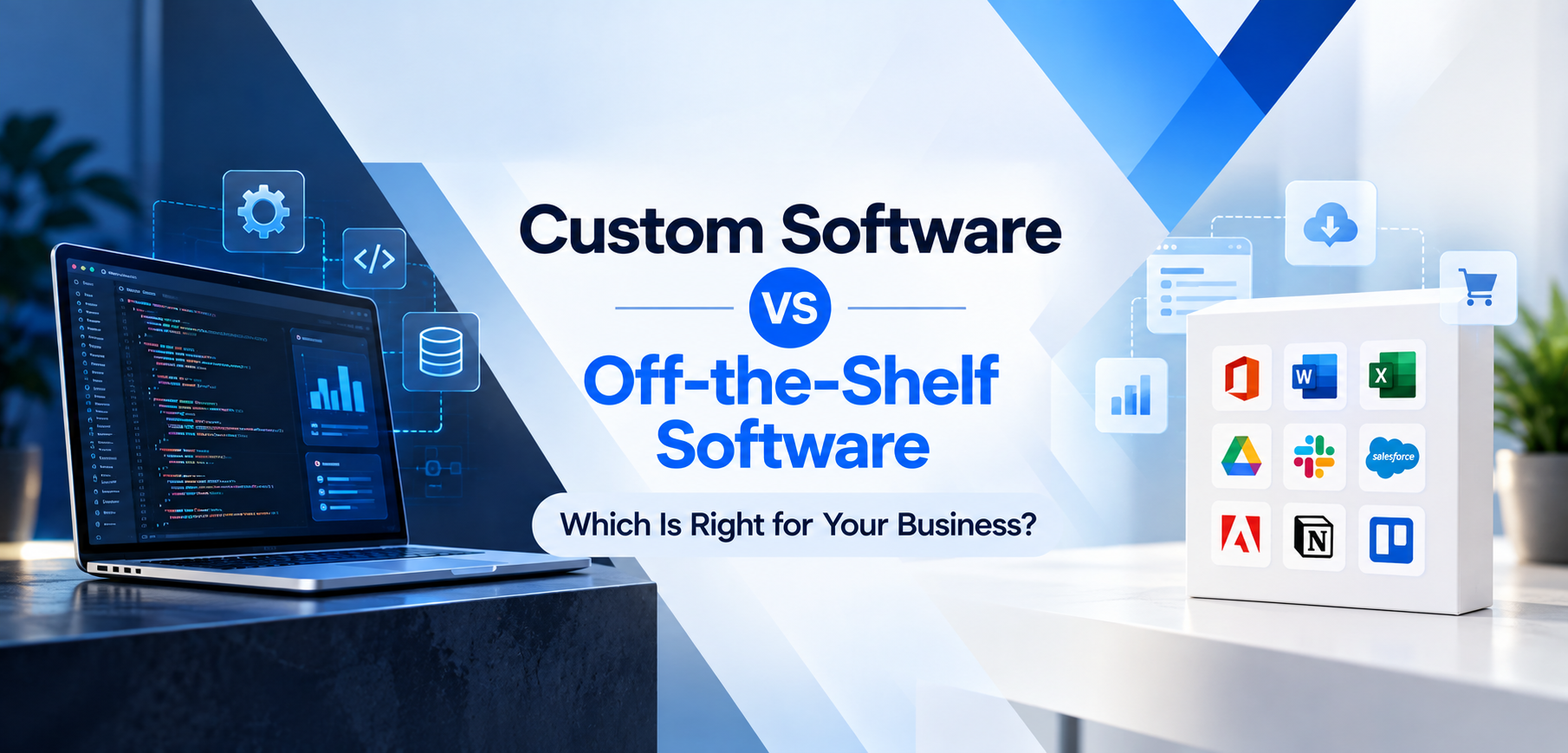
Choosing the right software can have a major impact on how efficiently a business operates. While some companies choose ready-made software because it is quick to deploy, others need a solution built specifically around their processes and goals.
The choice often comes down to custom software vs off-the-shelf software. Understanding the differences can help businesses determine which approach makes sense for their current needs and future growth.
What Is Off-the-Shelf Software?
Off-the-shelf software is a ready-made application designed for a broad range of users. It typically includes standard features that address common business needs.
Examples include accounting platforms, project management tools, customer relationship management systems, and communication applications.
One of the biggest advantages is speed. Businesses can usually purchase a subscription or license, configure the software, and start using it relatively quickly.
However, ready-made software may include features a company does not need while lacking functionality required for a specific workflow.
What Is Custom Software?
Custom software is developed specifically for an individual business or organization. Instead of adapting business processes to an existing application, the software is designed around the company’s requirements.
A custom solution can include specialized workflows, integrations, dashboards, automation, security requirements, and other features that may not be available in standard software.
Businesses considering this approach can work with a custom software development company to define requirements, develop the application, test it, and maintain it over time.
Where Custom Software Can Be Used
Custom software is not limited to one type of application. Businesses can develop specialized solutions for different operational and customer-facing requirements.
For example, Enterprise Planning (ERP) solutions can help businesses manage processes such as finance, inventory, purchasing, sales, and operations through connected systems.
Companies developing new digital products can also use Product Development services to turn an idea into a functional software product.
For businesses working with emerging technologies, Blockchain Development can be used to build applications involving decentralized systems, digital transactions, or secure data management.
Customer-facing applications are another common use case. Businesses may invest in Mobile App Development, WebApp Development, or Web Development depending on how customers and employees need to access their software.
Custom development can also be useful when a company already has older systems that no longer meet its requirements. Software Modernization can help update legacy applications, improve maintainability, and support integration with newer technologies.
For companies building subscription-based software products, SaaS Development provides an approach for creating applications that can be delivered to customers through a software-as-a-service model.
Custom Software vs Off-the-Shelf Software: Key Differences
1. Features and Flexibility
Off-the-shelf software provides a predetermined set of features. Some applications offer configuration options, but there are usually limits to how much the system can be changed.
Custom software provides greater flexibility because functionality can be designed around specific business requirements.
2. Implementation Time
Ready-made software generally has a shorter implementation process because the core product has already been developed.
Custom software takes longer because the application must go through planning, development, testing, and deployment.
For businesses that need a solution immediately, an existing application may therefore be more practical.
3. Cost
The initial cost structure can be very different.
Off-the-shelf software often uses subscriptions or licensing fees, making it easier to start with a predictable initial expense. However, costs can increase over time through recurring subscriptions, additional users, premium features, integrations, or upgrades.
Custom software usually requires a larger initial investment. The long-term economics depend on the project’s scope, maintenance requirements, number of users, and business value.
4. Scalability
A standard application may work well when a business is small but become restrictive as its requirements change.
Custom software can be designed with future expansion in mind. Businesses can build additional functionality as their operations, customer base, or internal processes evolve.
5. Integration
Modern businesses often rely on multiple systems. Connecting those systems can sometimes be difficult when using software that was not designed for a particular technology environment.
Custom applications can be developed with specific integrations in mind, allowing different systems and data sources to work together more effectively.
6. Control and Ownership
With off-the-shelf software, the provider controls the product’s development roadmap. Changes to features, pricing, integrations, and functionality are generally determined by the vendor.
With custom development, the business has significantly more control over how the software is designed and adapted to its requirements.
When Should You Choose Off-the-Shelf Software?
Ready-made software may be appropriate when:
- Your business has common software requirements.
- You need a solution quickly.
- Your budget does not support a custom development project.
- Existing applications already provide the features you need.
- You do not require extensive integrations or customization.
For many businesses, an established software product can be a practical starting point.
When Should You Consider Custom Software?
Custom development may make more sense when:
- Your business has unique workflows.
- Existing software requires too many workarounds.
- You need integrations with multiple systems.
- Automation is an important part of your operations.
- Your requirements are likely to change as the company grows.
- You need greater control over functionality and user experience.
The key question is not simply whether custom software is better. It is whether the additional flexibility and control justify the development investment for your particular business.
A Simple Way to Decide
Before choosing either option, make a list of your essential requirements.
Ask:
- What problems does the software need to solve?
- Which features are essential?
- What systems need to be integrated?
- How quickly does the business need the solution?
- How much customization will be required?
- How might these requirements change over the next few years?
If an existing application meets most of your requirements with minimal compromises, off-the-shelf software may be sufficient.
If your business processes are highly specialized or existing tools create significant limitations, custom software may be worth considering.
Final Thoughts
The decision between custom software and off-the-shelf software depends on a company’s requirements, budget, timeline, workflows, and plans for growth.
Off-the-shelf applications can provide a fast way to access established features, while custom software offers greater control and flexibility for businesses with specialized requirements. For companies planning to build subscription-based digital products, SaaS Development can also provide a scalable approach for delivering software to multiple customers through a cloud-based model.

Rather than choosing based solely on the initial price, businesses should consider implementation, integrations, scalability, ongoing costs, and how well the software supports their actual operations.