Picking the right blade grade decides how long your tooling lasts, how clean your cuts run, and how much downtime you absorb every month. Plant managers and procurement teams often default to whatever grade they used last time, but each steel type behaves differently under load, heat, and abrasion. Get the grade wrong, and you pay for it in chipped edges, burr rejection, and blades that need regrinding every few days instead of every few weeks.
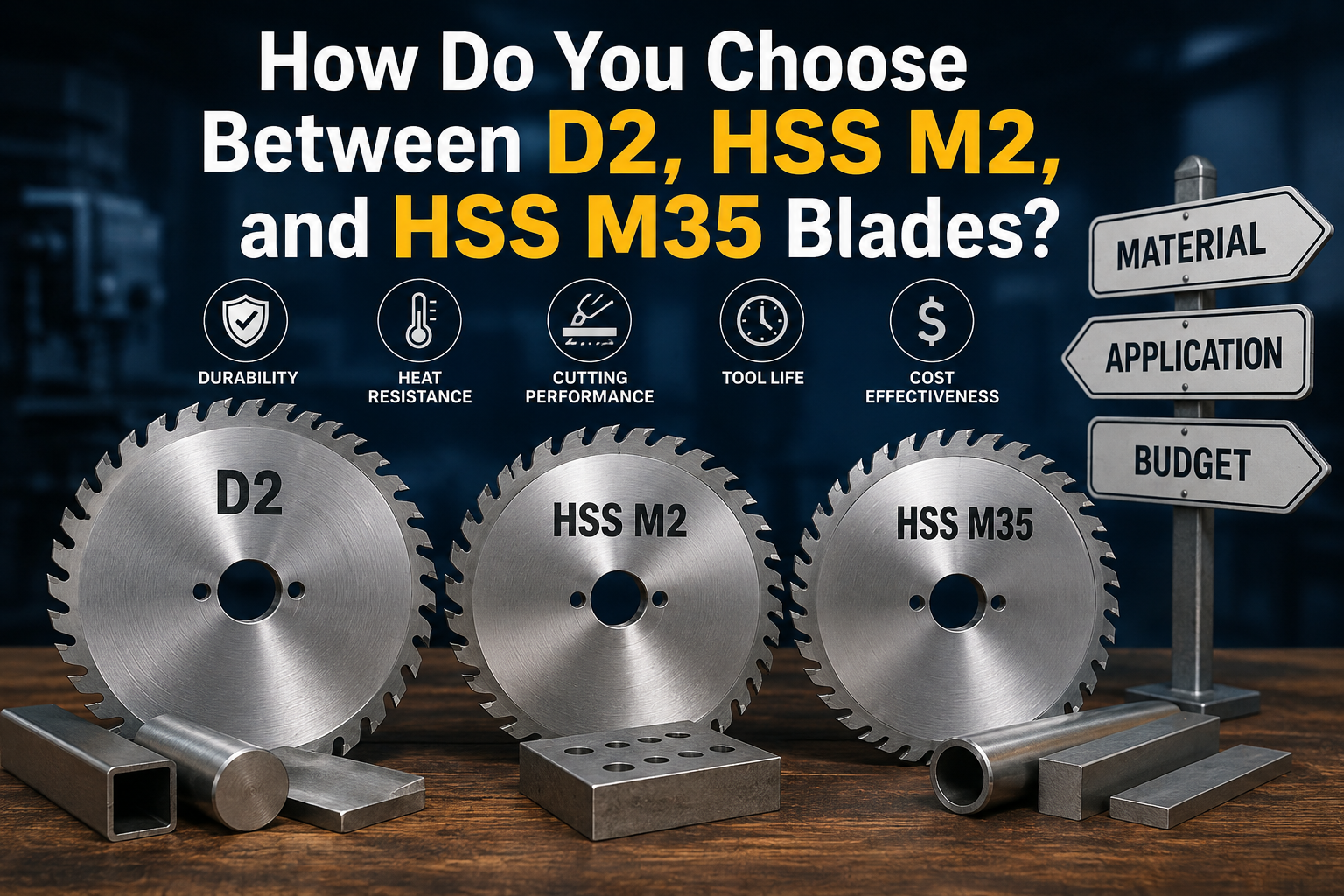
Slitter blades come in dozens of tool steel grades, but three dominate coil processing lines: D2, HSS M2, and HSS M35. Each one solves a different problem. This article breaks down what separates them, where each grade performs best, and how to match a grade to your material, line speed, and failure history.
What Makes D2 Different From HSS Grades
D2 is a high-carbon, high-chromium tool steel. Manufacturers harden it to 60–62 HRC, and it holds an edge well against abrasive wear from mild steel, cold rolled coil, and galvanized strip. D2 costs less than high-speed steel grades, and it machines and grinds faster during production, which reduces lead times.

D2 struggles when temperatures climb. Friction from high-speed slitting generates heat at the cutting edge, and D2 loses hardness faster than HSS grades once temperatures rise. That makes it a strong choice for general-purpose coil slitting but a poor one for high-speed stainless-steel lines or continuous-duty applications where the edge remains hot for extended periods.
Where HSS M2 Earns Its Place
HSS M2 blends tungsten, molybdenum, chromium, and vanadium into a steel that resists heat far better than D2. Hardened to 62–64 HRC, M2 keeps its edge under the friction and temperature spikes that come with stainless steel, silicon steel, and high-speed converting lines.
M2 costs more than D2 and takes longer to machine, since the alloy content makes grinding harder. Buyers who run stainless coil or push line speeds beyond what D2 tolerates usually switch to M2 once they calculate the tradeoff: fewer blade changes, fewer stoppages, and lower burr rates offset the higher unit price within a few months.
When HSS M35 Becomes Necessary
HSS M35 adds cobalt to the M2 formula, which raises red hardness, the ability to hold cutting hardness at elevated temperatures, even further. Hardened to 63–65 HRC, M35 handles the most demanding applications: hardened stainless steel and CRGO electrical steel, where abrasion and heat combine to destroy lower grades within days.
M35 costs the most of the three and carries the longest lead time, since the cobalt content slows down both machining and heat treatment. Plants that skip M35 on electrical steel lines often see blade life drop to a fraction of what M35 delivers, which erases any savings from the lower upfront price.
Matching Grade to Material and Line Conditions
Grade selection depends on four factors: material type, strip thickness, line speed, and current failure mode.
Material type narrows the choice fastest. Mild steel, cold rolled coil, and galvanized strip run well on D2. Stainless steel and silicon steel need M2 as a baseline. Hardened stainless and CRGO electrical steel call for M35.
Strip thickness matters because thicker material generates more cutting force, which raises heat at the edge. A grade that performs fine on thin gauge material may wear out faster once thickness increases past a few millimeters.
Line speed compounds the heat problem. Faster lines mean more cuts per minute, which means less time for the blade edge to cool between passes. High-speed lines push buyers toward HSS grades even on materials that would otherwise tolerate D2.
Failure mode tells the real story. A blade that chips usually needs a tougher grade or a different edge angle, not necessarily a harder one. A blade that dulls quickly but doesn’t chip usually needs better heat resistance, which points toward M2 or M35. A blade that develops burr consistently often points to a tolerance or flatness problem rather than a grade problem.
Maxwell Slitter Industries built a grade selection process around these four questions, matching material and failure data against production records instead of a generic catalog chart. The company reviews the current blade brand, the failure pattern, and the line specifications before recommending a grade, which prevents buyers from over-specifying an expensive grade where D2 would perform just as well, or under-specifying a grade that fails within days.
The Cost Comparison That Actually Matters
Buyers who compare grades on unit price alone miss the real cost driver: cost per cut. A D2 blade priced lower than an M2 blade can still cost more per month if it needs replacement twice as often. Downtime for blade changes, rejected material from burr or chipping, and labor for changeovers all factor into the true cost.
A rough framework for cost per cut:
- D2: Lowest unit cost, baseline edge life, best for general coil slitting under moderate speed
- HSS M2: 1.5x edge life over D2, higher unit cost, better fit for stainless and high-speed lines
- HSS M35: Highest edge life among the three, highest unit cost, necessary for hardened stainless and electrical steel
Running these numbers against actual production volume, not catalog averages, gives a clearer answer than comparing sticker prices.
A Practical Way to Decide
Start with the material. If it’s mild steel, cold rolled, or galvanized coil at moderate speed, D2 covers most needs. If it’s stainless steel or the line runs fast enough to generate noticeable heat at the edge, move to M2. If the material is hardened stainless or CRGO electrical steel, or if M2 blades already wear out faster than expected, M35 is the right call.
Send a sample of the current blade along with a description of the failure mode to a manufacturer that can review production data rather than guess from a spec sheet. Maxwell Slitter Industries responds to these requests with a grade recommendation, price, and delivery timeline within one working day, based on the same material and failure analysis outlined above.
Frequently Asked Questions
Is HSS always better than D2 for slitting?
No. HSS grades cost more and take longer to source, so they only pay off when heat resistance actually matters. On mild steel or cold rolled coil at moderate speed, D2 often lasts just as long at a lower price.
What’s the actual difference between M2 and M35 besides cobalt?
Cobalt raises red hardness, meaning M35 keeps its cutting hardness at higher temperatures than M2. The tradeoff is cost and machining time, since cobalt makes the steel harder to grind. M35 only makes sense when heat, not just abrasion, is causing blade failure.
Can one blade grade work across multiple materials on the same line?
Sometimes, but it usually means over-specifying for the easier material to cover the harder one. A plant running both mild steel and stainless coil often keeps separate blade sets rather than forcing one grade to handle both.
Why do blades from the same grade wear out at different rates?
Heat treatment consistency, edge geometry, and alignment on the machine all affect wear rate as much as the grade itself. Two D2 blades from different manufacturers can perform very differently if one has uneven hardness across the cross-section.
How do I know if my current blade grade is wrong for my line?

Track the failure mode. Chipping usually points to a toughness problem, not a hardness problem. Rapid dulling without chipping usually points to insufficient heat resistance. Consistent burr often points to a tolerance issue rather than the grade itself.