The important distinction is that exosome therapy should not be treated as a universal hair-regrowth injection. A well-designed protocol starts with identifying why the hair is thinning, determining whether viable follicles remain, and selecting an administration method appropriate for the scalp.
Exosome hair in Dubai is a regenerative approach designed to support the scalp environment and hair follicles through biologically active signaling molecules delivered to areas affected by thinning. Its main appeal is that it can be considered without surgery, while treatment planning can be adjusted according to the pattern, severity, and likely cause of hair loss.
Why Exosome Hair in Dubai Requires More Than an Injection
Hair loss is rarely caused by one factor. Genetic sensitivity, hormonal influences, age-related follicular miniaturization, inflammation, nutritional issues, stress, and certain medical conditions can produce overlapping patterns.

This makes diagnosis particularly important before choosing regenerative treatment. An exosome protocol that may be reasonable for early diffuse thinning is not automatically the right approach for advanced follicular loss where transplantation or another established treatment may need to be considered.
What Exosomes Are Designed to Do
Exosomes are extracellular vesicles involved in intercellular communication. In regenerative medicine research, they are studied for their ability to carry signaling molecules, proteins, lipids, and nucleic acids that may influence cellular behavior.
For hair applications, the proposed objective is to support the follicular microenvironment rather than physically create a completely new follicle. This distinction matters when setting expectations.
The goal is generally to encourage healthier follicular activity, support existing weakened follicles, and potentially improve hair density and shaft quality over time.

Exosome Hair in Dubai Versus Stem Cell Treatment
Exosome therapy should not be described as identical to stem cell therapy.
Stem cell-based approaches involve living cells, while exosome preparations are cell-free products containing extracellular vesicles. Their biological mechanisms, manufacturing processes, regulatory considerations, and evidence bases are therefore different.
Patients researching regenerative hair treatment should ask exactly what product is being proposed rather than assuming that every treatment advertised as “stem cell,” “exosome,” or “regenerative” represents the same technology.
How Exosome Hair in Dubai Is Planned Around the Scalp
A medically sensible treatment begins with the scalp rather than the syringe.
During assessment, a clinician may consider the distribution of thinning, hair caliber, scalp condition, previous treatments, family history, medications, and the speed at which hair loss has developed.
Mapping the Pattern of Hair Loss
The distribution of thinning can provide important clues.
For example, diffuse reduction across the scalp may require a different diagnostic approach from recession concentrated around the temples. Widening of the central part in women may also have different underlying considerations from isolated frontal thinning.
The objective is to determine whether the follicles in the affected region are still potentially responsive to stimulation.
Assessing Follicular Viability
Regenerative treatment is fundamentally different from replacing follicles.
Where follicles are still present but producing progressively finer hair, a regenerative strategy may be considered as part of a broader plan. Areas that are completely smooth and have experienced long-standing follicular destruction may require a different discussion.
This is why photographs alone should not determine a treatment plan.
Considering the Scalp Environment
Seborrheic dermatitis, significant inflammation, infection, excessive oiliness, irritation, or other scalp conditions may need to be addressed before or alongside a hair-regeneration protocol.
The scalp is the biological environment in which follicles function. Improving that environment can be as important as selecting the delivery technique.
Comparing Exosome Hair in Dubai Treatment Approaches
There is no single administration method that should automatically be considered superior for every patient. The appropriate technique depends on the product, scalp condition, treatment area, clinician’s protocol, and intended depth of delivery.
| Treatment consideration | Why it matters | What patients should ask |
|---|---|---|
| Product source | Exosome preparations can differ in composition and manufacturing | What product is being used? |
| Scalp assessment | Hair loss has multiple causes | What is causing my thinning? |
| Delivery method | Different techniques place the product differently | Why is this technique appropriate for my scalp? |
| Treatment area | Diffuse thinning and localized loss require different planning | Which areas will actually be treated? |
| Number of sessions | Response varies between patients | Why is this number of sessions recommended? |
| Combination therapy | Some patients may benefit from another hair-loss treatment | Is another evidence-based treatment more appropriate or complementary? |
| Follow-up | Hair growth is gradual rather than immediate | When will my progress be reassessed? |
| Safety | Product quality and clinical handling matter | What are the potential risks and contraindications? |
Direct Scalp Administration
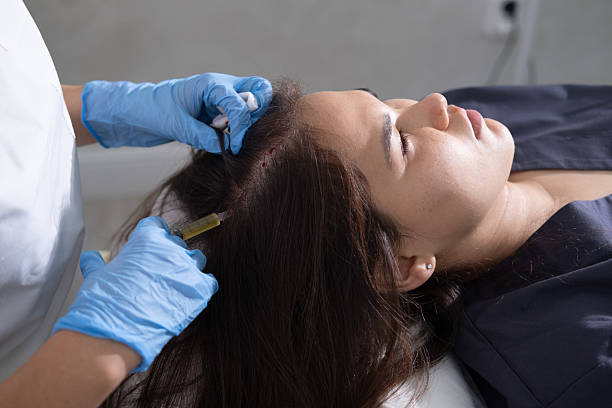
Direct microinjection places the selected preparation into targeted scalp areas. The clinician can distribute treatment according to the patient’s thinning pattern rather than treating the scalp as one uniform surface.
Injection depth, spacing, volume, and treatment coverage should be determined by the practitioner and the specific protocol rather than copied from a generic online formula.
Microneedling-Based Delivery
Some protocols use microneedling to create controlled microchannels and introduce a regenerative preparation to the scalp.
This approach may be attractive for patients who prefer a minimally invasive procedure, but the technique should still be selected according to the patient’s scalp and the product being used.
Combination Strategies
Exosome therapy may sometimes be discussed alongside established hair-loss approaches such as PRP, topical medications, low-level light-based therapies, or hair transplantation.
Combination treatment should not mean combining everything available. Each additional therapy should have a specific purpose and should make sense for the underlying diagnosis.
What Makes Exosome Hair in Dubai Different in the Local Environment
Dubai introduces practical considerations that are easy to overlook in generic hair-loss content.
Outdoor heat and intense sun exposure can make scalp protection particularly important after procedures. At the same time, prolonged exposure to indoor air conditioning can create a very different environment, with dry air and frequent temperature changes.
Desert Heat and Post-Treatment Care
Immediately after scalp treatment, patients should follow the specific aftercare instructions provided by their medical practitioner.
Depending on the protocol, this can include temporarily avoiding excessive heat, strenuous exercise, swimming, direct sun exposure, or products that could irritate the treated scalp.
The exact restrictions should come from the treating clinician because protocols vary.
Read mocare on: usamagazine
Air Conditioning and Scalp Comfort
People who spend much of the day in heavily air-conditioned offices, vehicles, malls, or homes may experience scalp dryness or irritation.
This does not mean air conditioning causes hair loss. However, maintaining a comfortable scalp environment can be useful when managing irritation or dryness alongside a broader hair-care plan.
Lifestyle and Treatment Scheduling
Dubai’s work and social lifestyle also makes downtime an important practical consideration.
A minimally invasive treatment may be attractive to professionals who cannot accommodate a lengthy recovery period. Even so, “minimal downtime” does not mean that every patient will have identical post-treatment symptoms.
Temporary redness, tenderness, swelling, or sensitivity can occur after scalp procedures, depending on the delivery technique and individual response.
How to Judge an Exosome Hair in Dubai Protocol
Price alone is a poor way to compare regenerative hair treatments.
Two treatments can have very different prices because of differences in consultation, product, clinical supervision, treatment area, number of sessions, follow-up, and overall protocol.
Questions Worth Asking Before Treatment
A patient considering exosome hair therapy should ask:
- What is the likely cause and pattern of my hair loss?
- Are my follicles still viable in the areas being treated?
- What exact exosome product will be used?
- Where is the product sourced and how is it handled?
- Why has this administration technique been selected?
- How many sessions are being recommended, and why?
- What results are realistic for my degree of thinning?
- What side effects should I expect?
- What alternative treatments should I consider?
- How will progress be measured after treatment?
These questions shift the conversation away from marketing claims and toward clinical decision-making.
Why Product Quality Matters
The term “exosome” does not automatically tell a patient everything about a product.
Manufacturing method, source material, characterization, storage, handling, sterility, and regulatory status can all influence how a product should be evaluated.
Patients should be cautious of claims suggesting that every exosome preparation is interchangeable or that the treatment can guarantee permanent hair regrowth.
Understanding Results From Exosome Hair in Dubai
Hair biology operates on a much slower timeline than most cosmetic treatments.
A patient should not judge the effectiveness of a regenerative scalp treatment immediately after the procedure. Early changes may relate to the scalp’s short-term response, while meaningful changes in hair caliber and density can take considerably longer to evaluate.
The First Few Days
Temporary redness, tenderness, sensitivity, or mild swelling may occur depending on the treatment technique.
The scalp should generally be handled gently during the immediate recovery period, with patients following the individualized instructions provided by their clinician.
The Following Weeks
The follicular growth cycle does not accelerate overnight.
During the following weeks, the focus is usually on allowing the scalp to recover and monitoring whether the hair-shedding pattern or scalp condition changes.
The Following Months
Hair density and shaft quality are better assessed over a longer period.
Consistent photographic documentation under similar lighting and hair positioning can help make subtle changes easier to evaluate than relying solely on memory.
Who May Be Considered for Exosome Hair in Dubai
Exosome therapy may be discussed for people experiencing certain forms of early or moderate thinning where follicles remain present.
Potential candidates may include individuals who:
- Notice progressive hair thinning rather than complete bald areas.
- Want a minimally invasive option.
- Have weakened or miniaturized follicles that may still be viable.
- Are looking for a regenerative component within a broader hair-loss plan.
- Understand that treatment response varies.
- Are willing to undergo proper scalp assessment before treatment.
It may be less appropriate as a standalone solution for every type of advanced hair loss.
The most important factor is not whether someone wants thicker hair. It is whether the underlying condition is suitable for the proposed treatment.
Building a Smarter Hair-Restoration Strategy
A modern hair-loss plan should be individualized rather than built around one fashionable procedure.
For some patients, the appropriate strategy may involve medical management. For others, regenerative treatment may be considered as an adjunct. In advanced cases, transplantation may become part of the conversation.
The strongest approach is therefore to identify the diagnosis first and then select the treatment.
When Exosome Therapy May Be Part of a Larger Plan
A clinician may consider regenerative therapy alongside other treatments when there is a logical clinical reason.
For example, a patient may need to address ongoing androgenetic hair loss while also exploring options intended to support follicular health.
Another patient may require treatment for scalp inflammation before regenerative therapy is considered.
This individualized approach is more meaningful than promising that one injection can solve every form of hair loss.
The Strategic Investment in Exosome Hair in Dubai
Choosing exosome hair in Dubai should be based on clinical assessment, product transparency, appropriate technique, realistic expectations, and follow-up rather than a headline price or a promise of instant regrowth.
For patients researching professional aesthetic and hair-restoration options, Tajmeels Clinic’s Dubai aesthetic and hair-treatment services provide a starting point for exploring available treatment pathways and discussing whether regenerative hair therapy is appropriate for their individual needs.

The strongest investment is not simply purchasing an exosome session. It is choosing a treatment plan that begins with the cause of hair loss, respects the biology of the follicle, uses appropriate medical oversight, and measures progress realistically. Patients can explore Tajmeels Clinic to learn more about its broader aesthetic and hair-restoration services.