Summary: Understanding FedEx Jewelry Shipping Restrictions and the $1,000 Cap
The right shipping arrangement depends on the type of jewelry, its actual value, the FedEx service selected, and the applicable terms and conditions. A declared value is not the same as insurance, and paying for additional declared value does not necessarily make a restricted item eligible for coverage. Businesses should confirm current rules before tendering valuable jewelry and consider specialized shipping arrangements when standard carrier services do not provide sufficient protection.
Overview
The fedex jewelry shipping limit is a critical consideration for jewelers, online retailers, wholesalers, repair businesses, and collectors shipping valuable items within the United States.

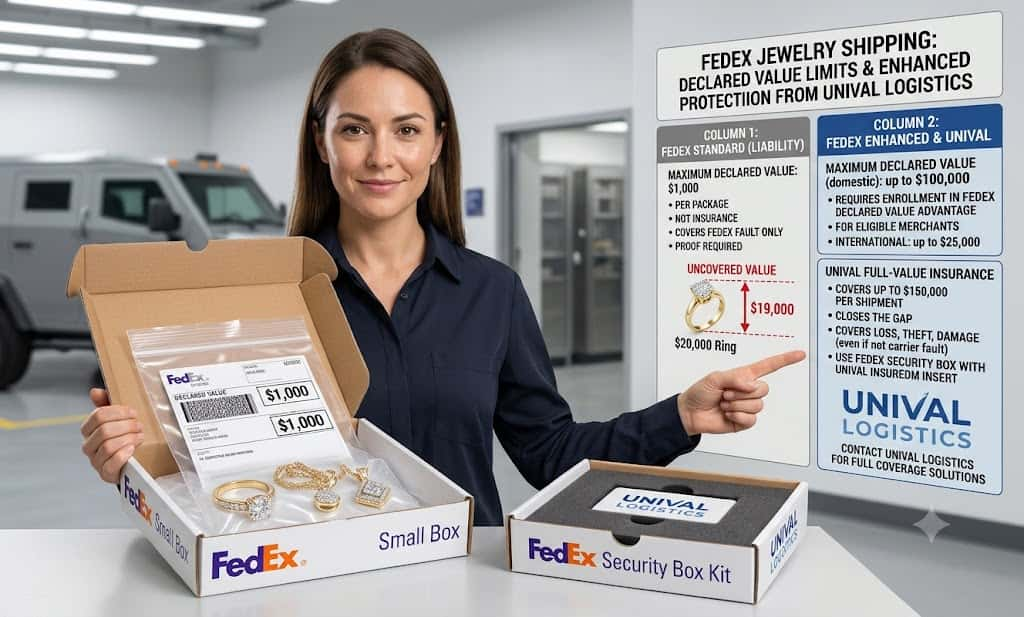
FedEx’s current jewelry guidance states that standard jewelry shipments are generally limited to a maximum declared value of $1,000 per package. Eligible businesses that ship jewelry regularly may qualify for the FedEx Declared Value Advantage program, which can allow declared values of up to $100,000 per domestic shipment and up to $25,000 for shipments to select international destinations, subject to the applicable contract and destination restrictions.
This distinction matters because declaring a value with a carrier is not the same as purchasing an insurance policy. FedEx’s declared value establishes its maximum contractual liability, subject to the applicable terms, restrictions, and claim requirements. It does not guarantee reimbursement for every loss or damage event.
For businesses in Los Angeles, New York, Miami, Chicago, Dallas, Houston, Philadelphia, Atlanta, Las Vegas, San Francisco, Boston, Newark, and Northern New Jersey, the practical goal is to select a shipping method that matches the item’s value, delivery requirements, and acceptable financial risk.
Key Takeaways
- Standard jewelry limit: FedEx generally caps the declared value of jewelry at $1,000 per package under its standard terms.
- Higher-value program: Eligible, approved business shippers may qualify for the Declared Value Advantage program, with limits of up to $100,000 for domestic shipments.
- Declared value is not insurance: It sets a contractual liability limit and does not guarantee compensation.
- Eligibility matters: The specialized program is designed for recurring jewelry shipments, not one-time or occasional shipments.
- Packaging is essential: Jewelry valued above $500 cannot be shipped in a padded envelope under FedEx’s published jewelry guidance.
- Alternative protection: Businesses shipping items above the standard limit should investigate suitable third-party insurance and confirm coverage before dispatch.
Quick Answer: FedEx generally limits standard jewelry shipments to a declared value of $1,000 per package. Eligible businesses with recurring jewelry shipments may qualify for the Declared Value Advantage program, which permits higher limits subject to approval and contract terms.
Understanding the FedEx Jewelry Shipping Limit
The standard $1,000 limit is a restriction on FedEx’s declared value for jewelry, not a statement that jewelry worth more than $1,000 cannot be shipped at all. The important distinction is whether the shipment qualifies for the standard service terms or an approved higher-value shipping program.
What Does the $1,000 Cap Mean?
Under standard FedEx terms, jewelry shipments are generally subject to a maximum declared value of $1,000 per package. This affects items such as rings, necklaces, bracelets, watches, gemstones, and jewelry made from precious metals.
Consider a jewelry retailer shipping a diamond ring valued at $4,000. Simply entering $4,000 as the declared value does not override the standard restriction. The shipment may remain subject to the $1,000 limit, and the sender could bear the remaining financial risk if the package is lost or damaged.
For this reason, businesses should verify the applicable service terms before creating a shipping label. A higher declared value entered into a shipping system does not automatically mean the carrier has accepted that value for liability purposes.
Does the $1,000 Limit Apply to Every FedEx Shipment?
The restriction applies to jewelry under standard terms, but FedEx offers a specialized program for eligible recurring high-value jewelry shipments. That program has different requirements and limits.
The applicable terms can depend on the type of item, service selected, shipping destination, and whether the shipper has an approved contract. Businesses should not assume that a general declared value limit advertised for other merchandise also applies to jewelry.
FedEx Declared Value Advantage: Shipping Jewelry Above $1,000
FedEx’s Declared Value Advantage program is designed for qualifying businesses that regularly ship jewelry and related eligible items. It provides access to higher declared value limits than those available under standard jewelry shipping terms.
How the Program Works
Eligible business shippers may be able to declare values of up to $100,000 per domestic shipment and up to $25,000 for shipments to selected international destinations. Actual limits depend on program eligibility, destination, and the shipper’s contract.
The program is not generally available for one-time or occasional jewelry shipments. FedEx evaluates applicants based on factors such as shipping history, shipment volume, commodities, claims history, and other business considerations. Its published eligibility guidance identifies recurring jewelry shipments, typically two to three times per week, as a qualification criterion.
Eligible goods can include jewelry, watches, watch movements, pearls, gemstones, and precious metals intended as jewelry components. Coins and gold bars are excluded from the program.
Who Should Consider This Program?
The program may be worth investigating for:
- Jewelry manufacturers and wholesalers shipping valuable inventory regularly.
- Established jewelry retailers fulfilling high-value customer orders.
- Watch businesses transporting eligible timepieces and components.
- Jewelry businesses that need consistent shipping procedures for frequent domestic shipments.
A business shipping one expensive engagement ring for a repair or special occasion should not assume it qualifies. FedEx directs occasional shippers with values above $1,000 to explore arrangements with their insurance provider.
Declared Value vs. Shipping Insurance
Understanding this distinction is essential when planning valuable jewelry shipments.
What Declared Value Provides
Declared value establishes the maximum contractual liability FedEx accepts for a shipment, subject to its service terms. It is not an insurance policy and does not guarantee that a claim will be paid.
FedEx may require the sender to establish that a loss or damage occurred, demonstrate the shipment’s value, and satisfy the relevant claim conditions. Any reimbursement can depend on the applicable repair cost, depreciated value, replacement cost, and other contractual limitations.
What Third-Party Insurance Can Provide
A separate insurance policy may offer broader protection, depending on the insurer’s terms. Depending on the policy, coverage may extend to eligible transit losses, damage, or risks not covered by the carrier’s liability terms.
However, purchasing third-party insurance does not automatically make an otherwise prohibited shipment acceptable to FedEx. The shipper must confirm both that the carrier will accept the item and that the insurer will cover it while it is being transported through the selected carrier.
Before purchasing a policy, review the covered events, exclusions, valuation method, deductibles, security requirements, and claim procedures.
FedEx Jewelry Shipping Rules and Packaging Requirements
Appropriate packaging helps protect jewelry from damage, reduces unnecessary movement, and supports a more reliable shipping process. FedEx provides specific recommendations for packaging jewelry.
1. Use a Secure Inner Box
Place each jewelry item in a soft pouch or cloth, then add suitable cushioning. Secure the item inside a small, sturdy inner box so it cannot move freely during transit.
For multiple pieces, separate the items to prevent scratches, tangling, or contact damage.
2. Use a Rigid Outer Box
Place the inner box inside a durable corrugated shipping box and fill empty spaces with appropriate cushioning. Secure the outer box using strong packing tape and seal all seams.
FedEx’s published jewelry guidance states that jewelry valued above $500 cannot be shipped in a padded envelope. Use an appropriate rigid box and verify any additional packaging requirements applicable to the selected service.
3. Keep Contents Discreet
Avoid displaying descriptions of valuable jewelry on the outside of the package. Use the required shipping documentation, but do not unnecessarily advertise the contents to people handling the shipment.
4. Maintain Evidence of Value and Packaging
Before dispatch, record the item’s description, serial number where applicable, photographs, purchase invoice, and declared value. Retain packaging photographs and shipment documentation according to your business procedures.
This evidence can help establish the item’s condition and value if a dispute or claim arises.
FedEx Jewelry Shipping Costs and Price Considerations
There is no single shipping price for every jewelry shipment. The final cost depends on the service, package dimensions and weight, destination, account pricing, additional services, and whether the shipper qualifies for a specialized program.
For jewelry shipments, consider the following cost categories:
Base shipping charge: Varies according to the selected FedEx service, origin, destination, package weight, dimensions, and applicable account rates.
Declared value charges: Additional charges may apply to eligible declared values above the standard included liability. A higher amount cannot override a jewelry-specific limit unless an applicable program or contract permits it.
Third-party insurance: Premiums vary according to the item’s value, commodity, route, security requirements, deductible, and policy terms.
Signature and delivery services: Signature options and other eligible security features may affect the total shipping cost. FedEx generally applies Direct Signature Required automatically to shipments with declared values of $500 or more on qualifying domestic services.
Specialized packaging: Approved high-value program customers may have access to designated packaging options. Additional costs can apply to certain reinforced containers and other packaging solutions.
Important Disclaimer
These cost categories are planning considerations, not a guaranteed shipping quote. Prices are baseline estimates subject to market fluctuations, supplier changes, and variable logistics fees. Actual carrier rates, insurance premiums, and program charges depend on the shipment and current terms. Contact UNIVAL Logistics for professional guidance and the latest and most accurate prices for your shipping requirements.
What to Do When Jewelry Is Worth More Than $1,000
When the value exceeds the standard limit, the safest approach is to resolve the coverage question before tendering the package to the carrier.
For Businesses Shipping Jewelry Regularly
Contact FedEx to determine whether the Declared Value Advantage program is available for your business and the specific jewelry you intend to ship. Confirm the applicable contract limit, approved commodities, eligible services, destination restrictions, and packaging requirements.
If your business qualifies, establish documented procedures for declaring values, packaging merchandise, recording serial numbers, and managing claims.
For One-Time or Occasional Shipments
If you are sending a valuable ring, necklace, watch, or other item on an occasional basis, ask a specialist insurance provider about an appropriate transit policy. Verify in writing that the policy covers the particular item, route, and carrier arrangement.
Do not assume that buying a separate policy automatically removes FedEx’s shipping restrictions. Confirm that the carrier accepts the shipment under its applicable terms and that the insurance arrangement remains valid for the chosen transportation method.
For Items Worth More Than the Program Limit
Even an approved higher-value program has contractual limits. If the item exceeds the applicable limit, explore specialist jewelry logistics providers and insurance arrangements that can accommodate the full value.
UNIVAL Logistics can help businesses evaluate shipping requirements, documentation practices, and suitable protection options when standard carrier terms do not meet their risk requirements.
Practical Shipping Guidance for US Jewelry Businesses
Businesses operating in Los Angeles, New York, Miami, Chicago, Dallas, Houston, Philadelphia, Atlanta, Las Vegas, San Francisco, Boston, Newark, and Northern New Jersey should use a consistent process for valuable jewelry shipments.
The following practices can improve shipment control:
- Confirm carrier acceptance and the applicable declared value limit before creating the shipping label.
- Match the insurance arrangement to the item’s actual value and the route.
- Use secure packaging that complies with carrier requirements.
- Retain proof of value, photographs, shipment records, and delivery confirmation.
- Use appropriate signature and delivery controls when available.
- Review coverage periodically as inventory values, shipping frequency, and business requirements change.
For businesses that ship jewelry frequently, documented procedures can reduce errors and make it easier to identify gaps between carrier liability and the protection actually needed.
UNIVAL Logistics emphasizes practical planning: select the transportation service, verify the coverage, and document the shipment before dispatch rather than relying on assumptions about a carrier’s maximum liability.
Common Mistakes to Avoid
Assuming Declared Value Means Insurance
Declared value is a contractual liability mechanism, not a guarantee of full reimbursement. A separate insurance policy may be needed to address risks beyond the carrier’s liability terms.
Entering a Value Above the Standard Limit
Entering a value above $1,000 does not automatically increase the accepted liability for a standard jewelry shipment. Verify eligibility for the specialized program or arrange an appropriate alternative before shipping.
Assuming All Jewelry Is Eligible for Higher-Value Coverage
The Declared Value Advantage program has specific commodity restrictions. Coins and gold bars, for example, are excluded. Confirm eligibility for the exact item rather than relying on a broad description such as precious metals.
Using Inadequate Packaging
Soft envelopes, loose cushioning, weak seals, and oversized boxes can increase the risk of damage. Follow the carrier’s packaging instructions and use suitable rigid packaging.
Waiting Until a Loss Occurs to Check Coverage
Insurance exclusions and carrier restrictions should be reviewed before the package is shipped. After a loss, a sender may discover that the selected service did not provide the expected protection.
How UNIVAL Logistics Supports High-Value Jewelry Shipping
Shipping fine jewelry requires careful coordination between transportation, declared value, insurance, packaging, and documentation. The right arrangement depends on whether the shipment is a one-time delivery or part of a recurring commercial operation.
UNIVAL Logistics helps businesses assess their shipping requirements and consider appropriate protection strategies for valuable goods. This includes evaluating declared value limits, identifying potential coverage gaps, improving packaging and documentation procedures, and considering specialized logistics options where standard services are insufficient.
For jewelry businesses, the goal is not simply to find the fastest or least expensive service. It is to establish a shipping process that reflects the value of the merchandise, the delivery requirements, and the financial consequences of a loss.
Frequently Asked Questions
1. What is the FedEx jewelry shipping limit?
Under standard terms, FedEx generally limits the declared value of jewelry to $1,000 per package. Eligible businesses may qualify for higher limits through the Declared Value Advantage program, subject to approval and contractual requirements.
2. Can I ship jewelry worth more than $1,000 with FedEx?
Yes, but you must determine which terms apply. Businesses that qualify for the Declared Value Advantage program may declare up to $100,000 per domestic shipment. One-time or occasional shipments are not eligible for that program, so other suitable arrangements may be necessary.
3. Does FedEx provide insurance for jewelry?
FedEx describes declared value as a limit on its contractual liability, not shipping insurance. A separate policy from an insurance provider may be needed for broader protection, subject to the policy’s terms and the carrier’s acceptance rules.
4. How can a jewelry business qualify for FedEx Declared Value Advantage?
FedEx evaluates eligible business applicants based on factors including shipping frequency, shipping history, package volume, commodities, and claims experience. The program is intended for recurring high-value jewelry shipments, not one-time or occasional deliveries. Contact FedEx to confirm current eligibility requirements.
5. What is the maximum value allowed under FedEx Declared Value Advantage?
Eligible customers may be able to declare up to $100,000 for domestic shipments and $25,000 for shipments to selected international destinations. The exact limit depends on the applicable contract and destination. Coins and gold bars are excluded from the jewelry program.
6. Can I ship a diamond ring worth $5,000 using standard FedEx services?
The ring may be physically shippable, but the standard $1,000 declared value restriction means you should not assume the full $5,000 is protected by FedEx. Confirm the service terms and arrange suitable coverage before dispatch.
7. Does the $1,000 cap apply to watches and gemstones?
FedEx’s jewelry guidance includes watches, gemstones, and other precious-metal jewelry among the items subject to the standard limit. Certain eligible watches, stones, and jewelry components may qualify under the specialized high-value program. Eligibility must be confirmed for the exact item.
8. Can third-party insurance cover jewelry above $1,000?
Potentially, yes. A specialist insurer may offer suitable transit coverage for higher-value jewelry, but eligibility, exclusions, deductibles, and security conditions vary. Confirm that the policy covers the selected carrier and route before shipping.
9. What packaging should I use for valuable jewelry?
Use a soft pouch or cloth, a secure inner box, cushioning to prevent movement, and a sturdy corrugated outer box. FedEx’s published jewelry guidance states that jewelry valued above $500 cannot be shipped in a padded envelope. Follow any additional packaging requirements for the selected service.
10. Does a declared value guarantee that FedEx will reimburse a claim?
No. FedEx reviews claims under its applicable terms and may require proof of loss, evidence of value, appropriate packaging, and evidence supporting carrier liability. Reimbursement is not guaranteed simply because a value was declared.
11. What should I do before shipping jewelry worth $10,000?
Confirm whether your business qualifies for the specialized FedEx program. If not, ask an insurance provider about suitable coverage and verify carrier acceptance. Retain the invoice, photographs, item details, packaging records, and shipping documentation.

12. How can UNIVAL Logistics help protect valuable jewelry shipments?
UNIVAL Logistics can help businesses assess their shipping and insurance requirements, identify potential coverage gaps, organize shipment documentation, and evaluate suitable logistics options. The best arrangement depends on the item’s value, shipment frequency, carrier restrictions, and the level of financial protection required.

