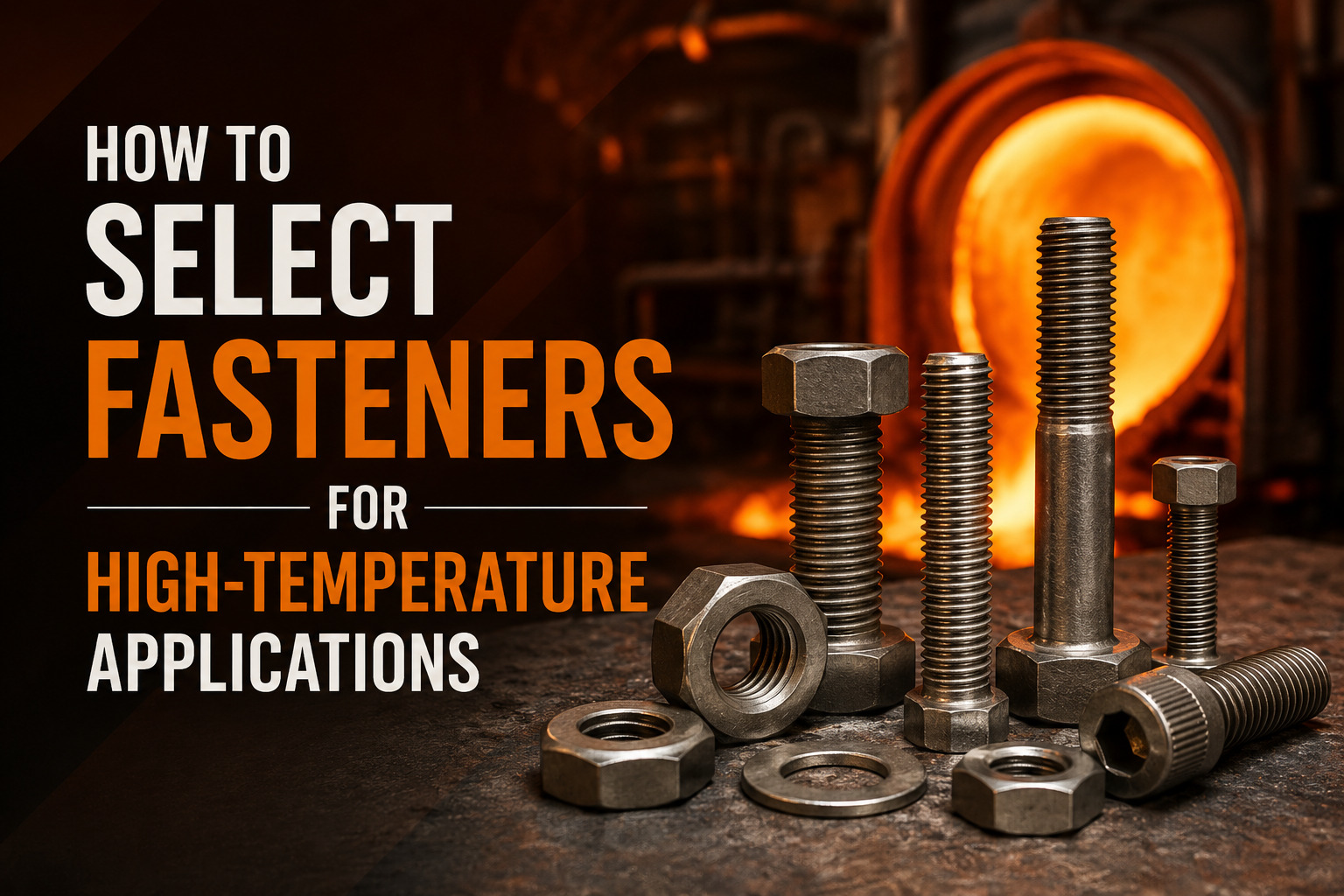
Fasteners are an important part of industrial systems since they keep together buildings, machinery and equipment under arduous working circumstances. Selecting the right fastener becomes even more crucial in high-temperature applications since excessive heat may drastically alter the strength, durability and performance of fastening systems. Proper fastener selection is a crucial engineering factor for industries such as power generation, oil and gas, aerospace, automobile manufacture, petrochemical processing and heavy engineering that often run equipment at extreme temperatures.
High temperatures may degrade materials, promote oxidation, speed up corrosion, and lower the clamping force in bolted joints. If the improper fastener is used then the joint will loosen, distort, split or break altogether in operation. This may lead to expensive downtime, risk of injury, equipment damage and lost output.

Understanding Effects of High Temperature on Fasteners
The impact of heat on the mechanical and chemical nature of fasteners is quite significant. Metal materials tend to lose hardness and strength at high temperatures. This drop in strength reduces the capacity of the fastener to retain preload and to support operating loads.
One is that fasteners will expand thermally as temperature rises, changing the size of both the fastener and the parts it fastens. Different rates of expansion of materials might induce extra stresses in the joint which may result in loosening or deformation.
Creep, a slow deformation of a material under a continuous load may be caused by long exposure to heat. These circumstances need the use of fasteners developed particularly for extreme temperature settings, as opposed to typical fasteners for regular working environments.
Importance of Material Selection for High Temperature Fasteners
When selecting fasteners for high temperature applications, one of the most essential factors is material selection. Different materials behave differently under heat. The right alloy choice provides dependable performance in harsh situations.
Carbon steel fasteners are fine at mild temperatures, but may lose strength quickly at higher heat levels. Stainless steel fasteners are used in many industrial situations due to their resistance to heat and corrosion.
For very high temperatures industries commonly employ alloy steels, nickel based alloys, titanium alloys or specific heat resistant materials. The materials are intended to retain strength, resist oxidation and endure heat cycling with little deterioration.
The operating temperature range must always be addressed when choosing a material since every material has a maximum suggested service temperature. When the temperature limit of a material is exceeded, it may result in loss of preload, deformation, or structural failure.
Thermal Expansion and Fastener Selection
Thermal expansion is a major concern in high temperature fastening applications. When materials are heated they become bigger. If the fastener and the attached parts expand at different rates, then the amounts of preload inside the joint may vary substantially.
Excessive thermal expansion might cause increased stress on the fastener and deformation of the assembly. Differential expansion sometimes reduces clamping force and loosens the joint during operation.
Preload stability with temperature variations is maintained by using fasteners with thermal expansion properties similar to the materials being fastened. Engineers will typically choose fasteners and joint materials with comparable coefficients of thermal expansion to reduce the stress variance. Proper joint design also has a significant impact in the control of thermal expansion phenomena in high temperature systems.
Fastener Creep Resistance Explained
Creep is the slow, permanent distortion of a material under a steady stress at a high temperature. The creep resistance is a major concern in high temperature applications since the fastener itself may be weakened over time by continuous exposure to heat and diminish the clamping force.
Materials that have weak creep resistance may stretch over time and cause loss of preload and joint instability. This may ultimately lead to leakage, vibration problems or structural collapse.
Nickel-base alloys and specific heat resistant steels are often utilized in situations where creep resistance is important. These materials are maintained with their mechanical qualities during long term high temperature exposure.
Industries that use boilers, turbines, furnaces, reactors and high pressure piping systems pay particular attention to creep performance in choosing fasteners. Oxidation causes scale or rust on the surface of fasteners and slowly degrades the substance.
Fasteners used in high temperature conditions need a great capacity to resist oxidation in order to maintain long term durability. Commonly utilized materials include stainless steels and nickel alloys . These materials generate protective oxide layers that assist prevent surface deterioration .
Importance of Load Requirements in Fastener Selection
In high temperature applications fasteners are commonly exposed to strong mechanical loads, vibration and dynamic stress. Since heat may impair these mechanical qualities, the fastener must have sufficient strength reserves to perform safely.
In sensitive applications where both temperature resistance and mechanical performance are needed, high strength alloy fasteners are often employed. Correct preload calculations assist to maintain the joint stability under different operating loads. Knowing the load requirements assures the fastener will operate reliably during its service life.
The Importance of Thread Design in High Temperature Fastening
The thread design influences the fastener performance under thermal stress and operational loads. Commonly fine threads are chosen for high temperature applications because they hold preload better and are less susceptible to vibration.
Another key issue is the length of engagement of the thread. Sufficient engagement provides good load distribution and minimizes stress concentration on individual threads.
Special locking mechanisms are also employed in high temperature environments to avoid loosening due to heat cycling and vibration. The stability of the joint is often increased by use of lock nuts, prevailing torque nuts, or thread locking compounds. A good thread design keeps everything tight and prevents the joint from failing.
The Importance Of Proper Tightening Procedures
In high-temperature applications, proper tightening processes are vital due to the fact that preload levels directly influence joint performance. High temperatures might cause difficulties with fittings that are loose or over-tightened.
Fasteners that are under-tightened are subject to loosening during thermal cycling and vibration. Over-tightened fasteners are subject to overstressing with increasing temperature. Controlled preload helps to preserve joint integrity and limit the danger of fatigue fracture.
The torque values for high temperature fasteners are usually accurately determined from the qualities of the material, the lubrication and the working circumstances. More sophisticated tightening technologies such as hydraulic tensioning or torque-angle control may be employed in essential systems. Correct installation procedures may provide improved dependability of the fastening in severe situations.

Conclusion
Industries working in severe temperature environments depend on sophisticated fastening solutions to ensure the integrity of structures and the functioning of equipment. Fastener World (India) continues to provide industrial assistance with reliable fastening know-how and excellent fastening products for harsh high-temperature applications.