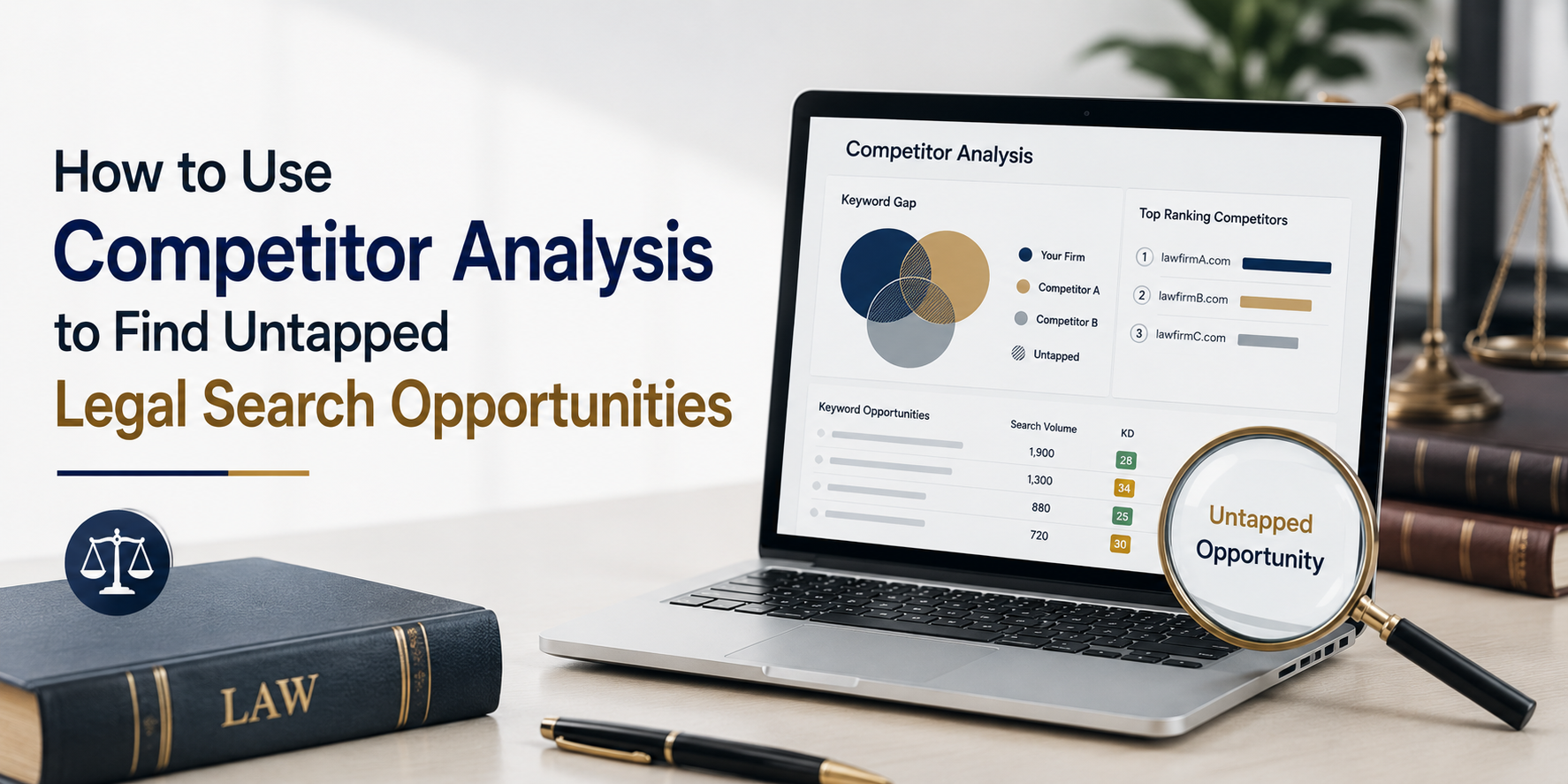
Legal search is highly competitive, and many firms are fighting for visibility around the same practice areas, locations, and high-value keywords. Simply creating more content does not guarantee better rankings. Firms need to understand what competitors are ranking for, where their content falls short, and what potential clients are still searching for. This is where SEO services for attorneys become particularly valuable, as competitor analysis can help uncover search opportunities that are easy to miss through traditional keyword research alone.
A useful competitor analysis is not about copying another law firm’s keywords or content. It is about finding gaps in the search results and understanding whether those gaps represent a genuine opportunity for the firm.
Which Law Firms Are Actually Your SEO Competitors?
The first step is identifying the right competitors.

The firms that compete with a law firm offline are not always the same firms competing with it in organic search. A large national firm may be a major business competitor but have little visibility for the local searches that matter to a smaller practice.
Start with the searches that potential clients are likely to make. Search important practice areas along with relevant locations, then note which firms appear repeatedly.
For example, a personal injury firm might review searches related to:
- Car accident claims
- Motorcycle accidents
- Uninsured or underinsured drivers
- Personal injury settlements
- Medical bills after an accident
- State-specific filing deadlines
The firms that consistently appear across these searches can provide much more useful SEO data than a list based only on market size or reputation.
What Are Competitors Ranking For That Your Firm Is Missing?
After identifying the main search competitors, compare their organic keyword coverage with the firm’s existing rankings.
This can reveal obvious gaps, but not every missing keyword deserves attention. Competitors may rank for terms that have little connection to the firm’s services or attract visitors who are unlikely to become clients.
Instead, look for groups of related searches that competitors have covered well and the firm’s website has barely addressed.
For instance, a personal injury competitor may rank for searches around:
- What to do immediately after an accident
- How insurance claims work
- What happens when the other driver is uninsured
- How long a settlement may take
- Whether medical bills can be recovered
A group of related searches can reveal a broader topic opportunity rather than just one keyword.
Are the Competitor Keywords Actually Worth Targeting?
A keyword gap is only useful when there is a reason to close it.
Search volume is one factor, but it should not be the deciding factor. A high-volume term can attract people who are simply looking for general information, while a lower-volume search may come from someone dealing with an immediate legal problem.
Consider these two searches:
“divorce”
and
“how long does an uncontested divorce take in Texas”
The first is broad and can have many different meanings. The second provides information about the person’s situation, location, and likely intent.
For each opportunity, consider:
| Factor | What to Ask |
|---|---|
| Relevance | Does it relate to a practice area the firm handles? |
| Intent | Is it clear what the searcher wants to know? |
| Demand | Is there evidence that people search for it? |
| Competition | How strong are the current results? |
| Business value | Could the search reasonably lead to legal assistance? |
This helps separate useful opportunities from keywords that look attractive in an SEO tool but have little practical value.
Which Competitor Pages Are Ranking With Weak Content?
This is where simply comparing keyword lists is not enough.
A competitor may rank well even though its page provides a limited answer. That can happen when the search results contain few strong alternatives or when the page has accumulated authority over time.
Read the pages that rank for important searches and assess them from the searcher’s perspective.
Ask:
Does this page actually answer the question that brought the person to Google?
Look for gaps such as:
- Important questions that are not answered
- Outdated information
- General explanations with little practical detail
- Missing state or jurisdiction-specific information
- Poor page organization
- Limited coverage of related questions
- Content that focuses heavily on the law firm rather than the user’s problem
The opportunity is not to create a longer copy of the competing page. The objective is to understand what information is missing and build a more useful resource around the actual search intent.
What Legal Questions Are Competitors Leaving Unanswered?
Many potential clients do not begin their search with legal terminology.
They search for the problem they are experiencing.
For example:
“Can my employer fire me for reporting harassment?”
“Can I file a claim if I was partly responsible for the accident?”
“Can a parent move out of state with a child?”
These searches can uncover opportunities that broad practice-area research misses.
Review competitor content alongside Google’s related searches and common question-based results. Look for questions that appear repeatedly but receive incomplete answers.
If several competing pages mention a question without properly addressing it, that can be a stronger opportunity than simply finding a keyword with no competing results.
Where Are the Local Legal Search Gaps?
Local search can reveal another layer of opportunity because legal rules and procedures often vary by state or jurisdiction.
A law firm may have comprehensive general information about a practice area but little content addressing the location-specific questions potential clients actually have.
Depending on the practice area, useful gaps may involve:
- State-specific laws
- Filing deadlines
- Local court procedures
- Jurisdictional differences
- Regional legal processes
- Practice-area searches combined with a city or state
For example, a general page about personal injury claims may explain the basic process. A useful state-specific resource could address how that process works under the relevant state rules.
The key is to provide genuine local value. Adding a location name to an otherwise generic article does not make the content locally relevant.
Does the Opportunity Need a New Page?
Competitor research should not automatically result in a new URL.
Before creating a page, review the firm’s existing content. The topic may already be covered but not deeply enough.
There are several possible actions:
Update an existing page when the information is outdated or incomplete.
Expand an existing page when it already matches the main intent but misses important related questions.
Create a new page when the search represents a distinct topic or intent.
Consolidate pages when several URLs cover nearly the same subject and compete with one another.
This step is important because creating a new page for every competitor keyword can quickly produce overlapping content and make the site’s structure harder to manage.
How Can You Tell if a Content Gap Is Genuine?
A strong opportunity usually has more than one positive signal.
For example, a topic becomes more interesting when:
- Competitors are already receiving organic visibility for it.
- The search has a clear legal intent.
- The current pages provide incomplete answers.
- Related questions appear across search results.
- The topic connects to an important practice area.
- The firm can provide information that is more useful or specific.
The combination matters.
A keyword with high search volume but poor business relevance may not deserve attention. A smaller search with strong intent and weak competition may be far more valuable.
Should You Copy a Competitor’s Content Strategy?
No. Competitor analysis should show where the search landscape has weaknesses, not provide a template to reproduce.
If several firms have similar articles about the same legal question, publishing another article with the same structure and information is unlikely to create much value.
Instead, ask what those pages fail to explain.
Perhaps they discuss the law but not the practical process. Maybe they answer the general question but ignore a common client scenario. Or they provide basic information without explaining related questions a person is likely to have next.
Those gaps give the content a reason to exist.
How Should Legal Search Opportunities Be Prioritized?
Once the research is complete, rank the opportunities according to their potential value.
A simple framework can help:
High-priority opportunities
These have strong relevance, clear search intent, meaningful business value, and weak or incomplete competing content.
Medium-priority opportunities
These are relevant and useful but face stronger competition or have less obvious business value.
Lower-priority opportunities
These have limited relevance, unclear intent, little business value, or significant overlap with existing content.
This keeps competitor analysis from becoming a large spreadsheet of keywords with no clear direction.
Turn Competitor Gaps Into Content Decisions
The final step is to connect each opportunity with a specific action.
| Competitor Finding | Possible Action |
|---|---|
| Competitors rank for an important question you do not cover | Create a focused resource |
| Existing page covers the topic poorly | Update and expand it |
| Several pages overlap | Consolidate the content |
| Competitors miss useful local information | Create genuinely location-specific content |
| Competitor ranks with incomplete coverage | Build a more complete resource |
| Keyword has traffic but little business value | Deprioritize it |
This turns competitor analysis into something practical. The research can directly influence content updates, new pages, internal linking, and broader organic search priorities.
Final Thoughts
Competitor analysis can reveal much more than the keywords another law firm ranks for. The real opportunity comes from understanding what competitors cover, what they miss, and what potential clients are still trying to find.
That can uncover valuable searches around legal questions, specific client situations, local issues, and topics that competitors have only addressed at a surface level.
For firms considering SEO services for attorneys, this type of analysis can help create a more focused search strategy based on actual gaps rather than simply chasing the keywords competitors already rank for. The goal is not to publish more content than competing firms. It is to identify meaningful opportunities and provide better answers.
As a performance-driven SEO agency, ResultFirst takes this broader view of search strategy, considering competitor visibility, search intent, content gaps, and business relevance when identifying opportunities for sustainable organic growth.