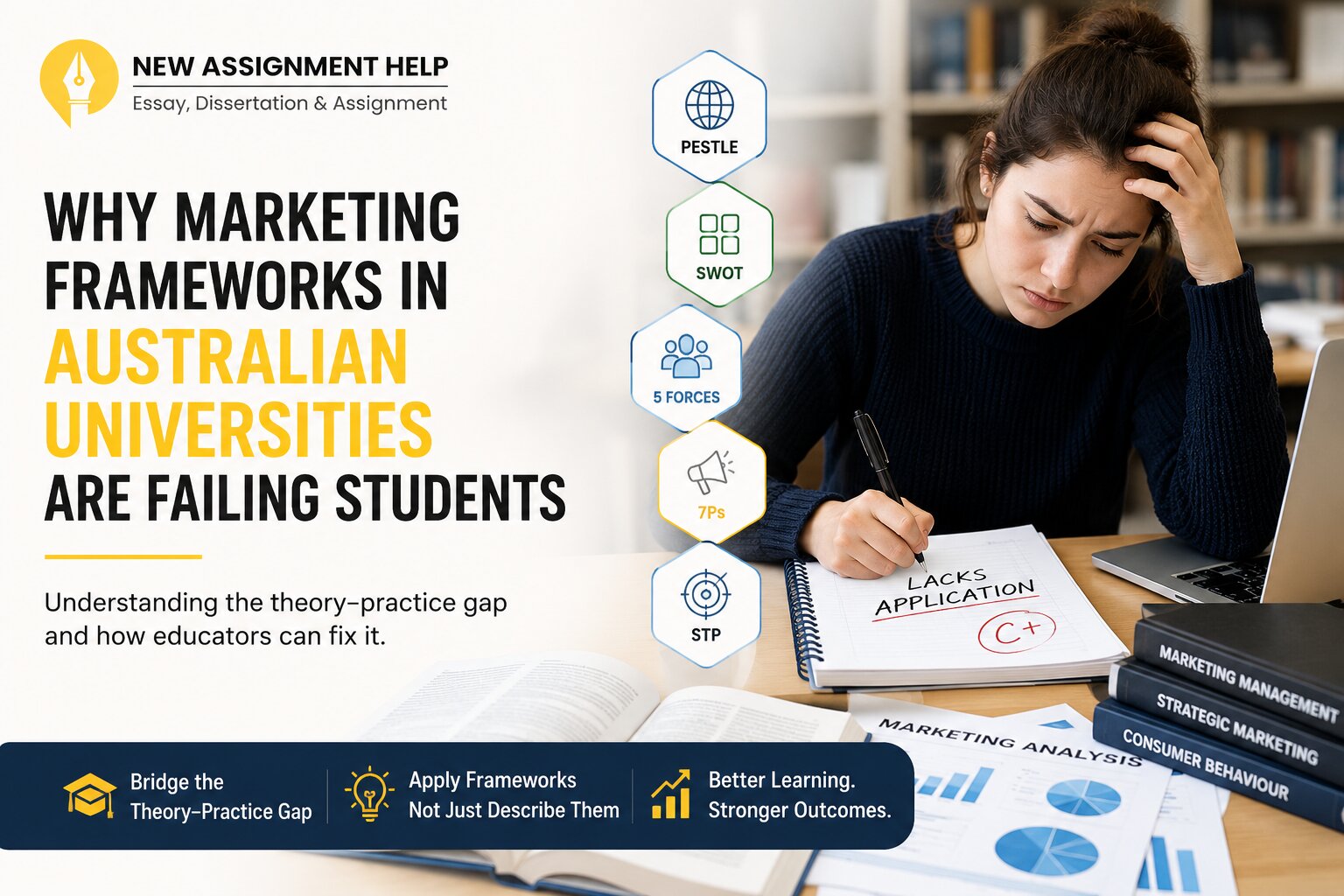
Imagine a third-year marketing student submits a PESTLE analysis for a brand strategy assignment. Every factor, from political and economic to technological and environmental, is there. Neatly defined, thoroughly researched and professionally formatted. Yet the feedback comes back as “lacks application” with a C+ grade.
Now the student is confused. They followed the framework and covered everything on the rubric. So, what went wrong? As an educator, you can’t completely blame them because their gap was about what they were never taught. Most curriculum design teaches students what frameworks are and stops there. And when assignments come, we expect them to apply it for critical evaluation. As a learner, they have the right to know this, so let’s break it down.
How is this a Curriculum Problem and Not a Student Problem
Before blaming students, it’s worth examining the architecture of how frameworks are typically taught. Let’s talk about David Kolb’s experiential learning model: how does it describe learning? As a four-stage cycle: concrete experience, reflective observation, abstract conceptualisation, and active experimentation.

The point is, effective learning happens only when all four meet. Lately, in Australian marketing courses, most framework instructions stop at stage three. Students receive only the framework theory without any idea of how to use it.
If you look at the Graduate Outcomes Survey (GOS), published by QILT, you’ll learn something about the teaching pattern. It consistently shows that marketing and business graduates rate their preparedness for applied workplace tasks lower than their knowledge of theory. Meanwhile, Australian universities have flagged the theory-practice gap as a recurring concern in management faculties. This is especially true in programmes where industry engagement is limited and assignments don’t reflect employer expectations.
Under the Australian Qualifications Framework (AQF), bachelor-level graduates are expected to demonstrate the ability to apply knowledge to complex problems. When framework assignments reward description over application, they’re not just producing weak thinkers. They’re producing graduates who don’t meet their own qualification standards.
In short, this isn’t a student effort problem. It’s a curriculum design problem. Frameworks are being taught as vocabulary when they need to be taught as tools.
The Five Frameworks Marketing Students Most Commonly Misapply
These five frameworks show up in nearly every Australian undergraduate marketing course and surprisingly, they’re always misapplied in the same predictable ways. Here’s what’s going wrong and what a better teaching approach could look like for each.
- PESTLE: Students usually list and define each factor but stop there. No prioritisation, no business implication, no application. The easiest way to fix this is by assigning PESTLE alongside a real Australian brand scenario. Then ask students to identify which two or three factors represent the greatest strategic risk or opportunity for that specific business. This way, they’ll build the habit of interpretation.
- SWOT: Four boxes, four lists, zero strategy. The SO/WO/ST/WT intersections rarely make it into the rubric. Here you can improve your teaching quality by asking for a strategy matrix as part of every SWOT submission. Through this, students must identify at least one actionable strategy from each quadrant intersection.
- Porter’s Five Forces: Five Forces is commonly taught as an industry-level diagnostic without relating it to a firm’s strategic options. The result is a broad industry description, not very useful for decision-making. The fix: assign it to a specific company’s strategic challenge and ask the one question that matters: what should this business actually do?
- 7Ps: The biggest issue here is that in Australian academics, this is used descriptively instead of diagnostically. Students map what a company already does rather than identifying what needs to change. To fix this you can pair a 7Ps audit with a real customer pain point and ask which element is most misaligned. For this, resources like marketing assignments help Australia provide guided examples for struggling students.
- STP: STP is taught as a linear sequence rather than an iterative, evidence-driven process. The fix here can be giving students two or three viable segments and making them argue for one using evidence. Then, they pressure-test their positioning against real competitors.
This proves that the pattern across all five is the same. Students aren’t failing because they don’t know the frameworks. They’re failing because the assessment design never asked them to go further than recognition.
What Australian Educators Can Do: Four Practical Curriculum Moves
Closing the application gap doesn’t require a faculty-wide restructure or a new unit outline lodged with TEQSA. It requires four deliberate design decisions that can be made at the individual educator level. This will be beneficial if included inside existing course structures, starting next teaching period.
1. Show Worked Examples of Framework Application in Assessments
Before students attempt a graded PESTLE or SWOT, show them a completed, annotated example from a comparable assessment context. A rubric tells students what will be judged. A worked example shows them what good judgment looks like on the page. This will immediately improve the submission quality.
2. Build Transfer Scaffolds Between Theory and Assessment
A transfer scaffold is a low-stakes practice task sitting between learning a framework and completing the graded assessment. This can either be a tutorial exercise, a Canvas discussion post, or a brief quiz using a real Australian brand.
3. Use Peer Review of Framework Application as a Formative Tool
Structured peer review works best when it asks targeted questions: What decision does this analysis support? Where does it describe rather than diagnose? Through this, both the reviewer and writer are forced to confront the application question directly. This will be helpful because when a student reviews weak frameworks, they rarely repeat them in their own submissions.
4. Point Students to Vetted External Support Resources
Some students need additional support in translating the framework into assessment-ready writing. This is often seen in the first-generation students, international students, students managing studies and jobs and career changers. For them, taking guidance from academic support services like New Assignment Help Australia can be a good resource. There, the students can learn to move from framework output to coherent analytical writing while enhancing what the classroom teaches
These four moves are not very tough to implement, but can have a really good impact on marketing learners. They are not a complete change from existing practice but good refinements to it. The educator who implements even two of them consistently across a teaching period will see the difference in their students. They’ll start engaging with frameworks and learn to perform better in their assessments.
The Student-Outcome Case: Why This Design Decision Matters
Here is what happens when Australian educators close the application gap: students stop performing compliance and start performing competence. The PESTLE stops being six definitions and becomes a strategic input. The SWOT stops being four lists and starts generating decisions. Grades begin to reflect actual marketing thinking not just the ability to recall and reproduce.
More importantly, students know the difference. When a student receives strong marks on a framework assignment because their analysis genuinely supported a recommendation, their confidence in their own judgment grows. That confidence carries forward into the next unit, the capstone project, the internship, and the graduate role.

Right now, Australian marketing programmes are producing graduates who know the tools but struggle to use them. That is not a student problem; it is a curriculum design opportunity. The issue isn’t in the frameworks; they are sound, but the teaching moment around them is where the work remains. And that work belongs to the educator. So, let’s start from today!