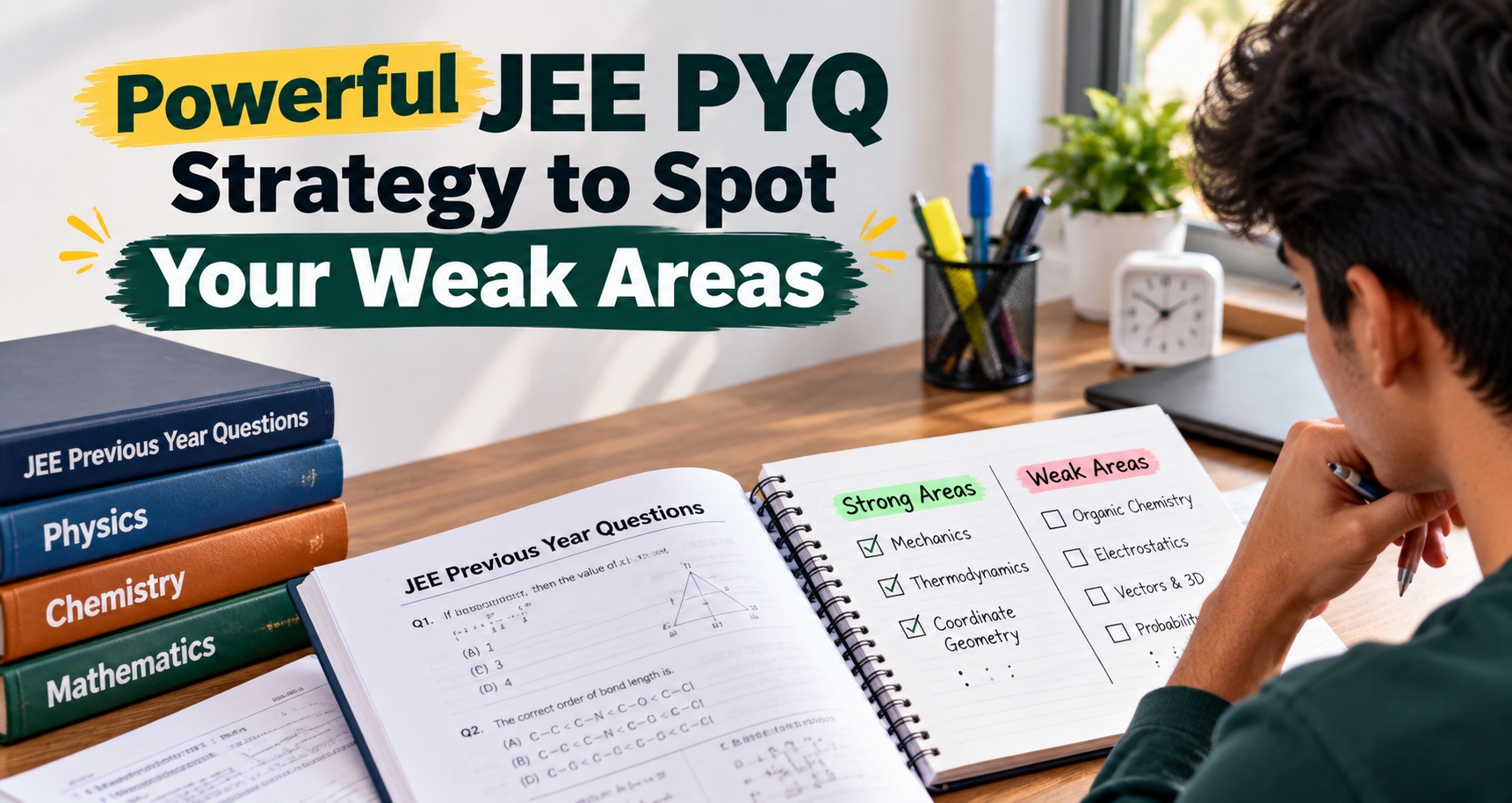
Preparing for JEE is not only about studying more chapters.
It is also about knowing where you are losing marks.
You may spend several hours studying a topic and still make mistakes when a question appears in a test. Sometimes you know the formula but cannot decide how to use it. Sometimes the concept is clear, but calculation mistakes cost you marks. And sometimes you have simply not practised enough questions.

This is where JEE Previous Year Questions can become extremely useful.
PYQs are not just questions to solve before the exam. They can act as a diagnostic tool.
When you solve them properly and analyse your mistakes, you start seeing patterns.
Maybe your mistakes in Physics mostly come from rotational motion.
Maybe Chemistry errors happen because you confuse similar reactions.
Maybe Mathematics takes too much time because you struggle with multi-step problems.
Once you know the pattern, your preparation becomes more focused.
Students preparing through JEE Coaching in Nagpur can also use this approach alongside classroom teaching, mock tests, assignments, and regular revision.
The key is simple.
Do not just ask, “How many PYQs did I solve?”
Ask, “What did these PYQs tell me about my preparation?”
What Are JEE Previous Year Questions?
JEE Previous Year Questions are questions that appeared in earlier JEE examinations.
They can help you understand:
- The type of questions asked
- Frequently tested concepts
- Question difficulty
- Different ways a concept can be tested
- Your speed and accuracy
- Areas where you repeatedly make mistakes
For JEE Main and JEE Advanced, PYQs can also help you become familiar with the style of questions you may face.
But there is a difference between solving PYQs casually and using them to analyse your preparation.
The second approach is much more useful.
Why PYQs Are Useful for Finding Weak Areas
Suppose you solve 30 questions from a chapter.
You get 24 correct.
At first, that sounds good.
But look closer.
Maybe four of the six incorrect answers came from the same concept.
That changes the picture.
Your overall score may look acceptable, but that particular concept needs attention.
This is why you should record your mistakes instead of simply checking your final score.
PYQs can reveal:
- Conceptual gaps
- Formula confusion
- Calculation errors
- Poor question selection
- Time-management problems
- Careless mistakes
- Weak revision
- Difficulty applying concepts
These are different problems.
And they need different solutions.
Powerful JEE PYQ Strategy
Step 1: Start With a Chapter-Wise PYQ Test
Do not immediately solve hundreds of mixed questions.
Start with one chapter.
For example, if you are studying Physics, choose a topic such as electrostatics.
Solve a reasonable set of relevant PYQs without looking at solutions.
Try to simulate test conditions.
Set a timer.
Keep your phone away.
Do not check formulas while solving.
The purpose is to see what you can actually do without help.
After finishing, check every question.
Not just the incorrect ones.
Even a correct answer deserves attention if you guessed it.
Step 2: Divide Your Questions Into Four Categories
This is one of the easiest ways to find weak areas.
After checking your answers, divide the questions into four groups.
Category 1: Correct and Confident
You knew the concept.
You selected the right approach.
You solved it without guessing.
These questions show areas where your preparation is working.
Category 2: Correct but Not Confident
You got the answer right, but you were unsure.
Maybe you guessed a formula.
Maybe you took too long.
Maybe you were choosing between two approaches.
Do not ignore these questions.
A lucky correct answer is not the same as strong understanding.
Mark them for revision.
Category 3: Incorrect Because of a Concept
This is one of the most important categories.
You may have misunderstood a concept or applied the wrong principle.
For example, you may know several formulas from mechanics but use the wrong equation because you do not understand the physical situation.
These mistakes need concept revision.
Category 4: Incorrect Because of a Silly or Calculation Error
Maybe you:
- Missed a negative sign
- Added incorrectly
- Copied a number wrong
- Used the wrong unit
- Read “incorrect” as “correct”
- Made a basic algebra mistake
Do not label every error as a conceptual weakness.
If you keep making calculation mistakes, your solution process needs attention.
Step 3: Maintain a PYQ Mistake Log
A simple mistake log can be more useful than repeatedly solving questions without analysis.
Create columns such as:
| Question | Chapter | Mistake Type | Why I Got It Wrong | Correct Approach | Action |
| Q1 | Current Electricity | Concept | Confused resistance relation | Revise concept | Reattempt |
| Q2 | Kinematics | Calculation | Sign error | Check equation steps | Practise |
| Q3 | Organic Chemistry | Memory | Forgot reaction condition | Revise reaction | Make short notes |
| Q4 | Algebra | Time | Took too long | Learn a shorter method | Timed practice |
You do not need a complicated spreadsheet.
A notebook works too.
The important part is recording the reason for the mistake.
Step 4: Find Repeated Mistakes
One wrong answer does not always mean you have a weak topic.
Repeated mistakes are more useful.
Suppose you solve 25 questions from a chapter and make mistakes in:
- Three questions involving graphs
- Two questions involving unit conversion
- One question involving a formula
The graph-based questions deserve more attention.
Now imagine you make five mistakes across different questions involving the same concept.
That is a stronger signal.
Your mistake log should help you identify these patterns.
Step 5: Separate Conceptual Weakness From Practice Problems
This distinction matters.
Imagine you cannot solve a question on probability.
Ask yourself:
“Do I not understand the concept, or have I simply not practised this type of question?”
The solution is different.
If you do not understand the concept, go back to your notes or textbook.
If you understand the concept but cannot solve questions, practise more variations.
Do not spend three hours rereading theory when the actual problem is a lack of question practice.
Step 6: Use PYQs to Check Your Speed
JEE preparation is not only about accuracy.
Time matters too.
A question that takes you eight minutes during practice may not be practical in an actual examination.
While solving PYQs, record the approximate time taken.
You may discover patterns such as:
- Easy questions taking too long
- Lengthy calculations slowing you down
- Difficulty deciding which method to use
- Spending too much time on one question
- Rechecking answers repeatedly
These are useful observations.
How to Identify Time-Management Weaknesses
Suppose you solve 20 Mathematics PYQs.
You get 16 correct.
That looks reasonable.
But you took much longer than expected.
Your problem may not be Mathematics knowledge.
It may be question selection or solving speed.
Try asking:
- Did I spend too long on one question?
- Could I have skipped a lengthy question temporarily?
- Did I know a shorter method?
- Did I spend too much time on calculations?
- Did I get stuck because I could not identify the starting point?
This type of analysis can change how you practise.
Step 7: Analyse Each Subject Differently
Physics, Chemistry, and Mathematics do not always require the same mistake-analysis approach.
Physics
Look for:
- Concept application
- Formula selection
- Diagram interpretation
- Units
- Calculations
- Graphs
- Multi-concept questions
For Physics, ask yourself:
“Did I understand what the question was describing?”
Sometimes the formula is not the real problem.
Understanding the physical situation is.
Chemistry
Chemistry has different sections, so your mistakes may have different causes.
In Physical Chemistry, check:
- Formula selection
- Calculations
- Units
- Approximation
- Numerical steps
In Organic Chemistry, check:
- Reaction mechanisms
- Reagents
- Conditions
- Product prediction
- Named reactions
In Inorganic Chemistry, check:
- Facts
- Trends
- Exceptions
- Chemical properties
If the same reaction or concept keeps causing mistakes, mark it for revision.
Mathematics
Mathematics often exposes problems with:
- Concept selection
- Algebra
- Calculation
- Problem interpretation
- Time management
- Multi-step reasoning
You may understand a chapter but still struggle with questions that combine two or more concepts.
Those questions deserve separate practice.
Step 8: Create a Weak-Area Ranking for Yourself
You do not need to rank yourself against other students.
Instead, rank your own topics based on your mistakes.
For example:
High Priority
Topics where:
- Accuracy is low
- Mistakes repeat
- You cannot explain the solution
- You struggle even after revision
Medium Priority
Topics where:
- You understand the concept
- But make occasional mistakes
- You need more practice
Low Priority
Topics where:
- Accuracy is high
- You solve confidently
- You rarely make mistakes
This gives you a personal study map.
Step 9: Reattempt Wrong PYQs After Revision
This step is often skipped.
You make a mistake.
You read the solution.
You understand it.
Then you move on.
A few days later, the same type of question appears, and the same mistake happens again.
So reattempt your incorrect PYQs.
Wait a few days after revising the topic.
Then solve the question without looking at the previous solution.
If you solve it independently, that is a better sign that the gap has been addressed.
Step 10: Use the 3-Question Rule
When you make a mistake, ask yourself three questions:
What did I misunderstand?
Find the exact issue.
Why did I make that mistake?
Was it a concept gap, calculation error, memory problem, or time issue?
What will I do differently next time?
This turns a mistake into an action.
For example:
“I forgot the condition for this reaction.”
becomes:
“Revise this reaction and write the reagent and condition in my reaction notes.”
That is much more useful.
How Many PYQs Should JEE Aspirants Solve?
There is no magic number.
Solving 500 questions without analysing mistakes may be less useful than solving fewer questions carefully.
Your focus should be:
- Quality
- Coverage
- Accuracy
- Analysis
- Reattempts
You can gradually increase the number of questions as your preparation improves.
The exact number also depends on your schedule, current preparation level, and whether you are preparing for JEE Main, JEE Advanced, or both.
How to Combine PYQs With Mock Tests
PYQs and mock tests serve different purposes.
PYQs help you understand actual question patterns and test your chapter-level preparation.
Mock tests help you practise the full examination experience.
You can use both.
A simple cycle could look like this:
Study
Learn or revise a topic.
Practise
Solve topic-wise questions.
Analyse
Record your mistakes.
Reattempt
Solve incorrect questions again.
Test
Take a mixed or full-length test.
Review
Find the next set of weak areas.
Then repeat the process.
How JEE Coaching Can Help With PYQ Analysis
If you are attending JEE Coaching in Nagpur, do not depend only on classroom tests to identify weak areas.
Bring your PYQ mistake patterns to your teachers.
For example, instead of saying:
“I am weak in Physics.”
You can say:
“I understand electrostatics theory, but I repeatedly make mistakes in questions involving electric potential and take too long to solve numerical problems.”
That gives your teacher something specific to work with.
You may then get targeted practice instead of revising the entire chapter from the beginning.
Common Mistakes Students Make While Solving PYQs
Solving with the solution open
This gives you a false sense of preparation.
Try the question independently first.
Checking only the final score
Your score tells you what happened.
Your mistakes tell you why it happened.
Ignoring questions you guessed correctly
A guess can hide a knowledge gap.
Mark uncertain answers for review.
Not recording repeated errors.
If you keep making the same mistake, you need a system to catch it.
Solving only favourite chapters
It feels good to score well in topics you already understand.
But your weak chapters need attention too.
Doing PYQs only before the exam
PYQs are useful throughout your preparation.
You can use chapter-wise questions while learning and mixed questions during revision.
A Simple Weekly PYQ Plan
You can adapt this to your timetable.
Monday to Friday
After studying a topic, solve a small set of relevant PYQs.
Record incorrect and uncertain questions.
Saturday
Review your mistake log.
Identify the topics where mistakes are repeating.
Sunday
Reattempt selected incorrect questions.
Then take a short mixed test covering recent topics.
This creates a feedback loop.
You study.
You test.
You find gaps.
You fix them.
Then you test again.
Frequently Asked Questions
Are JEE Previous Year Questions enough for preparation?
PYQs are an important part of preparation, but they should not replace learning concepts, regular practice, revision, mock tests, and other appropriate study material.
How do PYQs help identify weak topics?
They show where you repeatedly make mistakes. By recording the chapter, question type, and reason for each error, you can identify patterns in your preparation.
Should I solve PYQs chapter-wise or randomly?
Chapter-wise PYQs are useful while learning and revising individual topics. Mixed PYQs become more useful when you want to test whether you can identify the right concept without being told the chapter first.
Should I solve questions I got correct?
Yes. Pay particular attention to questions you solved by guessing or were not confident about. A correct answer does not always mean the concept is fully understood.
Final Thoughts
Previous Year Questions are much more than a collection of questions to finish.
Use them to understand yourself as a student.
Which concepts do you forget?
Which questions take too long?
Where do you make careless errors?
Which chapters look easy until you actually solve questions from them?
These answers can tell you where your preparation needs attention.
So the next time you finish a PYQ session, do not close the book immediately after checking your score.
Spend a few extra minutes analysing your mistakes.
That small habit can make your preparation much more focused.
And over time, your goal should not simply be to solve more questions.

It should be to make fewer of the same mistakes.