In modern software development, building high-quality applications requires more than just writing functional code. Teams must ensure that their software not only works correctly at a technical level but also aligns with real user expectations. This is where understanding tdd vs bdd becomes essential—not as competing approaches, but as complementary practices that can be used together to create a robust development workflow.
Test-Driven Development (TDD) and Behavior-Driven Development (BDD) are both widely adopted methodologies that improve software quality, reduce bugs, and enhance collaboration. However, many teams struggle to integrate them effectively. When used correctly, TDD and BDD can bridge the gap between business requirements and technical implementation, leading to faster development cycles and more reliable software.
This article explores how to use tdd vs bdd together effectively, with practical insights, real-world examples, and best practices.
Understanding TDD vs BDD
To combine tdd vs bdd successfully, it’s important to understand what each approach is designed to achieve.
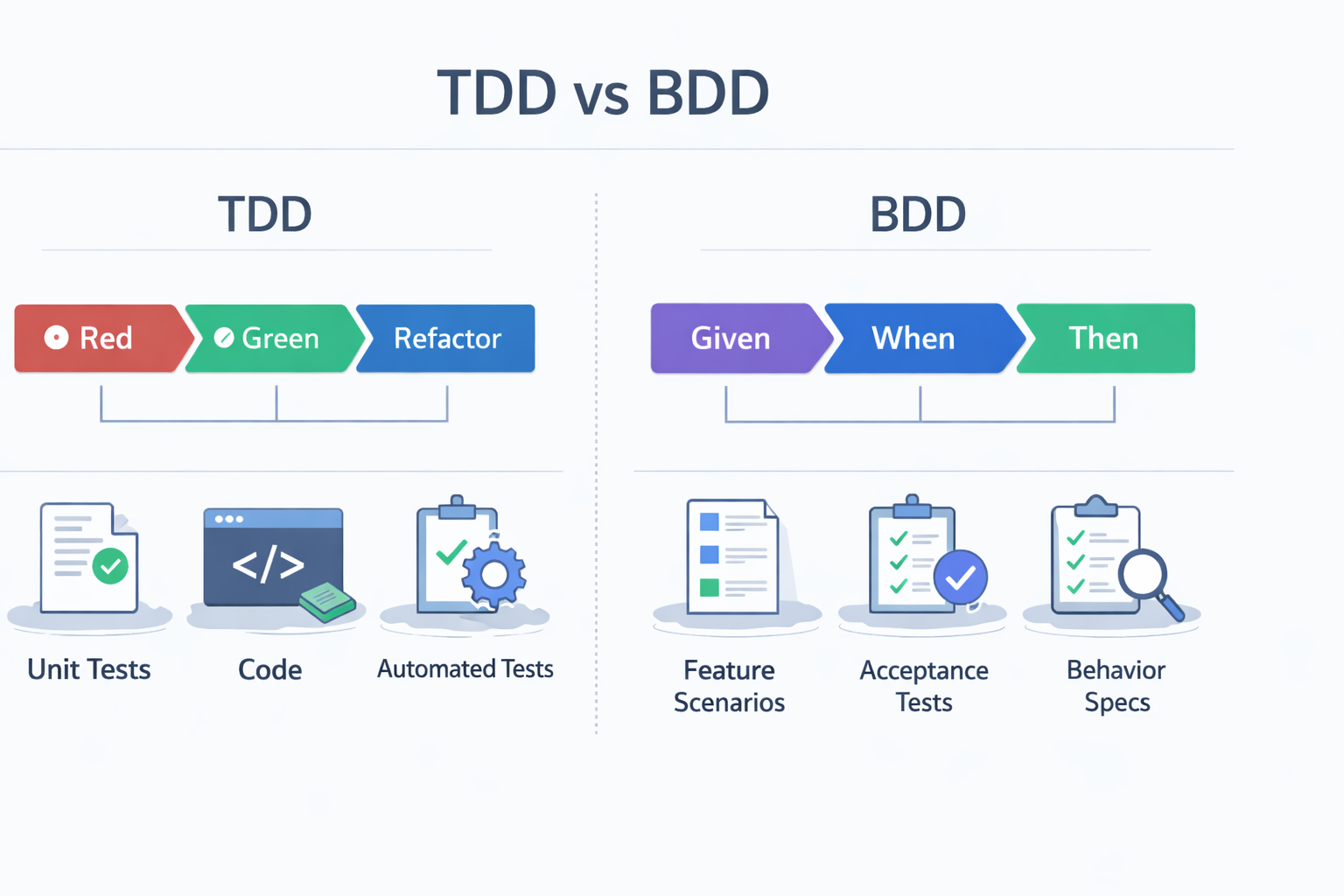
TDD is a development technique where tests are written before the actual code. Developers follow a cycle of writing a failing test, implementing the code to pass the test, and then refactoring it. This ensures that every piece of code is tested and works as intended.
BDD, on the other hand, focuses on defining how an application should behave from the user’s perspective. It uses simple, natural language to describe scenarios, making it easier for developers, testers, and non-technical stakeholders to collaborate.
In simple terms:
- TDD focuses on “how the system works”
- BDD focuses on “what the system should do”
Understanding this distinction is the first step toward integrating both approaches effectively.
Why Combining TDD and BDD Matters
Many teams treat tdd vs bdd as an either-or choice, but this limits their potential. In reality, both approaches solve different problems and work best when used together.
BDD helps define clear requirements by translating business needs into understandable scenarios. This reduces ambiguity and ensures that everyone involved in the project shares the same understanding.
TDD ensures that these requirements are implemented correctly at the code level. It provides a safety net that prevents regressions and improves code quality.
When combined:
- Requirements are clearer
- Code is more reliable
- Collaboration improves
- Bugs are caught earlier
This combination creates a feedback loop where behavior guides development, and tests validate implementation.
The Relationship Between TDD and BDD
TDD and BDD operate at different levels of the development process.
BDD typically works at the feature or acceptance level. It defines what the system should do in terms of user behavior. These scenarios act as both documentation and validation.
TDD operates at the unit level. It ensures that individual components and functions behave correctly.
Instead of overlapping, they form a layered approach:
- BDD defines the expected behavior
- TDD ensures correct implementation of that behavior
This layered structure is what makes the combination so powerful.
A Step-by-Step Workflow to Combine TDD and BDD
To effectively implement tdd vs bdd together, teams can follow a structured workflow.
Step 1: Define Behavior Using BDD
Start by writing BDD scenarios that describe how the system should behave. These scenarios should be:
- Simple and easy to understand
- Focused on user outcomes
- Written collaboratively
For example:
- Given a user adds items to the cart
- When the user proceeds to checkout
- Then the correct total should be displayed
This step ensures clarity before any code is written.
Step 2: Break Down Scenarios into Technical Tasks
Once the behavior is defined, the next step is to translate it into smaller, testable components.
This involves:
- Identifying required functions
- Defining inputs and expected outputs
- Planning the implementation structure
This step connects business requirements with technical execution.
Step 3: Apply TDD for Implementation
Now, developers use TDD to implement each component.
They follow the cycle:
- Write a failing unit test
- Write code to pass the test
- Refactor for optimization
This ensures that each part of the system is reliable and testable.
Step 4: Validate with BDD Scenarios
After implementing the code, run the BDD scenarios to verify that the system behaves as expected from the user’s perspective.
If the scenarios pass, it confirms that:
- The functionality is correct
- The behavior matches requirements
This completes the feedback loop between behavior and implementation.
Real-World Example: E-Commerce Checkout
To better understand how tdd vs bdd works together, consider an e-commerce checkout feature.
BDD Scenario
- Given a user has items in the cart
- When the user applies a discount code
- Then the total price should be updated correctly
TDD Implementation
Developers would write unit tests for:
- Price calculation logic
- Discount application
- Tax computation
Each function is tested individually using TDD, while the overall behavior is validated using BDD.
This ensures that both the internal logic and external behavior are correct.
Common Challenges When Combining TDD and BDD
While combining tdd vs bdd is powerful, it comes with challenges.
One common issue is duplication of effort. Teams may end up writing similar tests in both TDD and BDD, increasing maintenance overhead.
Another challenge is misalignment. If BDD scenarios are not clearly defined, developers may implement features incorrectly, even if TDD tests pass.
Collaboration can also be difficult. BDD requires input from multiple stakeholders, which is not always easy to coordinate.
Additionally, maintaining both unit tests and behavior scenarios can become time-consuming as the application grows.
Recognizing these challenges early helps teams plan better and avoid inefficiencies.
Best Practices for Using TDD and BDD Together
To get the most out of tdd vs bdd, teams should follow these best practices:
Keep BDD scenarios simple and focused on user behavior. Avoid technical details in these scenarios, as they are meant to be understood by all stakeholders.
Write clean and maintainable unit tests in TDD. Avoid overly complex or tightly coupled tests that are hard to update.
Ensure clear communication between developers, testers, and business teams. Collaboration is key to successful BDD implementation.
Avoid duplication by clearly defining the purpose of each test. TDD tests should validate logic, while BDD tests should validate behavior.
Continuously refactor both code and tests to keep them efficient and relevant.
Modern tools can also simplify the process. For example, platforms like Keploy help capture real API interactions and convert them into test cases, making it easier to validate both behavior and implementation without excessive manual effort.
When Should You Use Both TDD and BDD?
Using tdd vs bdd together is especially beneficial in certain scenarios.
Projects with complex business logic benefit from clear behavior definitions and strong unit testing.
Applications involving multiple stakeholders require BDD for better communication and alignment.
Teams practicing Agile or DevOps can integrate both approaches into continuous testing workflows.
Products that require high reliability, such as financial or healthcare systems, benefit from the combined assurance of TDD and BDD.
In these cases, relying on just one approach may not provide sufficient coverage or clarity.
How TDD and BDD Improve Software Quality
Combining tdd vs bdd leads to measurable improvements in software quality.
Defects are identified earlier, reducing the cost of fixing them.
Code becomes more modular and easier to maintain due to TDD practices.
BDD ensures that features align with user expectations, improving usability.
The overall development process becomes more structured and predictable.
These benefits make TDD and BDD a valuable combination for modern software teams.
Conclusion
The conversation around tdd vs bdd often focuses on differences, but the real advantage lies in how they complement each other. TDD ensures that your code is technically sound, while BDD ensures that your application delivers the right behavior.
By combining both approaches, teams can create a balanced development workflow that addresses both implementation and user expectations. This leads to better collaboration, fewer defects, and higher-quality software.