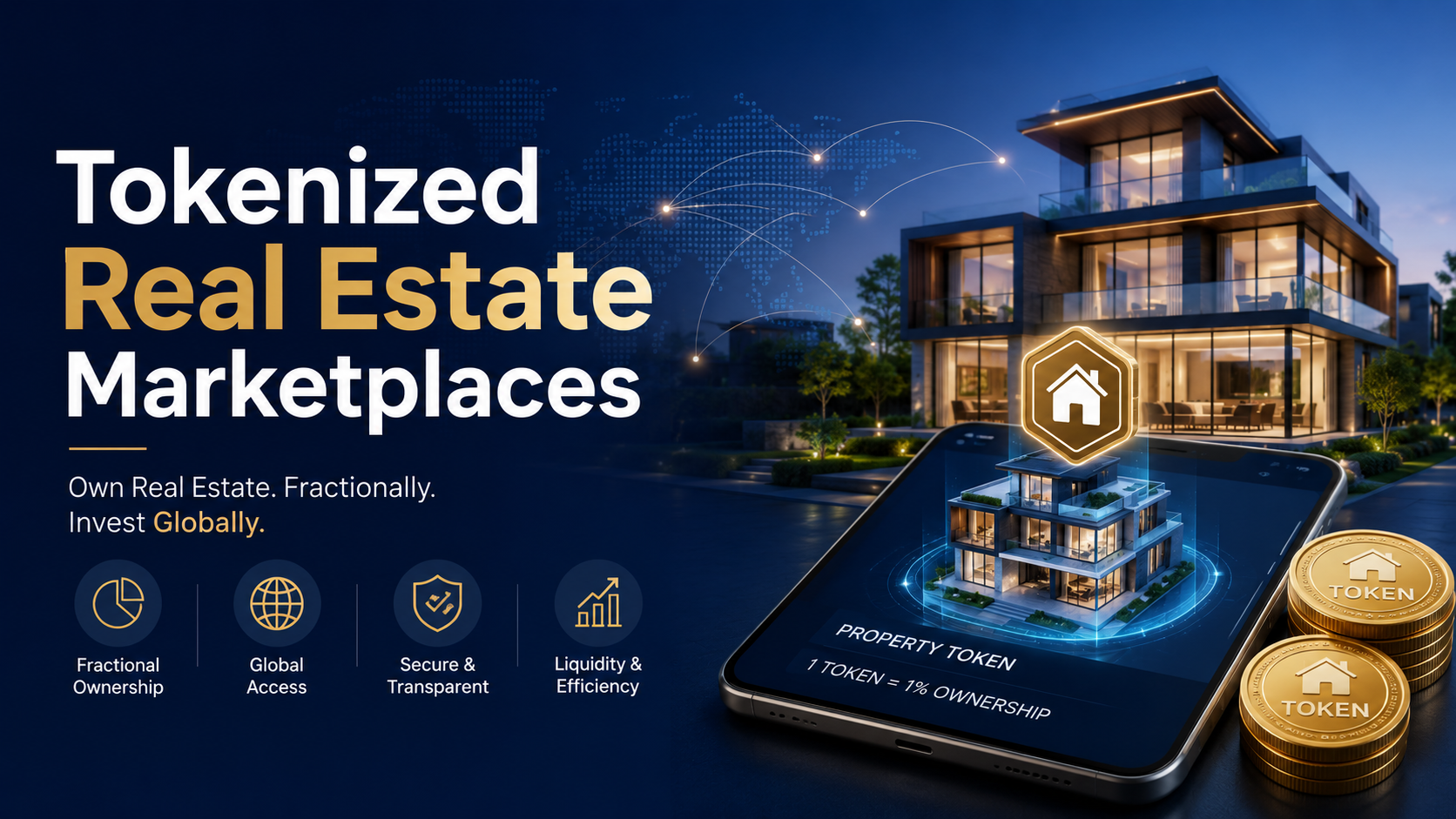
Real estate has long been one of the most established wealth-building asset classes, yet it has also remained one of the most structurally exclusive. High capital requirements, geographic barriers, illiquidity, and lengthy transaction cycles have traditionally limited participation to institutional investors and high-net-worth individuals. Tokenized real estate marketplaces are emerging as a structural response to these limitations, introducing blockchain-based fractional ownership models that reshape how property is accessed, traded, and managed.
Rather than replacing traditional real estate systems, these marketplaces are gradually building a parallel investment layer one that introduces programmability, divisibility, and improved liquidity into a historically rigid asset class.
Understanding Tokenized Real Estate Marketplaces
A tokenized real estate marketplace is a digital platform where ownership rights or economic interests in real estate assets are represented as blockchain-based tokens. Each token typically corresponds to a fraction of a property, a share of rental income, or a claim on capital appreciation.

These platforms sit at the intersection of real estate, fintech, and blockchain infrastructure. Their primary function is to enable issuance, distribution, trading, and settlement of property-backed digital assets in a transparent and programmable environment. At a structural level, tokenized marketplaces generally involve three components:
First, the underlying real estate asset, which may include residential units, commercial buildings, or mixed-use developments. Second, a legal wrapper such as a special purpose vehicle (SPV) or trust structure that holds the asset. Third, a blockchain layer that issues tokens representing fractional ownership or cash flow rights. This combination of legal structuring and digital representation enables a shift from indivisible property ownership to modular investment participation.
Why Traditional Real Estate Markets Create Access Barriers
To understand the significance of tokenized marketplaces, it is important to examine the structural limitations of conventional real estate investment systems. Real estate investments typically require large upfront capital commitments, which immediately restrict participation. Even when financing options exist, they often involve complex underwriting processes, long approval cycles, and geographic restrictions.
Liquidity is another major constraint. Selling a property or even a share in a property can take months due to valuation negotiations, legal processes, and market conditions. This lack of liquidity discourages smaller investors from entering the market.
Additionally, transaction costs including brokerage fees, legal expenses, and administrative overhead—reduce overall efficiency and returns. These friction points collectively create a system that favors scale and capital concentration. Tokenized marketplaces attempt to address these inefficiencies by restructuring ownership into smaller, transferable units.
How Tokenized Real Estate Marketplaces Work
The operational model of tokenized real estate marketplaces typically follows a structured lifecycle that includes asset onboarding, token issuance, distribution, and secondary trading.
Asset Structuring and Legal Framework
The process begins with asset structuring. A real estate property is placed under a legal entity such as an SPV or trust. This entity holds the title of the asset and defines investor rights, revenue distribution mechanisms, and governance rules. This legal layer is essential because blockchain tokens alone do not confer enforceable property rights. Instead, they represent a contractual claim linked to the underlying asset structure.
Token Issuance and Representation
Once the legal framework is established, digital tokens are issued to represent fractional ownership or economic rights. These tokens are recorded on a blockchain, ensuring transparency and traceability. Each token may represent a fixed percentage of ownership or a defined share of rental income generated by the property. Smart contracts are often used to automate distribution of income, governance voting, or compliance conditions. This structure allows investors to hold divisible interests in high-value properties without requiring full ownership.
Marketplace Listing and Investor Participation
After token issuance, assets are listed on a digital marketplace where investors can buy, sell, or hold tokens. These marketplaces function similarly to securities exchanges but are optimized for fractional real estate assets. Investors can evaluate property-backed tokens based on yield potential, location fundamentals, occupancy rates, and asset class performance. However, unlike traditional real estate transactions, entry barriers are significantly reduced due to fractionalization.
Secondary Trading and Liquidity Mechanisms
One of the most important innovations introduced by tokenized marketplaces is the potential for secondary trading. Traditionally, real estate is considered illiquid because ownership transfer requires full asset sale or complex restructuring. In tokenized systems, fractional ownership units can be traded more dynamically, subject to regulatory compliance and platform rules. This introduces a level of liquidity that was previously unavailable in real estate markets. However, liquidity depth is still evolving and often depends on platform adoption, investor base size, and regulatory clarity.
Key Advantages of Tokenized Real Estate Marketplaces
1. Fractional Access to High-Value Assets
Tokenization enables smaller investors to participate in premium real estate markets such as commercial office towers, luxury apartments, or logistics hubs. Instead of requiring full property purchase, investors can acquire fractional exposure. This fundamentally broadens the investor base and allows capital distribution across multiple assets rather than concentration in a single property.
2. Improved Transparency and Auditability
Blockchain-based recordkeeping introduces a transparent ledger of ownership, transactions, and distributions. This reduces reliance on intermediaries and minimizes information asymmetry between stakeholders. In traditional systems, property ownership records may be fragmented across registries, brokers, and legal entities. Tokenized systems consolidate these records into a unified digital infrastructure.
3. Programmable Income Distribution
Rental income, lease payments, or asset-generated revenue can be distributed automatically using smart contracts. This reduces administrative overhead and ensures consistent, rule-based payouts. Automation also minimizes delays and reduces operational inefficiencies associated with manual distribution systems.
4. Reduced Entry Barriers
Minimum investment thresholds are significantly lower in tokenized marketplaces. This allows participation from retail investors who were previously excluded from real estate markets due to capital constraints. The democratization of access does not eliminate risk, but it redistributes participation opportunities.
5. Portfolio Diversification Across Properties
Investors can allocate capital across multiple tokenized properties in different geographies and asset classes. This enables diversification strategies that are difficult to achieve in traditional real estate investment models. Diversification helps reduce exposure to localized market downturns and improves risk-adjusted returns over time.
Challenges Facing Tokenized Real Estate Marketplaces
Despite their structural advantages, tokenized real estate systems face several challenges that influence their adoption trajectory.
Regulatory Uncertainty
One of the most significant constraints is regulatory fragmentation. Different jurisdictions classify tokenized assets differently some as securities, others as digital assets or property-linked instruments. This affects compliance requirements, investor eligibility, and trading permissions. Without harmonized regulatory frameworks, cross-border tokenized real estate trading remains complex.
Valuation Standardization
Real estate valuation in tokenized form still relies on traditional appraisal methods. However, the introduction of fractional liquidity can introduce price variability that is not always aligned with underlying asset fundamentals. Establishing standardized valuation mechanisms for tokenized properties remains an ongoing challenge.
Liquidity Depth Constraints
While tokenization introduces the concept of liquidity, actual market depth depends on active buyers and sellers. Many tokenized assets still experience limited trading volume, which can restrict exit opportunities. Liquidity improves gradually as marketplaces scale, but it is not inherently guaranteed by tokenization alone.
Custody and Asset Verification
Ensuring that digital tokens are accurately backed by real-world assets requires strong custody and auditing systems. Without reliable verification mechanisms, trust in tokenized representations can weaken. This includes verifying property ownership, rental income flows, and maintenance of underlying assets.
Emerging Trends in Tokenized Real Estate Marketplaces
Several structural trends are shaping the evolution of tokenized real estate systems.
Institutional Participation
Institutional investors are increasingly exploring tokenized real estate as a diversification tool. Pension funds, asset managers, and private equity firms are experimenting with blockchain-based real estate exposure, particularly in stabilized income-generating properties.
Integration with DeFi Ecosystems
Tokenized real estate assets are beginning to interact with decentralized finance systems. In some models, real estate tokens are used as collateral for borrowing or integrated into yield-generating liquidity pools. This convergence introduces new financial layering between real-world assets and programmable financial systems.
Geographic Expansion of Tokenized Assets
While early adoption has been concentrated in select markets, tokenized real estate is gradually expanding into global property markets. This includes commercial hubs, emerging real estate corridors, and infrastructure-linked developments. Cross-border participation remains dependent on regulatory alignment but is expected to expand over time.
Hybrid Ownership Models
Future systems may combine traditional ownership structures with tokenized participation layers. This hybrid approach allows institutions to maintain regulatory compliance while enabling fractional investor participation. Such models may become a transitional framework between conventional real estate and fully digital asset markets.
The Structural Shift in Property Investment Access
Tokenized real estate marketplaces represent more than a technological innovation; they represent a structural shift in how property ownership is conceptualized. Instead of being a binary model of full ownership or non-participation, real estate becomes divisible, programmable, and partially liquid. This shift does not eliminate the complexity of real estate markets, but it redistributes access and introduces new layers of financial participation. Over time, these systems may redefine how capital flows into property markets and how investors interact with physical assets.
Conclusion
Tokenized real estate marketplaces are gradually reshaping the architecture of property investment by introducing fractional ownership, programmable income distribution, and improved liquidity potential. While the sector is still evolving and faces regulatory and operational constraints, its foundational model offers a significant departure from traditional real estate investment structures.

The long-term trajectory of these marketplaces will depend on regulatory clarity, institutional adoption, and the development of robust liquidity ecosystems. As these factors converge, tokenized real estate may become a foundational component of next-generation investment infrastructure, bridging physical property markets with digital financial systems in a more integrated and accessible way.