Regression testing is an essential part of software quality assurance, ensuring that recent changes, updates, or bug fixes do not break existing functionality. With increasingly complex applications, running full regression suites manually can be time-consuming and prone to human error. This is where test automation becomes a game-changer. By automating the right tests, teams can maintain quality without sacrificing speed.
Understanding the types of regression testing and how automation optimizes each type is crucial for modern QA teams. In this guide, we will cover all major regression types, their purpose, and practical automation strategies to maximize efficiency and coverage.
What Is Regression Testing?
Regression testing is a type of software testing performed to ensure that recent code changes have not adversely affected existing features. Any change in the software — whether a new feature, a bug fix, or a configuration update — can inadvertently introduce defects. Regression testing catches these issues before they reach production.
The process involves re-executing previously run test cases to confirm that the system still behaves as expected. Traditionally, regression testing has been a manual, repetitive process, but automation can drastically improve speed and reliability.
Why Automation Is Critical for Regression Testing
Manual regression testing has several limitations:
-
Time-consuming for large test suites
-
Prone to human error
-
Difficult to maintain with frequent releases
-
Limited repeatability
Automation solves these challenges by:
-
Executing tests quickly and consistently
-
Running tests in CI/CD pipelines
-
Providing faster feedback to developers
-
Ensuring reliable validation across multiple environments
By combining automated testing with the right type of regression testing, teams can improve quality, reduce cost, and maintain agility.
Types of Regression Testing and Automation Strategies
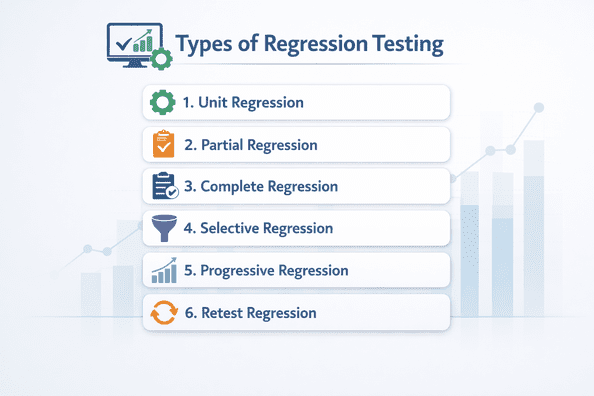
There are several types of regression testing, each suited for different scenarios. Let’s explore them and see how automation can optimize their execution.
1. Corrective Regression Testing
Definition: Corrective regression testing is used when there are no significant changes to the existing code. The system behaves according to existing specifications, and previously created test cases can be reused without modification.
Automation Strategy:
-
Automate all stable test cases that rarely change.
-
Use frameworks like Selenium, Cypress, or Playwright for UI automation.
-
Integrate with CI/CD pipelines to trigger automated tests on each code commit.
Example:
A minor layout fix is applied to a settings page. Automated functional tests can quickly verify that buttons, forms, and labels continue to work correctly.
Corrective regression testing is highly efficient when automation ensures consistent execution with minimal manual intervention.
2. Progressive Regression Testing
Definition: Progressive regression testing is applied when new features are added or existing functionality is modified. Since code changes impact system behavior, new test cases are created alongside the existing ones.
Automation Strategy:
-
Maintain modular automated test scripts for new features.
-
Use automated test case generation tools where possible.
-
Update regression suites to include new scenarios automatically.
Example:
An e-commerce app adds a new “Express Checkout” button. Automation scripts are written for this new flow while continuing to validate the existing checkout and payment processes.
By automating progressive regression, teams can ensure that new features integrate smoothly without breaking existing workflows.
3. Selective Regression Testing
Definition: Selective regression testing focuses only on modules or functionalities impacted by recent changes. Instead of running the entire suite, only relevant tests are executed.
Automation Strategy:
-
Use test impact analysis tools to identify affected components.
-
Maintain a mapping between code modules and automated test scripts.
-
Trigger only relevant automated tests in CI/CD pipelines.
Example:
If a developer updates the discount calculation logic, automated tests for the checkout and pricing modules are executed, skipping unrelated modules like user profiles or product listings.
Automation significantly reduces execution time while maintaining targeted validation for impacted areas.
4. Partial Regression Testing
Definition: Partial regression testing is similar to selective regression but includes dependent modules. Changes in one module may affect other modules that interact with it.
Automation Strategy:
-
Define dependencies in the automation framework.
-
Automate execution of tests for both the changed module and its dependent modules.
-
Use test orchestration tools to manage execution order and dependencies.
Example:
Updating the login system may require testing authentication, session management, and access control modules. Automated scripts ensure that all related workflows are validated consistently.
Partial regression testing ensures comprehensive validation while limiting unnecessary test execution.
5. Complete Regression Testing
Definition: Complete regression testing involves executing the full test suite to validate all functionalities. It is typically performed when major updates, architecture changes, or multiple module interactions occur.
Automation Strategy:
-
Automate end-to-end test suites using robust frameworks.
-
Use parallel execution to run large suites faster across multiple environments.
-
Integrate with reporting tools to track pass/fail rates and detect regressions early.
Example:
After a significant database migration in a financial application, the entire system, including reports, transactions, and user interfaces, must be validated.
Automation makes complete regression feasible and reduces the time required for extensive validation.
6. Retest-All Regression Testing
Definition: Retest-all regression testing involves executing all test cases, regardless of scope. When the impact of changes is uncertain or when testing critical features, this becomes useful.
Automation Strategy:
-
Automate the entire regression suite.
-
Schedule periodic full regression runs in CI/CD pipelines.
-
Use cloud-based execution to handle large-scale parallel testing.
Example:
A critical security patch affects authentication and session management. Automated retest-all ensures no hidden defects are left unchecked.
Although time-consuming, automation enables retest-all regression without exhausting QA resources.
7. Unit Regression Testing
Definition: Unit regression testing validates individual components or modules after code changes. Developers usually perform this level before integration.
Automation Strategy:
-
Implement automated unit tests using frameworks like JUnit, NUnit, or PyTest.
-
Integrate unit tests with CI pipelines for immediate feedback.
-
Ensure each module is independently validated before full system testing.
Example:
A function responsible for tax calculation is updated. Automated unit tests verify that the calculation logic is correct, preventing errors from propagating to higher-level modules.
Unit regression testing ensures early detection of defects, reducing overall debugging time.
8. Hybrid Regression Testing
Definition: Hybrid regression testing combines multiple regression approaches depending on the context, release frequency, and system architecture.
Automation Strategy:
-
Use automated orchestration to manage selective, partial, and complete regression tests.
-
Leverage risk-based prioritization to execute critical tests first.
-
Maintain modular test cases through dynamic selection.
Example:
In a SaaS product:
-
Daily commits → Selective regression
-
Sprint release → Partial regression
-
Major quarterly release → Complete regression
Automation provides the flexibility to switch between regression types based on project needs.
Benefits of Automating Regression Testing
Integrating automation into regression testing enhances productivity and quality. Key benefits include:
-
Faster Execution – Automated tests run much faster than manual tests, enabling quicker release cycles.
-
Consistency – Automation ensures tests are executed uniformly across different environments.
-
Early Feedback – CI/CD integration allows immediate feedback on defects after every commit.
-
Resource Efficiency – Reduces manual testing effort, allowing QA teams to focus on exploratory testing.
-
Scalability – Large applications with thousands of test cases can be managed effectively.
Challenges in Automated Regression Testing
While automation brings benefits, there are challenges:
-
High initial setup cost
-
Maintaining automated scripts as features change
-
Risk of flaky tests due to environmental issues
-
Choosing which regression type to automate first
A structured approach to combining automation with appropriate regression types mitigates these risks.
Best Practices for Automating Regression Testing
-
Maintain modular and reusable test scripts.
-
Prioritize high-risk and frequently changed areas.
-
Keep automation suites up to date with the application.
-
Integrate automated tests with CI/CD pipelines for continuous feedback.
-
Use selective and partial regression for daily builds to save time.
-
Reserve complete and retest-all regression for major releases or critical updates.
Following these practices ensures regression testing remains efficient and reliable in fast-moving development environments.
Real-World Example: E-Commerce Platform
An online shopping platform updates its payment gateway API and checkout flow. Regression testing needs include:
-
Corrective: Minor UI fixes for cart page layout
-
Progressive: New payment method integration
-
Selective: Checkout calculation tests for affected modules
-
Partial: Dependency testing for invoice generation and email notifications
-
Complete: End-to-end testing before major release
Automated regression tests ensure all scenarios run consistently, providing faster feedback and reducing the risk of critical failures in production.
Conclusion
Understanding the types of regression testing and integrating automation for each is essential in modern software development. From corrective and progressive testing to selective, partial, complete, and hybrid strategies, each type addresses different testing needs and risk levels. Automation ensures efficiency, speed, and consistency, enabling QA teams to validate applications effectively without slowing down release cycles.
By adopting the right regression type and automating wisely, organizations can achieve faster releases, higher software quality, and improved confidence in their deployments. Smart automation combined with a well-planned regression strategy is the key to maintaining stability in today’s fast-paced development environment.