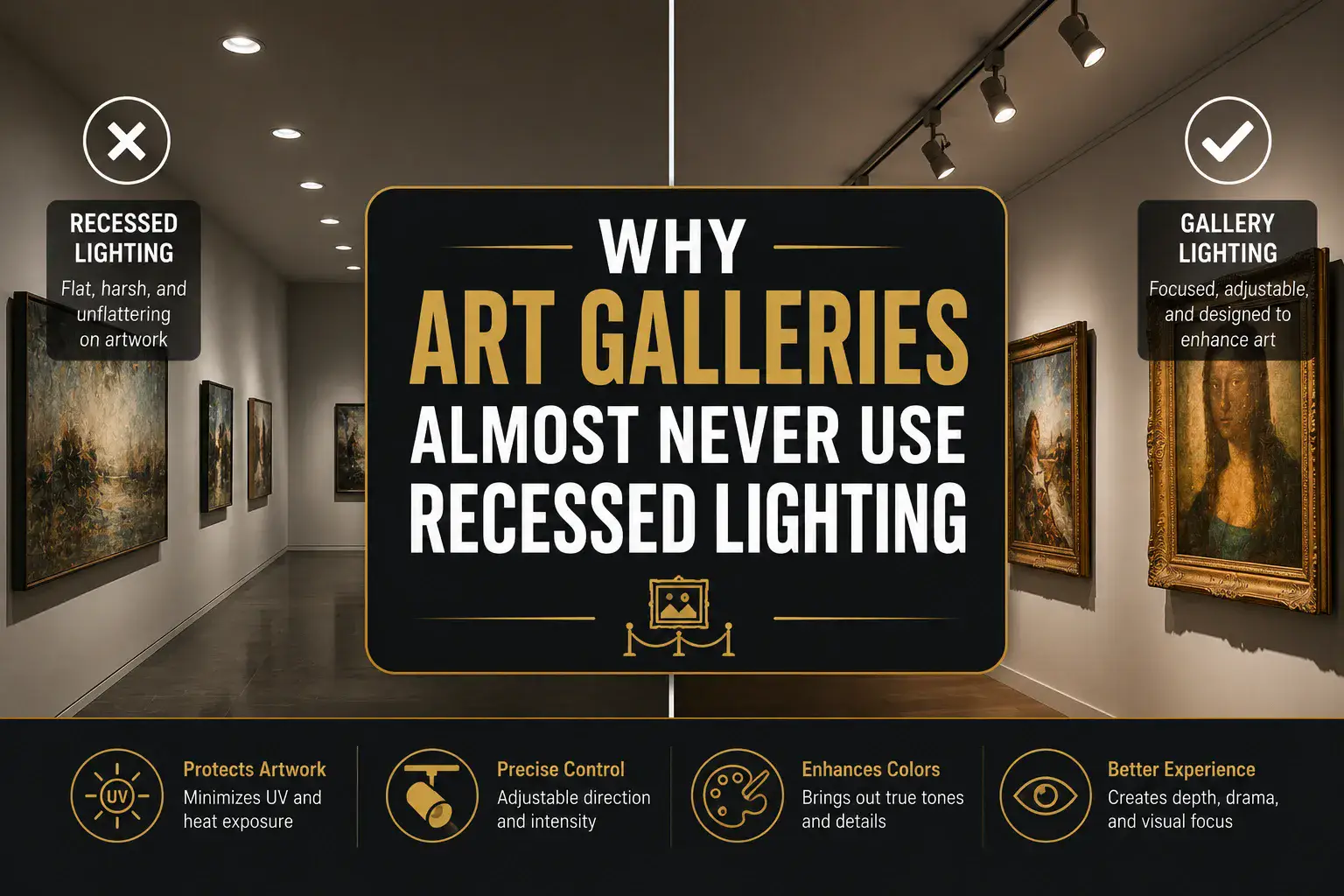
Spend enough time in galleries and a pattern becomes obvious once you’re looking for it: almost none of them light the art with fixtures built into the ceiling. Instead, you’ll see thin cables strung across the space with small adjustable heads clipped along them, angled precisely at individual pieces. It looks minimal, almost like an afterthought, but it’s actually one of the more deliberate lighting decisions in the whole space, and it solves a problem that recessed lighting genuinely can’t.
The problem recessed lighting can’t solve
Recessed lighting is fixed. Once it’s installed, the beam angle, position, and direction are locked into the ceiling, which is exactly why it works so well for general room lighting where consistency matters more than flexibility. But a gallery isn’t a static room. The art on the walls changes, sometimes every few weeks, and a piece that needs a tight, dramatic spotlight this month might be replaced by something twice the size needing a broader wash of light next month.
Recessed cans can’t adapt to that. Moving one means cutting into the ceiling, patching, repainting, and hoping the new position happens to line up with wherever the next installation ends up hanging. For a gallery reinstalling shows regularly, that’s simply not workable. It’s also not workable in a lot of residential and retail settings that share the same underlying problem: the thing being lit changes more often than the ceiling does.
What tension cable systems actually solve
A tension cable track system runs one or more thin steel cables between two anchored end points, spanning a room with almost no visual bulk compared to a rigid track or a run of individual recessed fixtures. Small directional heads clip onto the cable and can be slid to any position along its length, then rotated and aimed independently. Move the art, slide the light. No ceiling work, no patching, no waiting on an electrician for a repositioning that should take five minutes.
This flexibility is the entire value proposition, and it shows up in a few specific advantages over fixed lighting:
- Reconfiguration takes minutes, not a renovation. Sliding a fixture along a cable and adjusting its aim is something gallery staff or a homeowner can do themselves.
- Minimal visual footprint. A thin cable spanning a room reads almost as a line drawing rather than a piece of hardware, which keeps attention on what’s being lit rather than the fixture doing the lighting.
- Coverage over large or irregular spans. Cables can run significant distances between anchor points, making them practical for open lofts, long gallery walls, or oddly shaped rooms where a grid of fixed recessed cans would require awkward compromises.
- Individual control per fixture. Each head can typically be dimmed and aimed independently, so a single run of cable can throw a tight spot on one piece and a broader wash on another a few feet away.
Where this shows up outside of galleries
Once you notice this system in galleries, it becomes obvious how often the same underlying need shows up elsewhere. Retail boutiques that rotate merchandise displays seasonally have essentially the same problem as a gallery reinstalling a show. Open loft apartments with exposed structure and no interior walls to mount fixtures to benefit from a cable spanning the space rather than requiring ceiling penetrations throughout. Restaurants that rearrange seating or feature different areas for events run into the same flexibility need. Home offices and studios where a desk or workstation might move periodically benefit from being able to slide task lighting along with it instead of being stuck with light aimed at wherever the desk used to sit.
The common thread across all of these is the same one that drives gallery lighting decisions: whenever what’s being illuminated changes more frequently than a ceiling renovation is worth doing, a fixed lighting plan stops making sense and an adjustable one starts to.
What to look for in a cable track system
If you’re considering this approach for a space with changing display needs, a few specs are worth checking before buying:
- Voltage and safety rating. Low-voltage 12V systems are generally the standard for this category and are considered safer and more energy-efficient for the kind of close-proximity adjustable lighting these systems are used for.
- Span distance and support points. Confirm how far the cable can run between anchors for your specific space, since longer unsupported spans may need intermediate support depending on the system.
- Head compatibility and beam options. Adjustable spotlight heads with multiple beam angle options give more flexibility for lighting both large pieces and small detail work along the same run.
- Modularity. Systems with connectors, corners, and junction components let a single cable network expand or reconfigure as a space’s needs change, rather than being limited to one straight run.
Circ Lighting’s Tension Cable Track Series is built around exactly this kind of flexible, reconfigurable approach, with adjustable spotlight heads that slide and rotate along low-voltage cable runs, aimed at exactly the kind of gallery, retail, and open-loft applications where fixed lighting falls short.
The takeaway
Recessed lighting is still the right call for a huge share of residential and commercial spaces where the layout is genuinely stable. But the moment a room’s contents change more often than its ceiling does, whether that’s rotating art, seasonal retail displays, or a loft where furniture and work zones shift, a fixed lighting plan starts fighting against the space instead of serving it. That’s the exact gap a cable-suspended, endlessly repositionable system is designed to close.