Aisle navigation can look like a small part of grocery shopping until a shopper cannot find one item. In a large supermarket, that moment can turn a simple trip into unnecessary walking, repeated searches, and a request for staff help.
An AI wayfinding robot for supermarket environments can address that friction by connecting search, destination selection, mapped navigation, promotional discovery, and human assistance. The purpose is not to automate the entire shopping trip. It is to help customers move from “Where is this?” to the right aisle or department with fewer steps.
FMI’s 2026 U.S. Grocery Shopper Trends research found that 69% of shoppers want an easy in-store experience and 69% want to find aisles or departments easily. It also found that 71% use digital technology while grocery shopping. Those numbers show why navigation is becoming part of the wider digital grocery experience.

Why is aisle navigation becoming a technology problem?
Supermarkets are dynamic spaces. Product categories can span multiple aisles. Seasonal displays move. Promotional areas change. Service counters, pickup points, pharmacies, and fresh departments may sit far apart.
A wayfinding robot for supermarket use can give shoppers another route to assistance. Instead of relying only on overhead signs, a fixed directory, a mobile app, or an available associate, the shopper can begin with a structured request and receive support toward a configured destination.
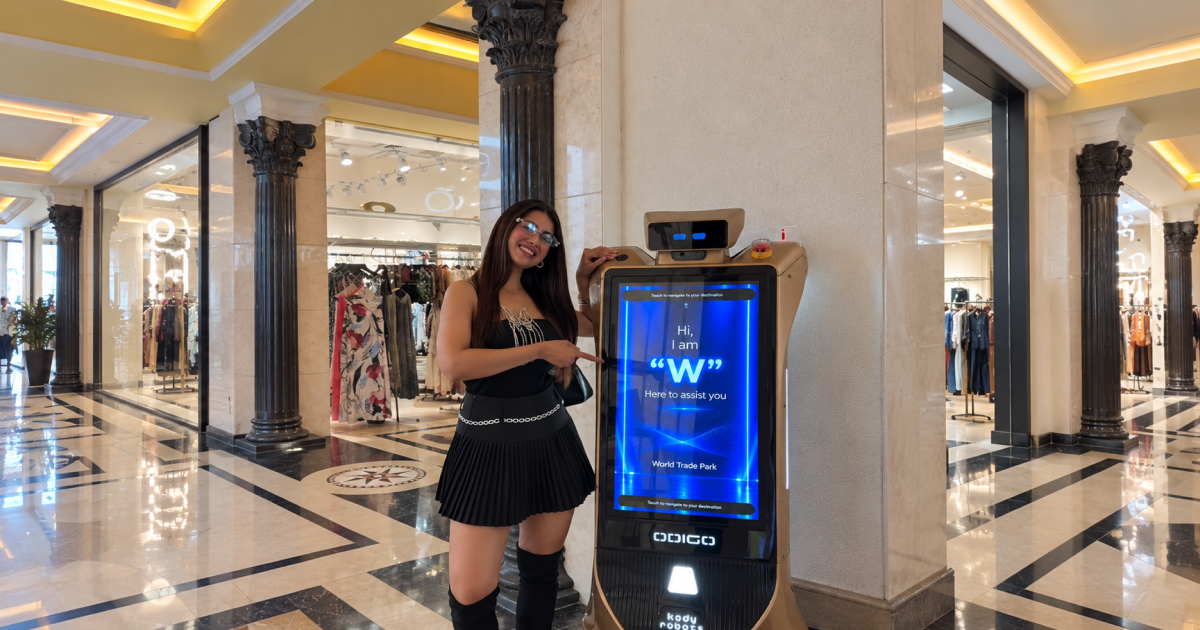
An Odigo, Supermarket Robot can be positioned around this customer-facing journey. Kody Robots can keep the role focused on product and destination discovery, aisle guidance, engagement, advertising, and human handoff.
The value is not the presence of a robot. The value is reducing the effort between shopper intent and the correct physical location.
What does an AI wayfinding experience look like?
A Supermarket Wayfinding Robot can support a simple journey:
Ask → Search → Select Destination → Navigate → Arrive
The shopper starts with a need. The system identifies an approved destination. Navigation supports movement through mapped areas. The shopper reaches the relevant aisle, department, promotional zone, or service point.
AI can improve the interaction by helping interpret structured requests and connect them with approved information. It should not invent product locations, availability, prices, or recommendations.
That distinction is important. A wayfinding robot for supermarket environment should make navigation easier while keeping store information controlled and human help available.
How does a robot help a shopper find the correct aisle?
The most obvious use case is item or category search.
A shopper may type or select a product category, such as cereal, beverages, baking supplies, or household essentials. If accurate store-location data is part of the deployment, the system can identify the relevant destination and support navigation.
A Grocery Store Wayfinding Robot can therefore connect digital search with the physical store.
This matters because search alone does not complete the journey. Telling a shopper “Aisle 14” may help, but the shopper still needs to reach Aisle 14. A mobile wayfinding robot for supermarket environment can support that second step.
For Kody Robots, this creates a clear role for Odigo around shopper assistance rather than unrelated forms of supermarket automation.
Why is AI useful for supermarket navigation?
AI is most valuable when it reduces friction without removing customer control.
McKinsey’s 2026 North American grocery research found that 51% of surveyed consumers were willing to try assisted product search, compared with 20% willing to try fully automatic ordering without user review. McKinsey concluded that near-term AI adoption is likely to be concentrated in assistive experiences where shoppers retain more control.
That is the right model for a wayfinding robot for supermarket deployment.
AI can support request understanding. Store data provides the destination. Navigation supports the route. The shopper chooses whether to follow the guidance, continue browsing, or ask an employee.
The technology assists. The customer remains in control.
How can aisle-level navigation improve customer experience?
A Supermarket Aisle Navigation Robot can make guidance more precise when aisle-level destinations are included in the configured experience. A first-time shopper searching for a specialty ingredient may need more than a broad department label.
This is one of the most practical Supermarket Wayfinding Robot Use Cases because the result is easy to understand: the shopper gets closer to the intended destination with less uncertainty.
A wayfinding robot for supermarket environment can also make configured searches more consistent.
How does robotic navigation help first-time shoppers?
Regular customers often build a mental map of the store. New shoppers do not have that advantage.
A Supermarket Navigation Robot can become a visible digital assistance point for visitors who are unfamiliar with the layout. The shopper does not need to learn the entire store. They only need to identify the next destination.
This can be especially useful in large-format supermarkets, stores with multiple departments, or environments where temporary displays frequently change familiar routes.
Kody Robots can position Odigo as a customer-facing layer that supports these moments without forcing every shopper to use it.
Can a wayfinding robot support product discovery too?
Yes. A shopper may begin with a broad category rather than an exact product. The system can direct the customer toward a relevant configured area where the final comparison and purchase decision happen.
That makes a wayfinding robot for supermarket environment useful beyond simple directions. The shopper still controls the choice.
FMI’s 2026 research found that 48% of shoppers would miss being able to select products if they could no longer shop in person, reinforcing why technology should support discovery rather than take over the decision.
What role does advertising play in aisle navigation?
Promotions often create navigation needs.
A shopper may see an offer but have no idea where the promoted product or category is located. That creates a break between marketing and shopping.
The question behind Static Screens vs Advertising Robots in Supermarkets is therefore not only where the message appears. It is also what happens after the shopper becomes interested.
A mobile customer-facing system can support a journey such as:
Promotion → Interest → Product Search → Aisle Guidance → Destination
This is where a wayfinding robot for supermarket environment can connect advertising with practical assistance.
For Kody Robots, Odigo can be positioned as an Advertising Robot Assistant that helps connect engagement, information, wayfinding, and human support.
How can robotic wayfinding support store employees?
Store associates receive many repetitive location questions during the day.
“Where is dairy?”
“Which aisle has pet food?”
“Where is customer service?”
A Supermarket Customer Assistance Robot can provide another route for these structured requests.
This does not remove employees from the experience. It can let them focus more attention on recommendations, complaints, substitutions, accessibility needs, and situations requiring judgment.
The division is straightforward:
Robots support structured repetition. People handle judgment, exceptions, trust, and complex service.
A wayfinding robot for supermarket environment should strengthen that model, not make human support harder to reach.
What happens when the robot cannot answer?
A strong customer experience needs a clear fallback.
If the requested product location is unavailable, the store data is uncertain, or the question moves beyond configured information, the interaction should not end in a dead end.
The shopper should be directed toward human assistance.
This is where Wayfinding Robots in Supermarkets need to be designed as part of a wider service journey rather than treated as isolated machines.
Kody Robots can position human handoff as part of the Odigo experience because some customer needs are better handled by people from the start.
How can robots handle changing store layouts?
Supermarket layouts change. Seasonal displays appear. Temporary promotions occupy open areas. Categories move. Endcaps change. A navigation system is only useful when its destination information stays current.
A wayfinding robot for supermarket deployment therefore requires operational discipline around maps and content.
Retailers should define who updates searchable destinations, how temporary changes are reflected, which areas are restricted, and what happens when a route is no longer appropriate.
A robot cannot compensate for outdated location data. The quality of the navigation experience depends on the quality of the information behind it.
What can retailers learn from navigation requests?
Navigation requests can reveal friction.
Repeated searches for the same category may point to unclear signage, while frequent requests for a seasonal area may show that the display is difficult to discover.
These insights are part of broader Supermarket Robot Use Cases for customer experience.
A wayfinding robot for supermarket environment can become another source of service insight when data is collected responsibly.
What should retailers measure in a pilot?
A pilot should be measured by outcomes, not curiosity.
Useful measures can include completed destination searches, successful navigation journeys, repeat destination requests, staff handoffs, promotional interactions, uptime, and shopper feedback.
The central question should be:
Did shoppers reach the right aisle or destination more easily?
A wayfinding robot for supermarket program should earn its place by improving this real customer task.
FMI’s 2026 State of Technology material also emphasizes that technology investment alone does not create results. Clear ownership, defined workflows, employee adoption, data management, and change management all affect whether technology produces measurable business value.
Where does Odigo fit in the aisle navigation journey?
At the middle of the funnel, retailers need to move from the idea of robotic navigation to a real customer-facing workflow.
An Odigo AI Robot Assistant can be positioned around connected customer needs such as destination discovery, wayfinding, advertising, engagement, and human handoff.
Kody Robots can keep Odigo close to the shopper journey.
A customer asks a question. The system identifies the configured destination. The shopper receives guidance. Promotional content may support discovery. A staff member takes over when the request requires human judgment.
This makes the wayfinding robot for supermarket role more useful than treating navigation as a standalone feature.
Why is mobility important compared with a fixed information point?
A fixed information point works well when shoppers know where it is and only need a location answer.
A mobile robot can operate within approved zones where questions arise and support the journey beyond a single lookup point.
This does not make mobile robotics universally better than static screens or kiosks. Different interfaces solve different jobs.
The case for a wayfinding robot for supermarket environment is strongest when mobility helps assistance reach more useful points in the customer journey.
Why should supermarkets consider Kody Robots?
At the bottom of the funnel, the decision should be based on fit.
Kody Robots can position Odigo around a focused set of customer-facing needs: assistance, aisle and destination guidance, promotional engagement, advertising, and human handoff.
For Kody Robots, the strongest proposition is not to claim that Odigo performs every form of supermarket automation. Its role is clearer when it supports the customer journey.
Retailers evaluating Kody Robots should test the experience in real store conditions. That includes peak traffic, carts, queues, temporary displays, changing promotional areas, and first-time shoppers.
Kody Robots should also be evaluated on whether the interface is easy to understand, destination information remains accurate, navigation feels natural, and staff can take over smoothly.
For Kody Robots, success should answer one question:
Did the technology make aisle navigation easier for the shopper?
That is where a wayfinding robot for supermarket environment becomes commercially meaningful.
Kody Robots can then connect the navigation experience with broader customer assistance without losing focus on the shopper problem the technology is meant to solve.
Frequently Asked Questions
What is a wayfinding robot for supermarket use?
A wayfinding robot for supermarket use is a customer-facing robotic system designed to help shoppers find configured products, aisles, departments, service points, or promotional areas and support navigation through approved mapped zones.
Can a supermarket robot guide shoppers to a specific aisle?
Yes, when aisle-level destinations are part of the configured map and approved store information. The robot can support guidance toward those destinations.
Can supermarket wayfinding robots replace employees?
No. Robotics is better suited to structured navigation and repeatable assistance. Employees remain essential for recommendations, complaints, accessibility needs, exceptions, and complex service.
Can a robot help shoppers discover promoted products?
Yes. Promotional engagement can lead into product or category search and then navigation when those workflows are configured.
What should retailers measure during an aisle-navigation pilot?
Retailers can measure completed searches, successful guidance journeys, frequently requested locations, staff handoffs, uptime, promotional interactions, and shopper feedback.
Why is human handoff important?
Some questions require context, judgment, empathy, or authority. A good robotic experience should make it easy for customers to reach employees when automation is no longer the right tool.
Conclusion
AI-assisted aisle navigation solves a practical grocery problem: helping shoppers find the right place without unnecessary searching.
A wayfinding robot for supermarket environment can connect product discovery, aisle guidance, department navigation, promotional engagement, and human assistance into one customer-facing journey.
For Kody Robots, Odigo provides a focused way to participate in that journey. Kody Robots can keep the value proposition close to real shopper needs rather than unrelated store automation.
The future of supermarket navigation is not about removing people or replacing every sign with a robot. It is about adding useful digital assistance where physical navigation creates friction.
When that happens, robotic wayfinding becomes more than a technology feature. It becomes part of a simpler shopping experience.
Sources
FMI, U.S. Grocery Shopper Trends 2026, was used for current research on easy shopping, aisle and department finding, digital technology use, and the continuing importance of physical product selection.
McKinsey & Company, The State of Grocery in North America 2026, was used for current research on assisted product search, consumer control, and the stronger near-term fit of assistive AI experiences.

FMI, The State of Technology 2026, was used for current context on technology investment, governance, workflow ownership, adoption, and measurable business value.