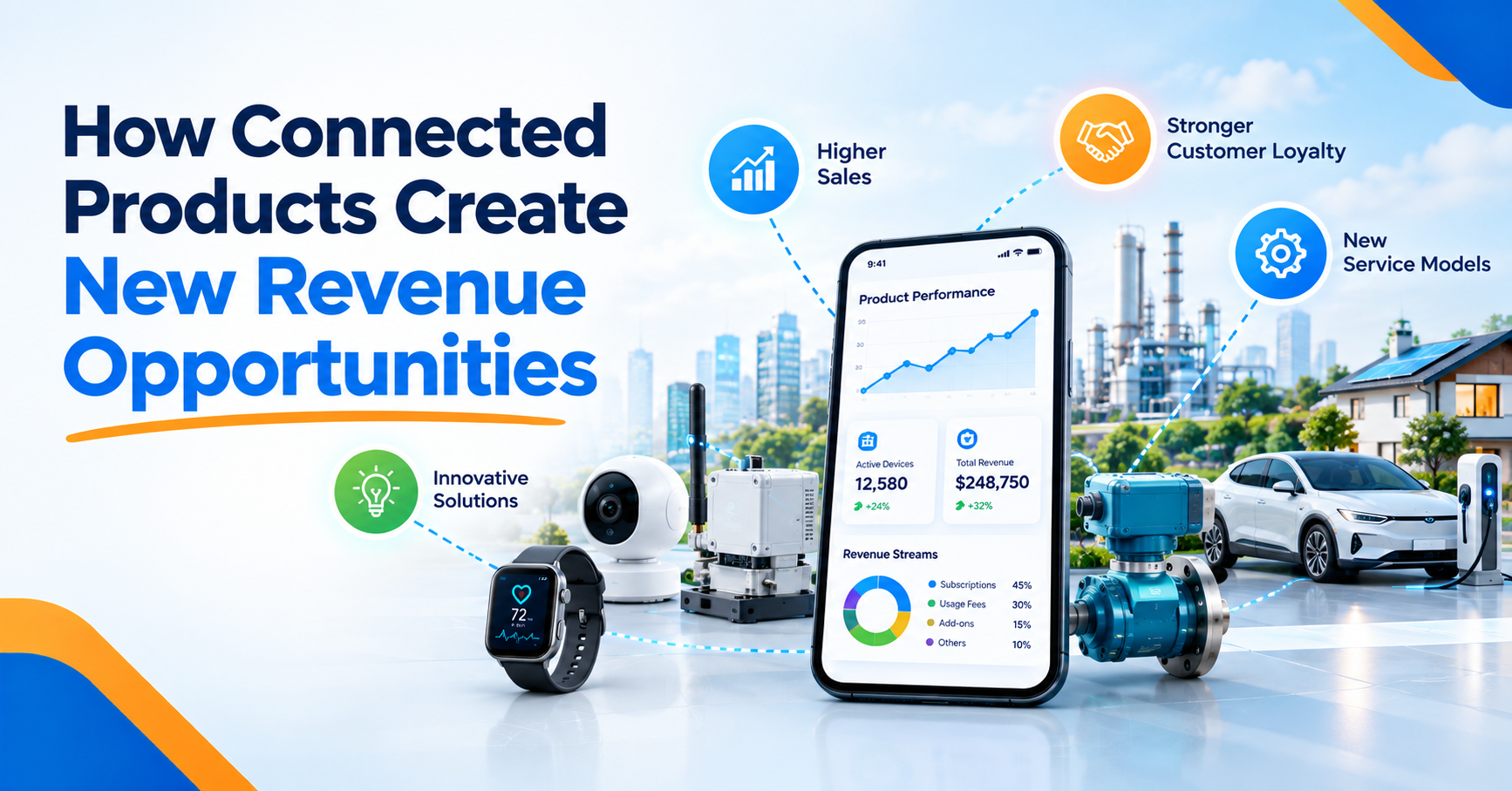
The economics of building physical products are changing. A washing machine, an industrial pump, or a fleet vehicle used to generate one transaction: the sale. Once it left the warehouse, the manufacturer’s financial relationship with that product mostly ended, aside from occasional parts and warranty claims. That model is breaking down, and the numbers explain why.
McKinsey estimates that servitization alone could generate $1 trillion in additional revenues for global manufacturers by 2030. Separately, the firm’s research on industrial digitization found that connected products and services could deliver $34 billion to $95 billion in incremental industry revenue through better monetization of data and ongoing services. And the shift toward outcome-based pricing keeps proving out financially: McKinsey has repeatedly found that while margin on new product sales sits around 10 percent, aftermarket service margin averages closer to 25 percent.
This is not a story about sensors and dashboards. It is a story about how manufacturers, equipment makers, and industrial technology companies are restructuring what they sell, how they price it, and how long a customer relationship actually lasts.

What Makes a Product “Connected” in a Business Sense
A connected product combines physical hardware with sensors, network connectivity, and software that reports back on how the product performs in the field. That is the technical definition. The business definition matters more: a connected product is one that keeps generating data and interaction after the sale closes.
That distinction changes what a manufacturer can sell. A traditional pump manufacturer sells pumps. A connected pump manufacturer can sell pumps, uptime guarantees, predictive maintenance contracts, and performance-based service tiers, all from the same underlying hardware. The product becomes a platform rather than a finished transaction.
From One-Time Sale to Continuous Value
Selling a physical unit caps revenue at the purchase price, minus whatever aftermarket parts a customer buys later. Connected products flip that ceiling into a floor. Once a device reports usage data, uptime, error codes, or consumption patterns, a company can build ongoing offerings around that stream instead of waiting for the next capital purchase cycle.
Industrial equipment manufacturers were early movers here. Kone’s connected elevators monitor ride quality and mechanical wear in real time, which supports maintenance contracts sold as a service rather than billed per callout. GE built its TruPay program around exactly this shift, tying payment to verified equipment performance instead of a flat purchase price. These are not pilot projects anymore. They represent how large equipment businesses now structure revenue.
Five Ways Connected Products Open New Revenue Streams
Connected hardware supports several distinct monetization paths, and most successful programs combine more than one rather than betting on a single model.
- Subscription and equipment-as-a-service pricing. Customers pay for continued access or performance instead of owning the asset outright, which converts a single sale into recurring, forecastable revenue.
- Usage-based and outcome-based pricing. Billing tracks actual consumption, cycles, or output, letting a manufacturer charge closer to the value a customer receives rather than a flat unit price.
- Predictive maintenance contracts. Sensor data flags wear before failure, which supports premium service tiers built around guaranteed uptime rather than reactive repair calls.
- Data and insights monetization. Aggregated, anonymized usage data can support benchmarking services, industry reports, or third-party partnerships, provided customer consent and data governance are handled properly.
- Feature and software upsells. Capabilities that used to require new hardware, like a performance mode or an extended range setting, can now be sold as an over-the-air software unlock on equipment already in the field.
None of these models work without a reliable pipeline of accurate field data reaching a system that can act on it. That pipeline is where the engineering work actually lives, and it is usually harder than the pricing strategy sitting on top of it.
A Real-World Example: Light as a Service at Schiphol Airport
Amsterdam’s Schiphol Airport partnered with Philips (now Signify) and contractor Cofely on a lighting arrangement that illustrates the model clearly. Instead of buying fixtures outright, Schiphol pays for the light it uses, while Philips retains ownership of the fixtures and installations, with both companies jointly responsible for performance and durability across the contract term.
The connected infrastructure behind the arrangement did the real work. Every luminaire connects to a control system, so failures trigger an immediate signal and repairs happen without waiting for a scheduled inspection. The fixtures were also engineered for the service model itself: LED fixtures built for the airport last 75 percent longer than conventional alternatives, while cutting electricity consumption by roughly 50 percent.
The result is a case study in aligned incentives. Philips earns steady, contracted revenue tied to actual performance instead of a one-time fixture sale. Schiphol gets guaranteed lighting quality with zero upfront capital cost. Neither side would have reached that arrangement without connected fixtures reporting real-time status back to a managed system.
Where IoT Product Development Services Fit Into This Shift
None of the revenue models above are pricing tricks. They depend on hardware that reliably captures the right data, firmware that survives years in the field without constant patching, and a cloud architecture that can process device telemetry at scale without falling over during a spike in usage.
This is the practical reason IoT Product Development Services have become a serious line item for manufacturers rather than an experimental budget. Building a connected product means solving problems that a standard product team rarely faces: sensor selection and calibration, low-power connectivity design, secure device provisioning, over-the-air update infrastructure, and data pipelines that stay accurate under real industrial conditions rather than lab conditions. Getting any one of these pieces wrong tends to show up later as false maintenance alerts, unreliable billing data, or security gaps that undermine the entire service contract. Companies that treat connected product engineering as a core competency, whether in-house or through a specialized development partner, generally reach a working revenue model faster and with fewer field failures than those that bolt connectivity onto an existing product as an afterthought.
Measuring the ROI of Connected Product Strategies
The financial case for connected products holds up under scrutiny, and it goes beyond top-line growth projections.
Independent research on connected product programs found that connected product initiatives increase product revenues by 13 percent on average, separate from whatever new service revenue the connectivity itself enables. Software AG’s customer data reinforces the pattern at the account level: manufacturers that connected their products reported service revenue growth of up to 30.5 percent, sales volume growth of 4.5 percent, and total revenue growth of 2.4 percent within a single year of deployment.
Margin economics matter just as much as growth rates. Since aftermarket service margins run roughly 2.5 times higher than new equipment margins, a manufacturer does not need to replace its entire hardware business to see meaningful profit improvement. Even a modest shift of revenue mix toward connected services moves blended margins in a measurable way, and it does so without the capital intensity of scaling hardware production.
Practical Challenges Worth Planning For
Connected product revenue does not appear automatically once sensors ship. A few recurring obstacles show up across industries.
Data ownership and privacy terms need clear definition before a contract goes live, particularly when usage data feeds into billing or benchmarking services. Security has to be built into the device and the backend from day one, since a compromised connected product creates liability far beyond a single unit malfunction. Sales and finance teams also need retraining, because selling a five-year performance contract requires a different sales motion and revenue recognition process than closing a one-time equipment purchase. Companies that treat these as engineering afterthoughts tend to see slower adoption and rockier customer relationships once the connected offering scales past a pilot group.

Final Thoughts
Connected products change what a manufacturer is actually selling. The hardware becomes the entry point into a longer relationship built on data, service contracts, and pricing tied to real performance rather than a single transaction. The companies capturing this value, from industrial equipment makers to consumer device manufacturers, share one trait: they invested early in the engineering foundation, not just the pricing strategy on top of it. As equipment lifecycles stretch and customers increasingly expect performance guarantees over ownership, that foundation is quickly becoming the difference between a company that sells products and one that builds a recurring, defensible revenue base around them.