Say a shop makes a hundred identical brackets. Part 1 measures perfectly. Part 40 is off by four thousandths. Same program, same tool, same machine. So what changed? Usually it’s how the part was sitting in the vise. Holding a part the same way every time sounds trivial. It isn’t, and custom fixtures and tooling are how shops get it right. For accurate CNC machining, they matter more than most people expect.
How Fixtures Hold a Part in the Same Position Every Time
A fixture is a holder made for one specific part. Pins or stops put the part in the same spot, then clamps lock it down. Drop in the next one, and it lands in the same place. The machine doesn’t have to guess where anything is.
Without a fixture, someone has to find the part’s position by hand every time. That’s fine for a prototype. With fifty parts, three operators and two shifts, small differences creep in.

Where Machining Errors Come From When Workholding Falls Short
When workholding isn’t up to it, accuracy leaks out in a few predictable ways:
- Creep: Cutting forces push on the part. A weak grip lets it slide a little.
- Chatter: Poor support makes the part vibrate, and the surface and the sizes suffer.
- Squeezed parts: Clamp too hard, or in the wrong spot, and a thin part bends. It springs back when released.
- Operator differences: Two people set up the same part two ways.
- Moved datums: Re-clamping for a second operation can shift where the features land.
Common Types of Custom Fixtures and What Each One Does
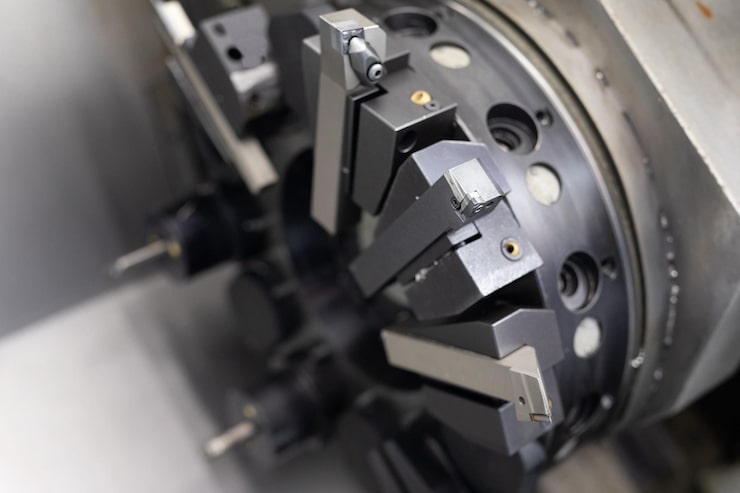
There are a few common kinds. Soft jaws are cut to match a part’s shape, which lets a lathe hold round or odd parts without marking them. With some fixtures, like tombstones or fixture plates, multiple parts can be held, meaning the machine can cut lots of parts at once. Some parts, however, require dedicated fixtures that are only used for one part and one job. There are vacuum fixtures, as well, for parts that are flat and thin. These use suction to hold parts, so there are no clamps in the way. Which type of fixture is best depends on a variety of factors, such as the shape, quantity, and number of sides of a part that needs to be cut.
What Good Fixture Design Looks Like in Practice
Good fixture design follows a short list of rules. Locate the part on the same datum features the drawing uses, so it’s measured and cut from the same starting point. Put clamps where the part is strong, not where it’s thin. Leave the cutter room to reach every feature. And give chips and coolant somewhere to go. Shops that think this through before the first cut tend to save time on the back end.
How Fixtures Save Time and Cost as Production Volumes Grow
Fixtures aren’t free, so they need to earn their keep. On repeat work, they usually do. Loading a part turns into dropping it in and clamping it. Operators spend less time measuring and adjusting, and fewer parts go in the scrap bin.
They can also stretch what a machine does in a cycle. One fixture can hold several parts, or let a 4-axis or 5-axis machine reach more than one side in a single setup. Fewer setups, fewer chances for errors to stack up.

How Amtec Solutions Group Uses Custom Tooling and Fixtures in CNC Production
Amtec Solutions Group is a machine shop in Huntsville, Alabama. Custom tooling and fixtures appear on its list of CNC machining capabilities, next to milling, turning, drilling, boring and surface finishing. The shop runs 3-axis, 4-axis and 5-axis machines, and takes jobs from one-off prototypes to high-volume production.
Its process runs from consultation and quoting off CAD files or drawings, to programming and setup, then machining and inspection. Setup is a step of its own, and that’s where fixture planning fits. The shop lists tolerances of ±0.005 inches or better, in-house inspection, AS9100 Rev D and ITAR registration.
FAQs
What is the difference between a fixture and a jig in CNC machining?
A fixture holds the part still while the machine cuts it. A jig does that too, but it also guides the tool, as a drill bushing does. Since a CNC machine controls its own tool path, fixtures are far more common here. Jigs mostly turn up in drilling work.
When does a custom fixture make sense instead of a standard vise?
A vise is fine for simple blocks and one-offs. A custom fixture earns its place when parts are odd-shaped or thin, when there are repeat orders, or when several sides need cutting, and the features must line up closely. More parts and tighter tolerances make the case stronger.
How does a fixture improve repeatability in CNC machining?
A program controls the position of the cutting head in relation to the part. The workholding or fixture design holds the part in position so that every piece of a production run, regardless of how many parts are produced, is in the same position. Without such fixturing and positioning, an operator would have to estimate the position of the cutting head, resulting in different positions and thus, different parts.
Can clamping a part too hard hurt accuracy?
Yes. Too much force, or clamps in the wrong spots, can squeeze a part out of shape, especially thin walls. It might measure fine while clamped, then spring back once it’s released and fall out of tolerance. Good fixtures spread the force and clamp near strong, supported areas.
What information does a machine shop need to design a fixture for a part?

The current drawing or CAD model with its revision, plus the material, quantity and any repeat orders expected. Critical dimensions, tolerances, surface finish and inspection needs help too. With those, a shop like Amtec Solutions Group can plan setups and fixtures before cutting starts. A clear drawing saves time.