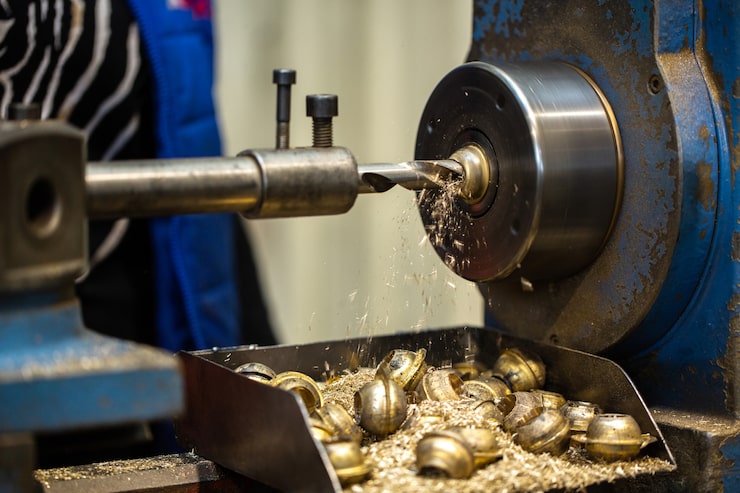
There are two competing stores offering the same bracket. One promises machining. The other promises printing. They may both be right because it all depends on the product. There is no competition between machining and printing; they are just different means of creating something useful. That’s how you can determine which one is applicable with an honest assessment of where metal additive manufacturing succeeds and where it fails.
How Each Process Makes a Part and Why That Changes the Cost
CNC machining begins with a blank piece and removes all the parts of it that are not the component required. With printing, the process involves the use of a laser to melt thin layers of metallic powder until the component is formed. This is where the price discrepancy lies.
Machining cost follows how much metal has to come off, how many setups it takes, and how fast tools wear. Printing cost follows machine time, which depends mostly on how tall the part is, plus powder, supports, and finishing. A part that’s cheap one way can be expensive the other.

Situations Where Metal Additive Manufacturing Usually Makes More Sense
Printing tends to win when:
- The geometry is complex: Internal channels, lattices, and curved passages that a cutter can’t reach.
- An assembly can become one part: Fewer joints, fasteners, and leak checks.
- The alloy is hard to cut: Nickel superalloys like Inconel 718 are slow going and tough on tools.
- Volume is low: There’s no tooling to pay for, and parts on the same plate share setup.
The design might still change. Changing a file is cheaper than changing tooling.
Situations Where CNC Machining Is the Better Choice
Machining wins more often than printing fans admit. Simple shapes made in volume are the classic case. AME’s own cost guide says it plainly: five hundred plain bushings should be machined. Machining also gives smoother surfaces and tighter tolerances straight off the machine, handles large parts that won’t fit a printer, and works well with common alloys that are cheap and easy to cut.
Why the Best Answer Is Often Both Processes Together
A lot of good parts get both. The shape gets printed near its final size, and the surfaces that need to be exact, like bores, sealing faces, and threads, are machined afterward. AME’s cost page lists machining of interfaces among the post-processing steps. Printing does the hard geometry, machining does the precision.
What Drives the Price on the Printing Side of the Decision
AME’s cost page says a printing quote is a sum of six things:
- Machine time, mostly set by part height
- Powder, which costs more for Inconel 718 and GRCop-42
- Supports, which add powder, laser time, and labor
- Post-processing, such as stress relief, hot isostatic pressing, and machining
- Inspection and documentation
- Quantity, since setup is paid once per build
Seeing which of those a part is heavy on is the fastest way to cut the price.

How Additive Manufacturing & Engineering Approaches the Decision
Additive Manufacturing & Engineering, known as AME, is a metal additive manufacturing shop in Huntsville, Alabama, a few miles from Marshall Space Flight Center. It prints with laser powder bed fusion on an EOS M400, with a 400 mm cube build volume, in Inconel 718 and GRCop-42, and it covers prototypes through pilot production. The team lists 35 combined years in additive.
AME says its quotes come from an engineer who reads every file, with no instant online pricing, and that it will say so when a part should be machined instead. There’s no minimum order. Customers can send a STEP file, with Parasolid, IGES and STL also accepted, plus material, quantity, tolerances and finish needs.
FAQs
Is metal 3D printing cheaper than CNC machining?
Sometimes. Printing is often cheaper for complex shapes, hard-to-cut alloys, and low volumes, since there’s no tooling. For simple shapes in larger quantities, machining usually wins. AME’s own guide says plain parts in volume, like hundreds of bushings, should be machined. Get both quotes if unsure.
Which is more accurate, metal 3D printing or CNC machining?
There are differences in surface finishing after parts are CNC machined vs. printed. With CNC machines, the finish is typically smoother, and the part is more precise as soon as it leaves the machine. Printed parts typically require additional finishing steps to be accurate. Consequently, most parts are first printed and then finished on a CNC machine if necessary. There are differences in the finishing steps that must be done in accordance with the precision requirements for the particular part.
When should a part be 3D printed instead of machined?
If the shape is difficult or impossible to cut, for instance internal passages or lattice structures; if there are several parts that can be combined into one; if the material is difficult to machine; or if volume is low and design is subject to change. If the shape is simple and volume high, machine it.
Can a part be both printed and machined?
Yes, and it’s common. The part is printed close to its final shape, then bores, threads, and sealing faces are machined to tolerance. Designers leave extra material on those surfaces. Heat treatment or hot isostatic pressing often happens before the final machining, so the part is stable when the precision work starts.
What should be sent to get an accurate quote for metal 3D printing?

A STEP file is the main format, and AME also accepts Parasolid, IGES, and STL. Add the material, quantity including repeats, critical dimensions and tolerances, surface finish needs, any heat treatment, HIP or testing, and the date it’s needed. With that, an engineer can quote it and suggest an orientation.