Mobile gaming has evolved dramatically over the last decade, but one challenge continues to affect player experience across regions and devices: unstable network connectivity.
This challenge becomes even more critical when developing multiplayer board games like Ludo, where every move, dice roll, and player interaction must stay synchronized in real time. Unlike casual offline games, multiplayer Ludo demands seamless communication between players, servers, and devices. Even a few seconds of lag can create confusion, disputes, or abandoned matches.
Recently, while evaluating partners for a Ludo gaming project, I had the opportunity to closely observe how a leading ludo game development company tackled these challenges at scale. What stood out wasn’t just the technical expertise but the practical problem-solving approach that transformed poor network conditions from a major obstacle into a manageable aspect of gameplay.

This article shares key lessons from that experience, highlighting the real-world strategies used to ensure stable gameplay, maintain player engagement, and support thousands of concurrent users even in challenging network environments.
The Reality of Ludo Gaming in Emerging Markets
When most people think about multiplayer gaming, they imagine players connected through high-speed Wi-Fi or 5G networks. The reality is very different.
Many Ludo players connect through:
- Fluctuating 4G and 5G networks
- Congested public Wi-Fi
- Rural internet connections
- Low-bandwidth mobile networks
- Temporary signal drops while commuting
For a multiplayer Ludo game, these conditions create several challenges:
- Delayed dice roll synchronization
- Missed player actions
- Match disconnections
- Incorrect turn calculations
- Session timeouts
- Increased player frustration
Research consistently shows that even minor latency issues can significantly increase game abandonment rates. For a competitive multiplayer title, maintaining a stable experience under imperfect network conditions is often more important than adding flashy visual features.
The Project Challenge
The project involved launching a fully functional multiplayer Ludo platform within an extremely aggressive timeline.
The development team had only 15 days to design, build, test, optimize, and launch the product.
Ordinarily, a multiplayer board game with custom features can take months to perfect. However, the team leveraged years of accumulated experience, reusable architecture, and proven frameworks to accelerate delivery.
This is where Yudiz Solutions, a highly experienced game development company, demonstrated its strengths.
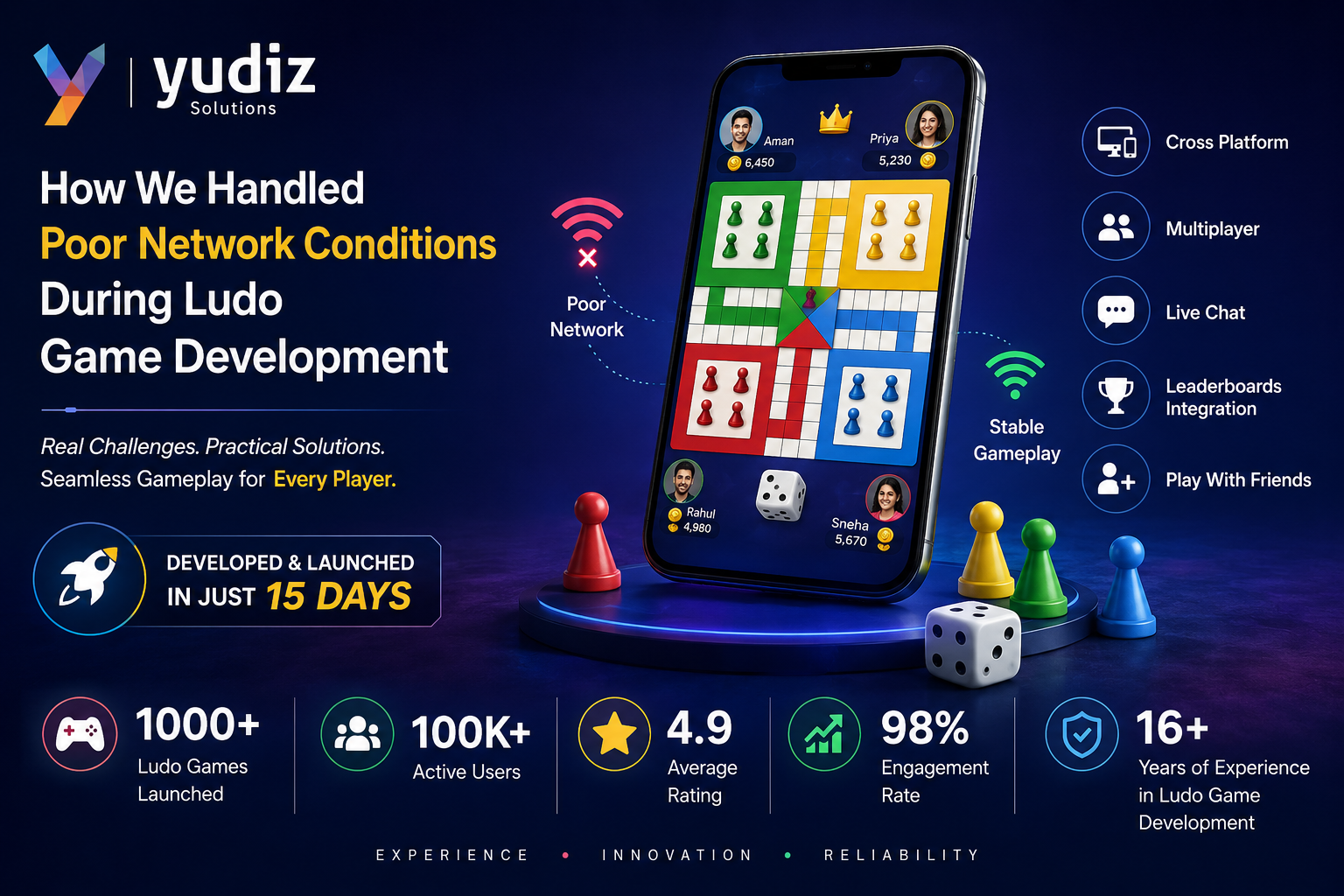
What immediately stood out was their extensive portfolio. Over the years, they had successfully launched 1,000+ Ludo game projects, supporting 100,000+ active users, achieving an impressive 4.9-star average rating, and maintaining a remarkable 98% engagement rate across multiple deployments.
Those numbers suggested that network optimization wasn’t something they were learning on the fly—it was a challenge they had solved repeatedly.
Understanding the Network Failure Points
Before implementing solutions, the development team identified the most common situations causing gameplay interruptions.
Scenario 1: Temporary Signal Loss
A player loses connectivity for 3–10 seconds.
Without proper handling:
- The player appears inactive.
- Opponents become confused.
- Turns may expire unfairly.
- Matches risk termination.
Scenario 2: High Latency
Data packets arrive slowly due to network congestion.
Potential issues include:
- Delayed dice outcomes
- Turn synchronization errors
- Incorrect game states
Scenario 3: Sudden Disconnects
Mobile users frequently switch between networks while moving.
Typical causes:
- Wi-Fi to cellular transitions
- Cellular tower handoffs
- Background app interruptions
Scenario 4: Packet Loss
Some game events fail to reach the server.
Without recovery mechanisms:
- Players may see different board states.
- Tokens appear in incorrect positions.
- Match integrity is compromised.
Instead of treating these situations as exceptions, the development team designed the game assuming they would occur regularly.
That mindset changed everything.
Solution #1: Server-Authoritative Game Architecture
One of the smartest decisions was implementing a server-authoritative architecture.
In simple terms:
The server became the single source of truth.
Rather than trusting individual player devices, all critical actions were validated by the central server.
This included:
- Dice rolls
- Token movements
- Turn transitions
- Match outcomes
- Reward calculations
Whenever conflicting information appeared, the server’s state prevailed.
Benefits included:
- Reduced cheating opportunities
- Accurate synchronization
- Consistent gameplay
- Faster conflict resolution
This approach significantly reduced network-related discrepancies and improved fairness across matches.
Solution #2: Intelligent Reconnection System
Disconnections are inevitable.
The real question is what happens afterward.
Instead of forcing players to restart matches, the development team implemented an intelligent reconnection framework.
When connectivity dropped:
- The game stored the player’s current state.
- The server maintained session information.
- Automatic reconnection attempts began.
- Gameplay resumed seamlessly when connectivity returned.
Players could often reconnect within seconds without losing progress.
As a result:
- Match abandonment decreased.
- Session completion rates improved.
- Player satisfaction increased.
Many users didn’t even realize a reconnection process had occurred behind the scenes.
Solution #3: Lightweight Data Transmission
A common mistake in multiplayer development is transmitting excessive data.
The team focused on minimizing network traffic.
Instead of repeatedly sending complete game states, they transmitted only essential updates.
Examples included:
- Dice result
- Token position change
- Turn completion
- Player status update
This optimization reduced bandwidth requirements substantially.
Advantages included:
- Faster synchronization
- Lower data consumption
- Improved performance on weaker networks
- Reduced server load
For mobile-first gaming audiences, these improvements had a direct impact on retention.
Solution #4: Predictive State Management
Network latency creates visible delays between actions and outcomes.
To address this issue, the team implemented predictive state management.
For example:
When a player moved a token, the animation could begin immediately while server confirmation occurred in parallel.
Once verification arrived, the client synchronized automatically.
Benefits included:
- Smoother gameplay
- Reduced perceived latency
- More responsive interactions
- Better user experience
Players experienced near-instant feedback despite underlying network delays.
Solution #5: Smart Timeout Logic
Traditional timeout systems often punish players unfairly.
A weak signal should not automatically result in losing a match.
The development team created adaptive timeout mechanisms.
Factors considered included:
- Network quality
- Historical connection stability
- Temporary signal loss
- Reconnection attempts
Instead of immediate penalties, the system provided recovery opportunities.
This balanced fairness with gameplay continuity.
The result was fewer complaints and significantly improved player retention.
Solution #6: Regional Server Optimization
Latency often depends on physical distance from the server.
To reduce delays, the infrastructure was designed to support regional deployment strategies.
Players connected to the nearest available server whenever possible.
Benefits included:
- Faster response times
- Reduced ping
- Improved synchronization
- Better multiplayer stability
For games targeting international audiences, this optimization became especially valuable.
Solution #7: Real-Time Network Monitoring
One of the most impressive aspects of the project was the emphasis on continuous monitoring.
The development team tracked:
- Latency spikes
- Reconnection frequency
- Packet loss rates
- Match completion percentages
- User drop-off behavior
This provided immediate visibility into performance issues.
Rather than waiting for negative reviews, problems could be identified and resolved proactively.
This data-driven approach contributed significantly to maintaining the high engagement metrics observed across deployments.
Beyond Networking: Building a Complete Ludo Ecosystem
Network optimization alone doesn’t create a successful game.
Players expect modern multiplayer experiences.
The platform included several advanced capabilities designed to improve retention and social engagement.
Cross-Platform Gameplay
Players could compete across multiple devices and operating systems without compatibility concerns.
Multiplayer Infrastructure
Real-time multiplayer functionality supported smooth gameplay between friends and global opponents.
Social Features
Modern players want interaction beyond gameplay.
The platform included:
- Friend invitations
- Social connectivity
- Community-driven engagement
Live Chat Integration
Real-time communication enhanced player interaction and increased session duration.
Leaderboard Systems
Competitive rankings encouraged long-term participation and repeat engagement.
Play-With-Friends Functionality
Private matches became a major retention driver, allowing users to challenge friends directly.
Together, these features transformed a simple board game into a social gaming platform.
The Numbers Behind the Success
Technical decisions ultimately matter because of the outcomes they create.
The metrics achieved through years of experience were particularly noteworthy:
- 1,000+ Ludo games launched
- 100,000+ active users
- 4.9-star average user rating
- 98% engagement rate
- 15-day project launch timeline
- 16+ years of game development expertise
These figures demonstrate what becomes possible when technical architecture, user experience design, and multiplayer infrastructure work together effectively.
More importantly, they illustrate the value of partnering with an experienced ludo game development company rather than attempting to solve complex multiplayer challenges from scratch.
Why Experience Matters in Multiplayer Game Development
Many development teams can build a Ludo game.
Far fewer can build one that performs reliably under real-world network conditions.
The difference often comes from experience.
After observing the project closely, one conclusion became clear:
Years of accumulated knowledge significantly reduce development risk.
The team at Yudiz Solutions didn’t spend valuable time discovering common multiplayer issues because they had already encountered and solved them across hundreds of previous deployments.
Their 16+ years of experience helped accelerate development, avoid costly mistakes, and deliver a polished product under an aggressive timeline.
For businesses entering the multiplayer gaming market, that experience can make a substantial difference in both launch success and long-term player retention.
Final Thoughts
Poor network conditions remain one of the biggest challenges in multiplayer gaming, particularly for mobile-first audiences spread across diverse regions and connectivity environments.
The project demonstrated that network instability doesn’t have to damage the player experience.
Through server-authoritative architecture, intelligent reconnection systems, lightweight data transmission, predictive state management, adaptive timeout handling, regional server optimization, and real-time monitoring, the team successfully delivered a stable and engaging multiplayer experience.
Perhaps the most impressive aspect was achieving all of this within a 15-day launch timeline while maintaining the quality standards expected by modern gamers.
After seeing the process firsthand, it’s easy to understand why businesses searching for a reliable ludo game development company often prioritize proven experience, scalable infrastructure, and measurable results.

For organizations evaluating a trusted game development company for multiplayer board games, the lessons from this project highlight an important truth: successful Ludo game development is not just about building the game itself—it is about ensuring the game performs flawlessly when real users, real networks, and real-world conditions put it to the test.