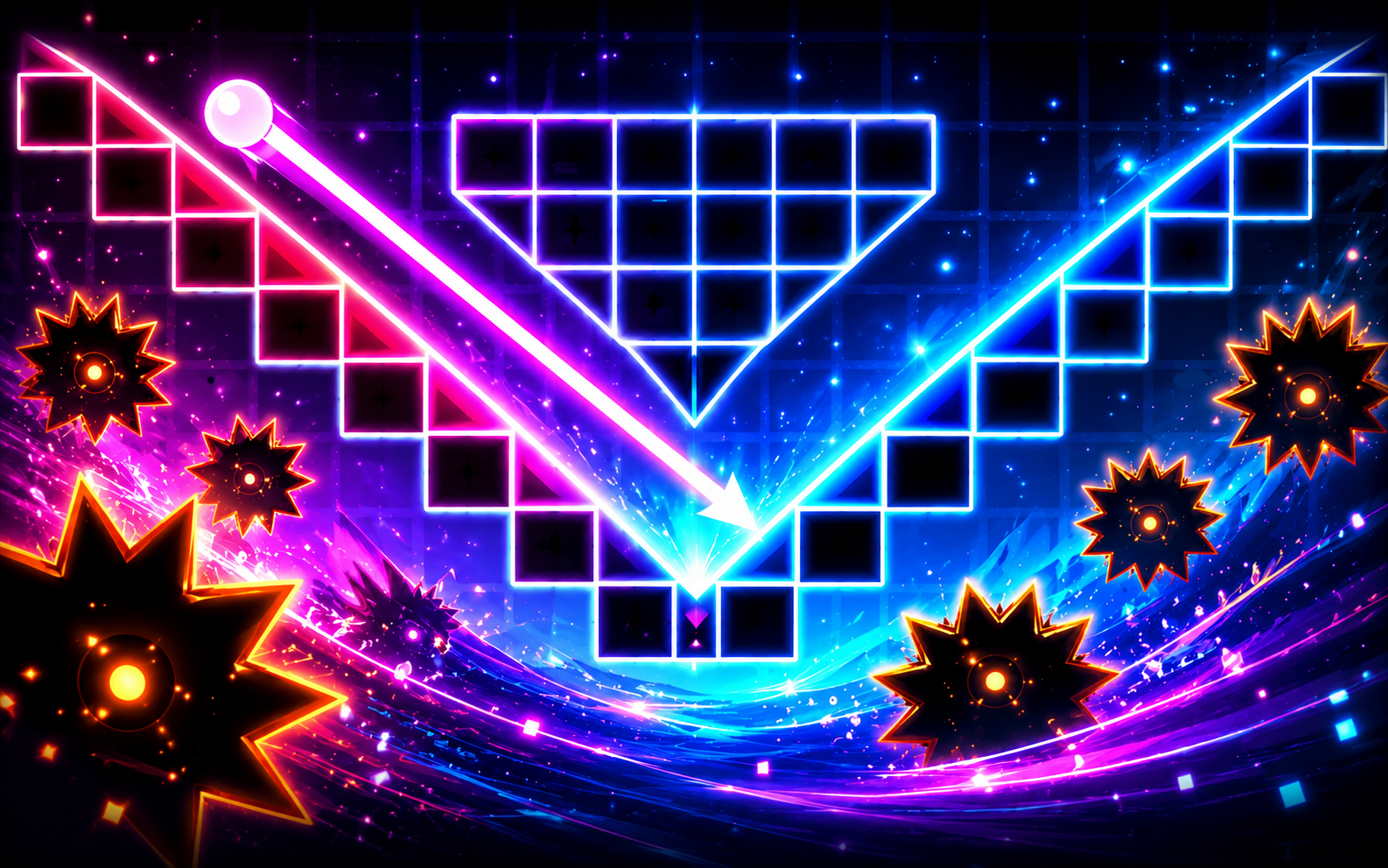
Introduction to Geometry Dash Wave
The Wave mode in Geometry Dash is one of the most intense and skill-demanding mechanics ever introduced in the game. Unlike other gameplay styles that rely on jumping or flying, the Wave focuses entirely on continuous diagonal movement, requiring precise control and fast decision-making.
Developed by Robert Topala under RobTop Games Official Website, Geometry Dash has evolved into a rhythm-based platformer known for its difficulty spikes, and Wave sections are often the most challenging parts of any level.
For many players, mastering Geometry Dash Wave is not just a skill—it is a milestone that separates beginners from advanced players.

Understanding the Core Mechanics of Wave Mode
Geometry Dash Wave works on a very simple control system, but the execution is extremely difficult.
When the player holds the control button, the Wave moves diagonally upward. When the button is released, it moves diagonally downward. This creates a continuous zigzag motion that must be carefully controlled to avoid obstacles.
Unlike Cube or Ship mode, there is no gradual movement adjustment. Every input creates an immediate change in direction, making precision essential.
The challenge comes from balancing timing, rhythm, and spatial awareness all at once.
Why Geometry Dash Wave Is So Difficult
Extremely Precise Movement
Wave sections often include very tight corridors where even a single pixel of mistake leads to failure. Players must maintain perfect control over movement angles, which becomes increasingly difficult in faster levels.
Fast Reaction Requirements
Many levels use speed portals that dramatically increase Wave speed. At high speed, players have almost no reaction time, forcing them to rely on instinct and muscle memory.
Complex Level Designs
Modern Geometry Dash levels include advanced designs with moving obstacles, fake paths, and sudden direction changes. These elements make Wave gameplay even more unpredictable.
The Evolution of Wave in Geometry Dash Levels
Over time, Wave sections have evolved from simple zigzag corridors into highly complex gameplay segments.
Early levels featured wide and forgiving Wave paths, allowing players to learn the mechanics easily. However, as the game community grew, creators began designing more advanced challenges.
Today, many Extreme Demon levels rely heavily on Wave gameplay as their main difficulty source. These levels often push players to their absolute limits, requiring perfect execution over long periods of time.
Popular Geometry Dash Levels Featuring Wave Sections
Several iconic levels are known for their difficult Wave gameplay:
- Nine Circles
- Sonic Wave
- Crimson Planet
- Tartarus
- Acheron
- Slaughterhouse
These levels are widely recognized in the Geometry Dash community for their extreme difficulty and precise Wave mechanics. Completing them is considered a major achievement among skilled players.
Different Types of Wave Gameplay
Standard Wave
The Standard Wave is the default version and the easiest to control. It is commonly used in beginner and medium-difficulty levels to introduce players to Wave mechanics.
Mini Wave
Mini Wave reduces the size of the player icon, making it easier to pass through tight spaces but significantly harder to control. Small movement errors become more punishing.
Dual Wave
Dual Wave requires controlling two Wave icons simultaneously. This mode demands extreme focus and coordination, as both movements must be perfectly synchronized.
Speed Wave
Speed Wave increases gameplay speed, forcing players to react instantly. This variation is commonly used in high-difficulty Demon levels.
Essential Skills to Master Geometry Dash Wave
Muscle Memory Development
Repetition is key in Wave gameplay. Players must repeatedly practice sections to build muscle memory, allowing them to react without conscious thinking.
Rhythm Awareness
Although Wave is highly mechanical, many sections are synced with music. Understanding rhythm helps players predict movement patterns more effectively.
Calm Decision-Making
Panicking during Wave sections often leads to mistakes. Successful players maintain calm focus even during high-speed sequences.
Consistent Practice
Daily practice significantly improves performance. Even short training sessions help develop better control over time.
Common Mistakes Players Make in Wave Mode
Overcorrecting Movement
New players often move too aggressively, causing unnecessary zigzag patterns that lead to crashes.
Ignoring Level Patterns
Many Wave sections follow predictable patterns. Failing to recognize these patterns increases difficulty unnecessarily.
Lack of Practice Mode Usage
Skipping Practice Mode makes it harder to learn difficult sections efficiently. Experienced players rely heavily on checkpoints to master Wave timing.
Why Geometry Dash Wave Is So Popular in the Community
The Wave mode has become a cultural symbol within the Geometry Dash community. It represents skill, precision, and dedication.
Many players share gameplay clips focused entirely on Wave sections because they showcase high-level control and reflex ability. Content creators also highlight Wave challenges in tutorials, speedruns, and difficulty showcases.
In competitive discussions, Wave performance is often used as a benchmark for player ranking.
Tips for Improving Your Wave Performance
Start with Easier Levels
Beginners should avoid Extreme Demon levels and instead focus on easier maps that introduce Wave mechanics gradually.
Use Practice Mode Effectively
Practice Mode allows players to repeat difficult sections until they achieve consistent performance. This is essential for mastering complex Wave patterns.
Adjust Sensitivity Settings
Some players improve performance by adjusting control sensitivity to better match their reaction style.
Watch Experienced Players
Observing skilled players helps beginners understand movement patterns and timing strategies.
The Future of Wave Gameplay in Geometry Dash
As the Geometry Dash community continues to evolve, geometry dash wave gameplay is becoming even more creative and challenging. Level designers constantly push boundaries by introducing new mechanics, visual effects, and hybrid gameplay systems.
Future levels are expected to feature even more complex Wave designs, including mixed modes and advanced dual-control systems. This ensures that Wave will remain one of the most important and exciting parts of the game.
Conclusion
Geometry Dash Wave is more than just a game mechanic—it is a true test of precision, patience, and skill. Its simple controls hide an extremely deep level of difficulty that challenges even the most experienced players.

Whether you are a beginner learning the basics or an advanced player tackling Extreme Demon levels, mastering Wave mode is essential for progressing in Geometry Dash. With consistent practice and focus, any player can improve and enjoy one of the most thrilling gameplay experiences in the game.