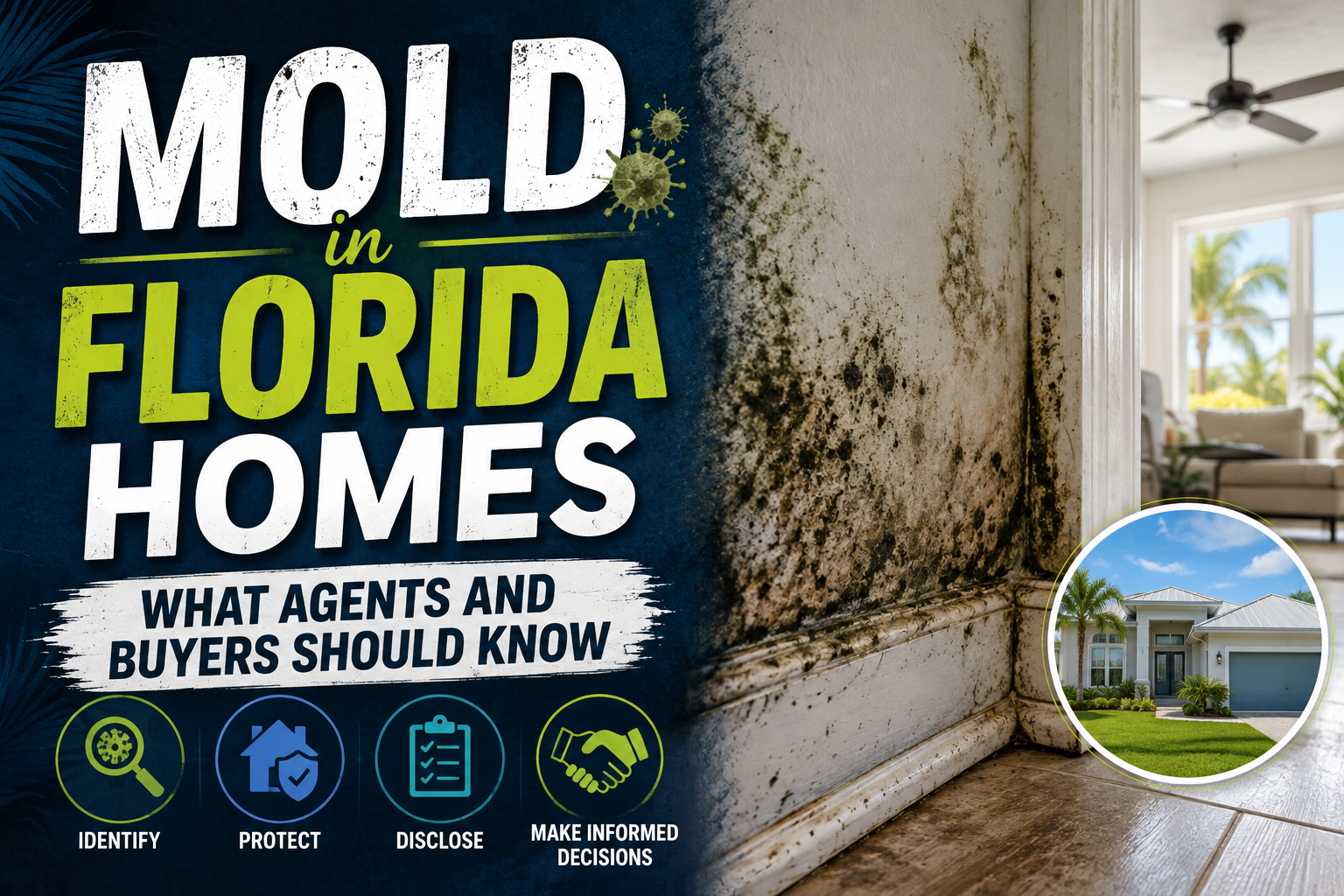
Mold is a Florida fact of life. In 2022, Florida saw roughly 264,000 mold-related insurance claims, more than 20% of all home insurance claims in the state, second only to Louisiana. Humid summers, hurricane season, and closed-up seasonal homes create ideal conditions for growth, which means mold comes up in transactions far more often than most agents expect.
The problem is that most agents learn about mold the hard way: a deal falls apart over an inspection finding, or a seller is surprised by a disclosure question they cannot answer. Both are avoidable when you know the rules, the timeline, and how to advise clients through it.
This guide covers what agents and buyers actually need to know about mold in Florida transactions: disclosure duties, inspection contingencies, the difference between inspection and testing, and how to handle a finding when it happens.

Quick answer: Florida has no specific mold-disclosure statute, but under the Johnson v. Davis ruling, sellers must disclose known material defects, including mold, and as-is sales do not waive that duty. Agents who know about mold cannot withhold it. Buyers should schedule a mold inspection within the inspection contingency window, typically costing $300 to $700.
Yes, Mold Is a Real Florida Problem: Here’s What the Data Shows
The numbers are worth knowing because they come up in negotiations. Florida ranked second in the nation for mold claims, with roughly 264,000 claims in 2022, more than 20% of the state’s home insurance claims, according to reporting by WUSF Public Media. Hurricanes Ian (2022) and Helene and Milton (2024) produced waves of water damage that turned into mold growth, much of it hidden inside walls and HVAC systems.
For agents, this means mold is not an edge case. It is a routine part of Florida transactions, and the ones who handle it smoothly are the ones who know the playbook.
Does a Seller Have to Disclose Mold in Florida?
Yes, under the right conditions. Florida’s Johnson v. Davis standard requires sellers to disclose known material defects that are not readily observable. Mold qualifies when it is known and hidden. The FAR/BAR contract forms include disclosure language, and the standard does not disappear in an as-is sale: as-is protects against defects the buyer discovers, not against concealment by the seller.
Agents have a parallel duty. If you know about mold in a listing, you cannot withhold it. The honest approach, documented in writing, protects everyone: the seller from a later lawsuit, the buyer from a surprise, and you from an errors-and-omissions claim.
The Mold Inspection Contingency: What to Advise Buyers
A standard home inspection is not a mold inspection. General inspectors look for visible mold and obvious moisture issues, but hidden growth inside walls, under floors, and in HVAC systems requires specialized inspection and often testing. Buyers in humid climates should add a mold inspection to the contingency window, especially for older homes, homes with recent water history, or properties that sat vacant.
Advise buyers to schedule it early in the due diligence period so there is time to negotiate. A mold finding inside the window is leverage; a finding after the window closes is a problem.
Mold Inspection vs. Mold Testing: What Your Buyer Actually Needs
Inspection is visual and physical: a specialist looks for moisture, visible growth, and conditions that promote mold, using moisture meters and sometimes thermal imaging. Testing collects samples, air or surface, and sends them to a lab for analysis. Testing confirms what species is present and in what quantity; inspection finds where the problem is.
For most transactions, inspection is the starting point. Testing is worth it when there is a known water event, visible growth that needs identification, or a health concern. Typical inspection costs run $300 to $700, with testing added per sample. Knowing the difference helps agents set accurate client expectations instead of guessing.
Mold Shows Up: Negotiating Credits, Repairs, and the Mold Rider
When a mold finding appears, the transaction does not have to die. The options, in rough order: the seller remediates before closing, the parties agree on a credit or price adjustment, or the buyer walks. Florida’s FAR/BAR contract includes the Mold Inspection Rider (CR-6_I), which allows the buyer to have a mold inspection and negotiate based on the results.
The professional move is to bring in a remediation specialist for a scope and estimate rather than guessing at numbers. A documented remediation plan with clearance testing after completion protects the buyer and gives the seller a defensible path. Vague credits without a plan tend to fall apart later.
Red Flags to Flag at a Showing
Train your eye for the signs buyers miss: musty odors (the most reliable indicator), water stains on ceilings or walls, peeling paint or bubbling drywall, warped baseboards, and recent “repairs” that look like they are hiding something. A musty smell in a closed-up seasonal home is almost always mold somewhere.
When you spot these, say so plainly and recommend the inspection step. The agent who flags it early looks competent; the one who hides it looks guilty, and Florida’s disclosure duty makes hiding it legally dangerous anyway.
How to Handle a Finding Gracefully
The best outcome for everyone is a documented, verified remediation. When a buyer finds mold, the conversation should be: what is it, where is it, what does it cost to fix, and who pays. Florida remediation professionals who follow the IICRC S520 standard contain the area, remove contaminated materials, and verify results with clearance testing. Naples Mold Removal companies operating to that standard are the kind of transaction partner agents can recommend with confidence, because the work comes with verification, not just a claim.
Mold does not have to kill a deal. Poor handling does. Know the rules, recommend the inspections, and bring in professionals who document their work.
Frequently Asked Questions
Does a seller have to disclose mold in Florida?
Yes, under the Johnson v. Davis standard. Florida has no specific mold-disclosure statute, but sellers must disclose known material defects that are not readily observable, and courts have applied this to mold. As-is sales do not waive this duty when the seller knows about the mold.
How much does a mold inspection cost in Florida?
Most mold inspections in Florida cost between $300 and $700, with lab testing added per sample (typically $75 to $100 each). The cost depends on home size and scope. Inspection finds where the problem is; testing identifies the species and concentration.
Should I get a mold inspection before buying a home in Florida?
Yes. Florida’s humidity and storm history make mold common, and standard home inspections often miss hidden growth. A dedicated mold inspection within the contingency window is especially important for older homes, homes with water history, or properties that sat vacant.

Can you buy a house with mold in Florida?
Yes, and it happens regularly. Buyers typically negotiate a remediation plan, a credit, or a price adjustment using the Mold Inspection Rider (CR-6_I). The key is a documented remediation with clearance testing so the buyer knows the problem was actually solved.