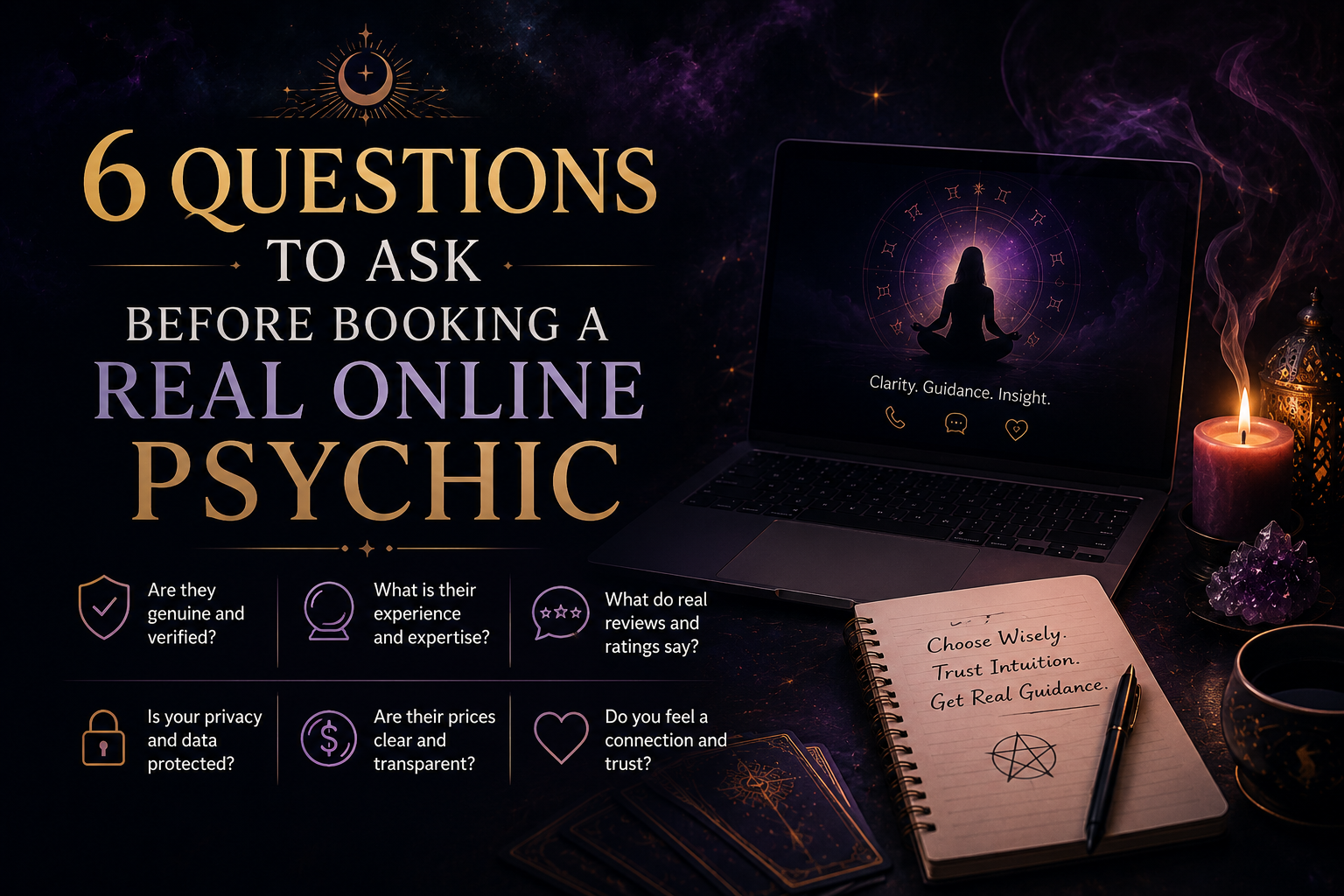
Booking an online psychic reading is easy. Booking a good one takes a little more thought. With hundreds of platforms and thousands of readers competing for your attention, the difference between a session that leaves you clearer and one that leaves you poorer often comes down to the questions you ask before you ever hit “book.”
Most first-timers skip this step entirely. They see an attractive profile, a promising rating, and a “start now” button, and they dive in. Sometimes that works out. More often, it leads to a vague reading, an awkward upsell, and the conclusion that online readings “aren’t for me.” In reality, it was never the format that failed. It was the lack of a filter.
Here are seven questions worth asking, along with what the answers should tell you.

1. What is this reader’s specialty?
Not every reader does everything, and the honest ones will tell you so. Tarot, astrology, love and relationships, career guidance, and mediumship are distinct skills that take years to develop. A reader who is excellent at untangling relationship dynamics may be a poor fit for a career decision, and a gifted medium may not be the person to consult about your business plan.
Before booking, match the reader’s stated specialty to your actual question. Read their profile carefully: what do they describe as their strength? What tools do they use? What kinds of questions do they say they enjoy working with?
If a profile claims deep expertise in everything, treat that as a sign of marketing rather than mastery. The most credible readers are usually the ones who are candid about what they don’t do.
2. How is the reading delivered, and does that suit me?
Online readings typically happen over chat, phone, or video. Each format has real trade-offs, and choosing the wrong one can undermine an otherwise good session.
- Chat gives you a written record you can revisit weeks later, and many people find it easier to be open in text. It’s also the most discreet option if privacy is a concern.
- Phone feels more personal and allows for tone, pauses, and nuance without the self-consciousness that video can bring.
- Video is the closest to an in-person experience. It’s useful if you want to see the cards being drawn or simply prefer face-to-face connection.
There’s no universally right answer, only the format you’ll be most comfortable in. Comfort matters more than people expect, because a guarded client gets a guarded reading. If you know you’ll be distracted by how you look on camera, choose chat or phone. If you find text impersonal, choose video.
3. What does it cost, and is that clear upfront?
A real online psychic will never be vague about pricing. Before the session begins, you should know whether you’re paying per minute, per session, or a flat rate, what the minimum commitment is, and what happens if the reading runs long.
Be especially cautious of platforms that lead with “free minutes.” The offer itself isn’t the problem; the problem is what often follows. Some readers use the free window to build suspense, then make it awkward or difficult to end the call once the paid minutes start ticking. Others surprise you with connection fees or “premium reader” surcharges at checkout.
Transparent pricing is one of the strongest signals of an ethical platform. If you have to hunt for it, or if the numbers seem to change depending on where you look, keep looking.
4. What do recent reviews actually say?
Star ratings alone tell you very little. A 4.9 average could mean hundreds of thoughtful clients or a dozen enthusiastic friends. Read the written reviews and look for specifics: did clients mention accurate details the reader couldn’t have known? A clear takeaway? A decision they were able to make afterward?
Reviews that only say “amazing!” or “so accurate!” without any substance are far less useful than a handful of detailed ones that describe what the session was actually like.
Also check the dates. A reader with glowing reviews from three years ago and nothing since may no longer be active, may have changed their approach, or may have moved platforms. Recent, specific, mixed-but-mostly-positive feedback is the most trustworthy pattern.
5. What are the reader’s boundaries?
This question separates professionals from pretenders faster than any other. Ethical readers are clear about what they won’t do: diagnose medical conditions, tell you to stop treatment, advise on specific financial investments, predict death, or claim to remove curses or “negative attachments” for a fee.
These boundaries exist for your protection. A reader who is willing to cross them is either untrained or unethical, and neither is someone you want guiding a major life decision.
If a profile or platform makes no mention of boundaries, ask directly before booking. A reader who bristles at the question, or who responds with vague reassurance instead of a straight answer, is telling you something important.
6. How does the platform vet its readers?
Individual readers vary, but the platform hosting them sets the floor. Reputable platforms screen readers before listing them, verify identities, monitor reviews for manipulation, and provide a clear process for reporting problems or requesting refunds.
Look for a visible code of conduct, a straightforward support channel, and evidence that low-quality readers get removed. Platforms that accept anyone with a profile photo and a paragraph of copy are essentially leaving the filtering to you, which defeats much of the purpose of using a platform in the first place.
You don’t need to audit the company. Five minutes on the “About” or “How it works” page will usually tell you whether standards exist.
7. What do I actually want from this session?
This one is for you, not the reader. Before booking, take five minutes to write down one or two specific questions. “Should I accept this job offer, and what am I not seeing about it?” gives a reader something concrete to work with. “What does my future look like?” does not.
Clarity on your end leads to clarity on theirs. Readers consistently say that clients who arrive with a focused question get significantly more from the session than those who arrive hoping to be impressed or “tested.”
It also helps to decide in advance how you’ll know the reading was worthwhile. Are you looking for confirmation of something you already sense? A fresh angle on a decision you’ve been circling? Comfort during a hard season? Naming that expectation makes it far easier to evaluate the session honestly afterward.
A note on managing expectations
Even the best reading is guidance, not a guarantee. A skilled reader can help you see a situation more clearly, surface what you already sense but haven’t admitted to yourself, and reframe a decision so the next step feels obvious. That is genuinely valuable, and for many people it’s exactly the nudge they needed.
What a reader cannot do is promise a reconciliation, a promotion, or a windfall. Anyone who does is selling something other than insight. Walk in open, walk out empowered, and keep the decisions in your own hands.
Final thoughts
Seven questions and ten minutes of preparation will filter out most of what makes online readings frustrating for first-timers. You’ll know who you’re talking to, what it costs, what they will and won’t do, and what you’re hoping to walk away with.

The right reader is out there. Asking the right questions is simply the fastest way to find them.