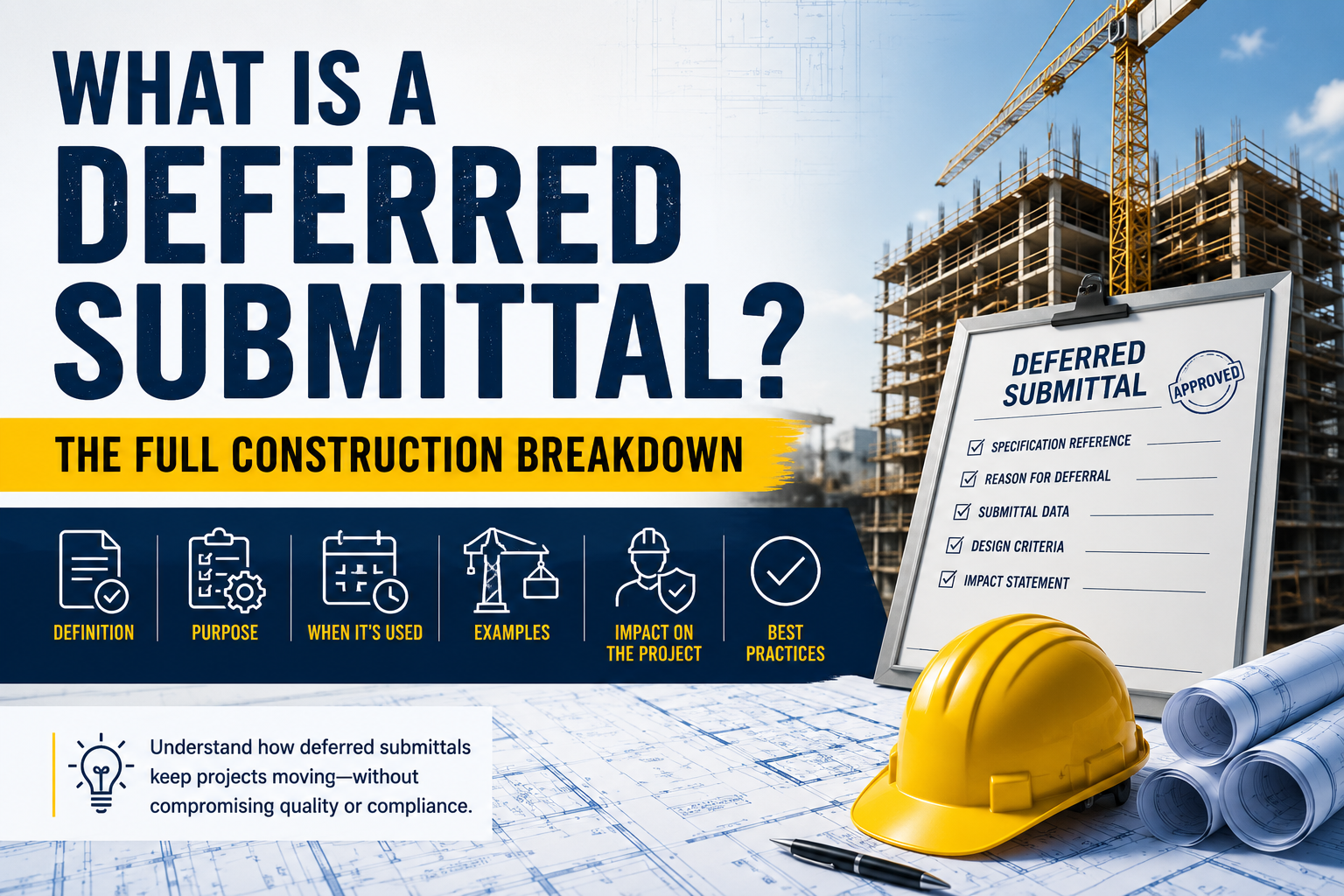
In modern construction projects, timelines are tight, coordination is complex, and design decisions often evolve even after a permit is issued. This is where deferred submittals come into play — a concept that helps keep projects moving without waiting for every single design detail to be finalized upfront.
But as projects get more complex, traditional tracking methods (spreadsheets, email threads, manual logs) are starting to fall behind. That’s where AI bid management tools are reshaping how contractors handle submittals, bids, and preconstruction workflows.
Let’s break it all down.
What Is a Deferred Submittal?
A deferred submittal is a portion of a construction design that is submitted for approval after the main building permit has already been issued.
In simple terms:
The project is approved to begin, but some design components are submitted later for separate approval.
These are typically specialty or delegated design elements that require additional engineering detail.
Common Examples of Deferred Submittals:
- Structural steel connections
- Curtain walls and façade systems
- Trusses and pre-engineered components
- Mechanical, electrical, and plumbing (MEP) shop drawings
- Fire protection systems
Instead of delaying the entire permit approval process, these items are “deferred” so construction can start on the main structure.
Why Deferred Submittals Are Used in Construction
Deferred submittals exist to solve a real-world problem: not everything is ready at the same time.
Here’s why they’re commonly used:
1. Faster Project Start
Contractors can begin foundational work without waiting for every engineered detail.
2. Specialty Engineering Requirements
Some systems require manufacturer-specific or delegated engineering that isn’t available during initial design.
3. Parallel Workflows
Design, procurement, and construction can run in parallel instead of sequentially.
4. Reduced Early Bottlenecks
Architects and engineers can issue permits without being blocked by long-lead specialty designs.
How Deferred Submittals Work (Step-by-Step)
Here’s how a typical deferred submittal process flows:
- Permit Application Submitted
- Core design documents are submitted to the building authority.
- Permit Approval Granted
- Construction begins on approved scope.
- Deferred Items Identified
- Certain systems are marked as deferred submittals.
- Specialty Design Development
- Subcontractors or specialty engineers complete detailed designs.
- Submission to AHJ (Authority Having Jurisdiction)
- Deferred documents are reviewed separately.
- Approval Before Installation
- Work cannot proceed on those systems until approved.
This separation allows construction momentum while maintaining regulatory control.
The Risk: Why Deferred Submittals Can Become a Bottleneck
While deferred submittals improve speed, they also introduce coordination risks:
Common Problems:
- Missed deadlines for submittal approvals
- Poor tracking of pending items
- Communication gaps between GC, subcontractors, and designers
- Installation delays due to late approvals
- Cost overruns from rework or redesign
In many projects, deferred submittals become invisible “approval traps” that surface late in the schedule — exactly when delays are most expensive.
Where AI Bid Management Changes Everything
This is where AI bid management systems are transforming construction preconstruction workflows.
Instead of manually tracking bids, submittals, and approvals across disconnected tools, AI-driven platforms centralize and automate the process.
What Is AI Bid Management?
AI bid management uses artificial intelligence to:
- Analyze bid packages
- Track subcontractor responses
- Identify missing scope items
- Predict pricing gaps or risks
- Automate submittal and compliance tracking
It connects estimation, bidding, and submittal workflows into a single intelligent system.
How AI Bid Management Improves Deferred Submittals
Here’s how AI directly impacts deferred submittal workflows:
1. Automatic Tracking of Deferred Items
AI systems can flag which scope items are deferred and assign ownership automatically.
2. Deadline Prediction & Alerts
Instead of relying on manual follow-ups, AI predicts approval delays and sends proactive alerts.
3. Risk Detection in Bid Packages
AI can identify missing or incomplete deferred scope during the bidding stage — before it becomes a construction issue.
4. Better Subcontractor Coordination
Subcontractor submissions are tracked in real-time, reducing confusion and email overload.
5. Centralized Documentation
All deferred submittals, revisions, and approvals are stored in a structured system instead of scattered folders.
Deferred Submittals vs Traditional Submittal Process
| Aspect | Traditional Process | With AI Bid Management |
|---|---|---|
| Tracking | Manual spreadsheets | Automated dashboards |
| Risk visibility | Low | High (predictive alerts) |
| Communication | Email-based | Centralized system |
| Approval delays | Often discovered late | Flagged early |
| Coordination | Fragmented | Unified workflow |
Real-World Impact on Construction Projects
When deferred submittals are poorly managed, projects often face:
- Schedule slippage
- Increased RFIs (Requests for Information)
- Rework due to late design changes
- Budget overruns
But with structured systems and AI bid management in place, contractors gain:
- Faster approval cycles
- Fewer coordination errors
- Improved subcontractor accountability
- Better bid-to-build continuity
The Future of Deferred Submittals
The construction industry is moving toward fully integrated digital workflows. In the near future:
- Deferred submittals will be auto-linked to bid packages
- AI will predict approval timelines based on historical data
- Submittal logs will update in real-time across all stakeholders
- Project dashboards will highlight risk before it becomes delay
In other words, deferred submittals won’t disappear — but they will become much easier to control.
Final Thoughts
A deferred submittal is not just a paperwork delay — it’s a strategic tool that allows construction projects to move forward efficiently. However, without proper tracking, it can quickly turn into a hidden source of delays and cost overruns.
This is why AI bid management is becoming essential in modern preconstruction workflows. It brings structure, visibility, and intelligence to what was once a fragmented and manual process.
For contractors, estimators, and preconstruction teams, the real advantage today isn’t just faster bidding — it’s smarter control over every moving part of the project, including deferred submittals.