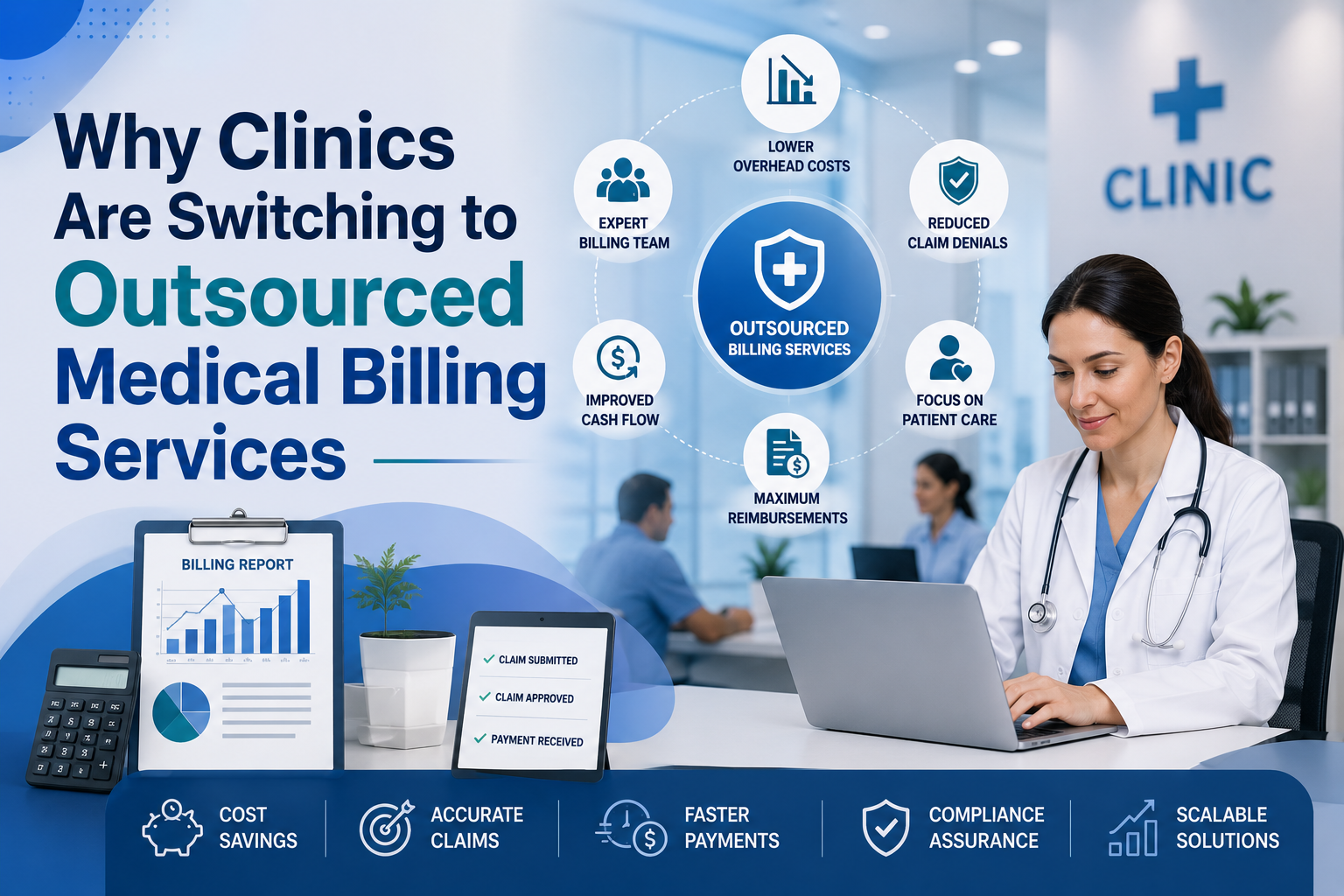
Why Clinics Are Switching to Outsourced Medical Billing Services
A few years ago, most clinics wouldn’t have considered handing their billing operations to an outside company. Billing felt like something that needed to stay close to home managed by familiar staff who understood the practice, the patients, and the providers. But that mindset has shifted dramatically. Today, clinics of every size and specialty are making the move to outsourced medical billing services, and the reasons go far beyond simply saving money.
Rising administrative costs, increasingly complex payer rules, staffing shortages, and mounting claim denials have pushed many practice owners to rethink how billing should be handled. What used to be a function kept strictly in-house is now widely recognized as one of the smartest areas to outsource. Clinics that partner with experienced providers of medical billing services often gain access to specialized expertise, advanced technology, and proven revenue cycle strategies that improve reimbursement outcomes and reduce administrative burdens. If you’re wondering whether this trend applies to your clinic too, here’s a close look at why so many practices are making the switch and what’s actually driving the results.
The Breaking Point: Why In-House Billing Is Getting Harder
Running an in-house billing department used to be relatively straightforward. Hire a couple of billers, train them on your most common payers, and let them handle claims as they come in. That model worked when payer rules were simpler and claim volumes were manageable.
That’s no longer the reality. Several forces have converged to make in-house billing significantly harder to sustain:
Payer Complexity Has Exploded — Each insurance company, and often each individual plan within that company, has its own coverage policies, prior authorization requirements, documentation standards, and claims formats. Keeping an in-house team current on all of these changes requires constant training and monitoring that most clinics simply don’t have the bandwidth for.
Staffing Shortages Are Real — Experienced medical billers are in high demand, and turnover in billing departments tends to be high. When a key biller leaves, claims backlog quickly while a replacement is recruited and trained often taking months to get back up to speed.
Technology Costs Keep Rising — Modern billing requires investment in practice management software, clearinghouse fees, claim scrubbing tools, and denial management systems. For a small or mid-sized clinic, the cost of maintaining cutting-edge billing technology in-house can be difficult to justify.
Denial Rates Keep Climbing — Industry data shows that claim denial rates have been trending upward for several years running, driven largely by stricter payer review processes and increased use of automated denial algorithms. Without dedicated denial management resources, clinics are losing more revenue than ever to preventable denials.
These pressures have created a tipping point. For many clinics, the cost and complexity of maintaining a high-performing in-house billing operation now exceeds the cost of outsourcing to a specialized team.
What Outsourced Medical Billing Actually Solves
Switching to an outsourced billing partner isn’t just about cutting payroll costs though that’s certainly part of the appeal. The real value comes from the specific problems a dedicated billing company is built to solve.
Reduced Claim Denials
Professional billing services live and breathe claims data. They know which codes commonly trigger denials with which payers, they stay current on policy changes across dozens of insurance plans, and they build claim scrubbing processes that catch errors before submission. The result is a meaningfully higher clean claim rate often above 95% compared to the industry average closer to 75-80% for many in-house teams.
Faster Reimbursement
When claims go out clean and accurate the first time, payers process them faster. Combined with proactive eligibility verification and prior authorization tracking, outsourced billing partners routinely reduce average days in accounts receivable from 60-70 days down to 30-40 days. That kind of improvement has a direct, tangible effect on a clinic’s cash flow.
Systematic Denial Management
When denials do occur and some always will outsourced billing teams have dedicated staff and workflows specifically for managing them. Every denial is categorized, tracked, and either corrected and resubmitted or escalated through formal appeal. Given that the majority of appealed denials are eventually overturned when handled properly, this follow-through alone often recovers revenue that would have otherwise been written off.
Lower Overhead
Outsourcing eliminates the cost of salaries, benefits, training, software licenses, and ongoing compliance education for an in-house billing team. Most outsourced billing companies operate on a percentage-of-collections model, which means their incentives are directly aligned with maximizing the clinic’s reimbursement they only get paid more when the clinic gets paid more.
Access to Specialized Expertise
Billing companies that work across multiple clinics develop a depth of payer knowledge that’s difficult for a single in-house team to match. They see denial patterns across dozens of practices, understand regional payer quirks, and bring lessons learned from a much broader base of claims experience.
The Specialty Factor: Why Generic Billing Isn’t Enough
One of the most important and often overlooked reasons clinics are switching to outsourced billing is the need for specialty-specific expertise. Generic billing knowledge only goes so far. Different specialties have dramatically different billing requirements, coding nuances, and payer relationships.
A dermatology practice deals with a mix of medical and cosmetic billing, requiring careful distinction between covered and non-covered services. A physical therapy clinic must navigate visit limits, modifier requirements, and functional outcome reporting. A behavioral health practice faces session-based billing, parity law compliance, and complex prior authorization rules for ongoing treatment.
Clinics that try to manage this complexity with a generalist in-house team or a billing service that doesn’t specialize in their field often see higher denial rates simply because the nuances of their specialty aren’t being accounted for. This is why many clinics specifically seek out billing partners with proven experience in their exact specialty. For example, practices providing ongoing therapeutic care often look for partners experienced in radiology billing services because the billing rules for that specialty differ so significantly from general medical billing.
What the Transition Actually Looks Like
Clinics considering the switch to outsourced billing often worry about disruption and it’s a fair concern. But a well-managed transition with an experienced billing partner typically follows a structured process designed to minimize downside risk.
Initial Assessment — A good billing partner starts by reviewing the clinic’s current billing data, denial patterns, payer mix, and existing workflows to identify the biggest opportunities for improvement.
System Integration — The billing company integrates with the clinic’s existing practice management system or EHR, ensuring a smooth data flow without requiring the clinic to switch software platforms in most cases.
Parallel Run Period — Many billing partners run a transition period where both the old and new processes operate in parallel, allowing any issues to be caught before fully cutting over.
Ongoing Reporting and Communication — Once fully transitioned, the clinic should receive regular, transparent reporting on key metrics like clean claim rate, days in A/R, denial rate, and collection percentage giving administrators full visibility into performance.
Clinics that work with an experienced medical billing company typically find the transition far smoother than expected, with measurable improvements in revenue performance visible within the first 60 to 90 days.
The Bigger Picture: Billing as a Strategic Decision
Perhaps the most important shift happening in clinics today isn’t just operational, it’s philosophical. Billing used to be viewed as a back-office task, something to be managed quietly in the background. Increasingly, practice owners and administrators are recognizing billing as a core strategic function that directly determines whether a clinic can grow, invest in new equipment, hire additional staff, or even remain financially viable.
Viewed through that lens, outsourcing billing isn’t a sign of giving up control; it’s a deliberate decision to put that critical function in the hands of specialists who can execute it better than an internal team realistically can, freeing up clinic leadership to focus on what they do best: delivering excellent patient care.
Final Thoughts
The shift toward outsourced medical billing isn’t a passing trend; it reflects a fundamental change in how healthcare practices think about revenue management. Rising payer complexity, persistent staffing challenges, and increasing claim denial rates have made in-house billing harder to sustain than ever before.
Clinics that make the switch to a specialized, experienced billing partner consistently see fewer denials, faster payments, lower overhead, and far greater visibility into their financial performance. For practices looking to protect their revenue and reduce administrative strain, outsourcing billing isn’t just a cost-saving measure, it’s a strategic upgrade that pays dividends well beyond the balance sheet.