A friend of mine opened a small bakery last year and spent almost her entire first marketing budget on Instagram ads: good photos, decent engagement, barely any actual foot traffic from it. What finally moved the needle was something way less glamorous: she sat down one Sunday afternoon and got her bakery listed on about fifteen directories. Google, Yelp, and a couple of local ones nobody’s heard of outside her city. Within a month, people were showing up saying, “I found you on Google Maps.” Not Instagram. Maps.
That’s basically the whole pitch for this article. Business directories aren’t exciting. Nobody’s writing think-pieces about them. But they work, they’re free, and most businesses either ignore them completely or set one up in 2019 and never touch it again.
So let’s talk about what these things actually do, and why bothering with them is worth an afternoon of your time.
What Is a Business Listing Directory, Really
It’s basically a digital phone book. You make a profile, you put in your name, address, phone number, hours, website, whatever’s relevant — and anyone searching by category or location can stumble onto you.
But here’s the part people miss: it’s not really about the humans browsing these sites (though that matters too). It’s about what happens behind the scenes with Google. When your Business Directories info shows up the same way across a handful of trustworthy sites, Google basically goes “okay, this is real, this is where it is, I believe it.” Small thing. Big effect on your rankings.
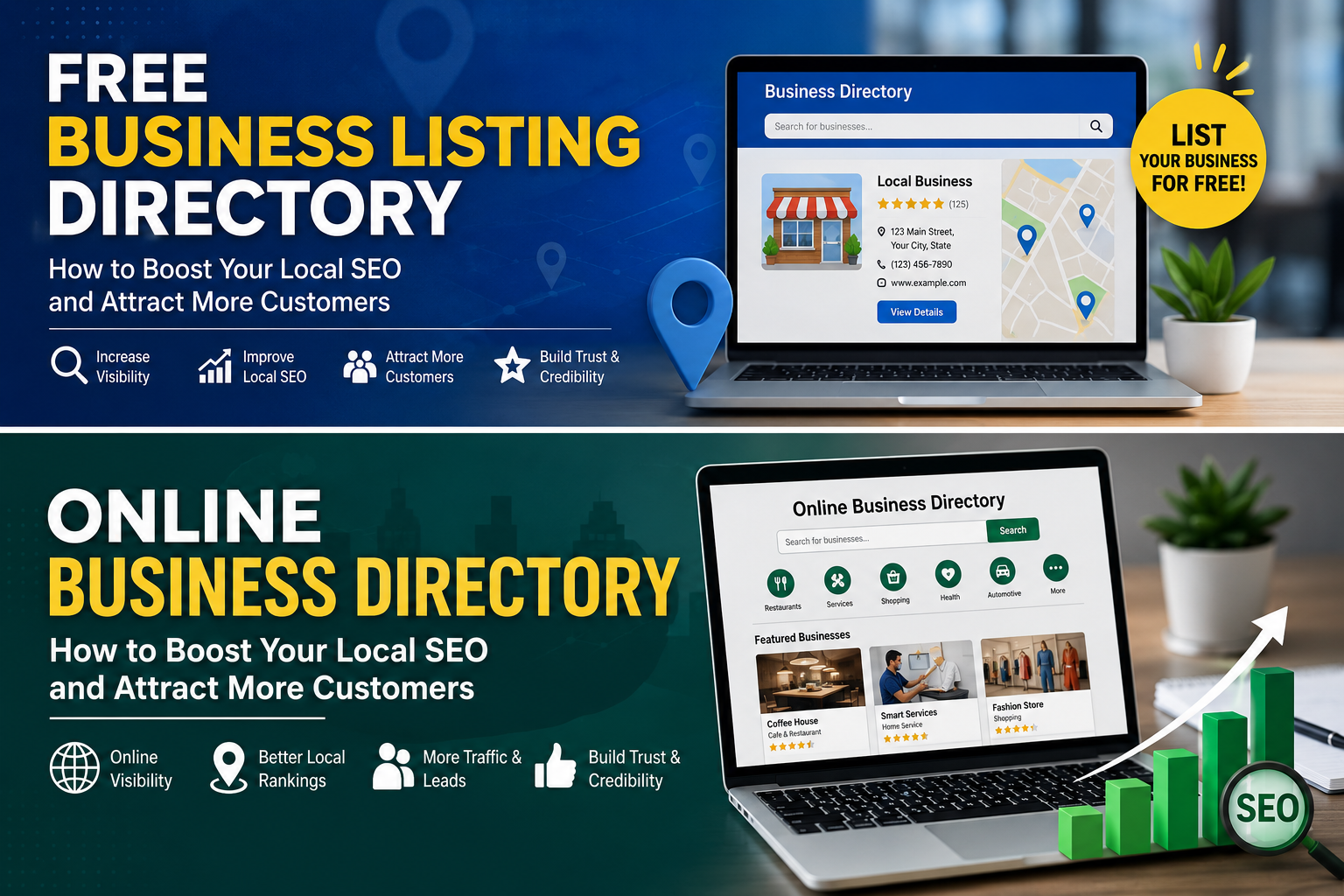
IMPORTANT: Learn how a free business listing directory improves local SEO, increases online visibility, builds credibility, and helps your business attract more customers.
Why It Actually Helps Your Local SEO
Local SEO, if you’re not familiar, is just the stuff that determines whether you show up when someone types “plumber near me” into Google at 11 pm because their pipe just burst. Directories feed into that more than people realize.For one, many directories already rank well on their own. So even if your website is stuck on page three of Google (rough, I know), your directory listing might be sitting right there on page one, and that person clicks through to you anyway.
Then there’s consistency, which honestly might be the most underrated concept in all of local SEO. If your name, address, and phone number match up everywhere — people call this NAP, don’t ask me who came up with that — Google trusts the listing more. And if they don’t match, say your street is written as “St.” in one place and “Street” in another, that’s the kind of tiny inconsistency that quietly drags your rankings down without you ever noticing why.
There’s also the traffic angle, which is pretty straightforward. Most directories let you drop your website link right there on the profile. Somebody already interested clicks through, no ad spend involved. And the people doing this kind of searching tend to have higher intent than random visitors — someone scrolling a directory for an electrician is a lot closer to actually hiring one than someone who landed on your blog from a Google search about home repair tips.
And reviews. Can’t forget reviews. Most directories have some kind of review system built in, and reviews do more heavy lifting in convincing someone to pick up the phone than almost anything else on the page.
What You Get Out of Doing This Properly
Better local rankings, obviously. More visibility. Real credibility instead of just a nice-looking website nobody trusts yet. Free traffic that doesn’t dry up the second you stop paying for ads. Some brand recognition is building up quietly in the background. Stronger citations, which feed back into everything else. And honestly, it just compounds and the longer you keep this stuff up to date, the more it works for you.
Compare that to paid ads, where the moment your card gets declined, the traffic just… stops. This doesn’t do that.
How Directories Actually Move Your Rankings
Google looks at an enormous number of signals before deciding who ranks locally, and directories touch several of them at once.
Citations are one — basically any mention of your business info online counts, and the more accurate ones you rack up on reputable sites, the more local authority you build. There’s also a kind of borrowed trust thing that happens: big directories have spent years earning credibility with search engines, and when you’re listed on them, a bit of that rubs off on you.
Activity matters too. A profile that’s getting clicks, has recent photos, gets the occasional review — that looks alive to Google. A profile set up once in 2020 and never touched again looks, well, dead. And directories sort you by category and location, which just helps Google understand what you actually do and where, which loops right back into showing up for the right searches.
Doing It Well vs. Just Doing It
Submitting your business is the easy part. Doing it well takes a bit more care.
Keep your info identical everywhere — I mean identical, down to whether you write “Street” or abbreviate it. Write your own description instead of pasting the same paragraph into every directory (Google can tell, and honestly so can readers). Use actual photos of your storefront, your team, your work — not stock images, those fool nobody. Pick the correct category, even though it feels like a minor checkbox, because getting it wrong basically makes you invisible to the exact people searching for what you do. And respond to your reviews. All of them, good and bad. It shows you’re paying attention, and it says a lot to whoever’s reading through them before deciding whether to trust you.
Mistakes I See Constantly
Info that doesn’t match across different sites. Duplicate listings for the same business that somehow both got created. Phone numbers that changed two years ago, and nobody updated. No website link at all. Bad photos, or none. Descriptions stuffed with keywords until they read like spam. Reviews nobody ever responded to. Profiles that are maybe 40% filled out and then abandoned.
None of it is hard to fix. It just requires someone to actually sit down and go through it, which nobody wants to do on a Tuesday afternoon.
Not Every Directory Is Worth Bothering With
Quality really does beat quantity here. A handful of well-known, relevant directories will do more for your rankings than a hundred random ones you found on some “Top 200 Directories” listicle. Look for real domain authority, active users, decent search visibility, and, this should go without saying by now, an HTTPS-secured site.
It’s Not a One-Time Thing
This isn’t set-it-and-forget-it. Hours change, new photos are worth adding, reviews come in, and deserve a reply. Google notices which businesses actually keep their info fresh versus the ones that set up a profile once and vanish.
So, Bottom Line
Free business directories are one of the most boring-sounding, underrated tools available to any small business right now. Costs nothing. Isn’t complicated. And done properly, it genuinely helps people find you and trust you once they do.
There’s no clever trick to any of this — it’s just consistency, showing up with real information, and actually engaging with the people leaving reviews. Do that for a few months, and you’ll start noticing it in your rankings, your traffic, and eventually in the people walking through your door saying they found you on Google.

Pair it with a decent website and you’ve basically got a quiet, steady source of new customers that doesn’t need a marketing budget behind it.